
Movement breaks at work: a 1-minute system for desk workers
Most desk workers know they should move more.
The harder part is remembering to do it during a real workday.
Interestingly, humans evolved to be physically active when movement was necessary or rewarding, but also to conserve energy when it was not. From an evolutionary perspective, avoiding unnecessary effort was often a survival advantage.
So when someone sits at a desk and does not feel naturally motivated to get up every 30 minutes, that is not necessarily a willpower issue. It reflects a basic human tendency: the brain often prefers to conserve energy unless there is an immediate reason, reward, or social cue to move.
Modern desk work creates an evolutionary mismatch. Movement is no longer built into survival, transportation, or daily labor, so people must intentionally create prompts, routines, and habits that encourage movement throughout the day.
At the same time, research on sedentary behavior provides strong evidence that prolonged sitting can affect metabolic, vascular, and musculoskeletal health.

What if movement breaks work best when they are treated as a habit rather than a workout?
Make them short
Make them repeatable
Make them easy
Attach them to existing habits such as finishing a call, sending an email, standing up from a meeting, or refilling a water bottle. That simple idea is the foundation of the 1-minute movement break system presented in this guide.
Scientific references:
Lieberman, D. E. (2015). Is exercise really medicine? An evolutionary perspective.
Why movement breaks work
A movement break is a short interruption of sitting, usually lasting 1–3 minutes, during which you stand, walk, stretch, or move your joints through a comfortable range of motion.
In the scientific literature, this is often described as breaking up sedentary behavior or interrupting prolonged sitting with physical activity breaks.
Research suggests that these brief interruptions can positively affect both physical and mental well-being.
A systematic review of 37 studies found that replacing uninterrupted sitting with short bouts of activity improved markers of metabolic health, particularly blood sugar regulation.
One interesting question is whether it is better to take many small movement breaks throughout the day or complete one continuous exercise session and then remain seated for the rest of the day.
When total energy expenditure was matched, frequent movement breaks were slightly more effective at lowering blood glucose levels than a single exercise session. For insulin and blood-fat measures, the differences were less clear.
The benefits appear to be particularly strong in people with:
Higher body mass index (BMI)
Physical inactivity
Obesity
Type 2 diabetes
This does not mean healthy individuals receive no benefit, it simply means the measurable improvements tend to be larger in higher-risk populations.
The long-term value comes from consistency. A single 1-minute action may feel small, but repeating those actions across the workday can change how much uninterrupted sitting you accumulate over time.
Learn more in our guide to the long-term benefits of movement breaks for desk workers.
Movement breaks may also help reduce the physical and mental strain associated with prolonged sitting.
Research on office workers has shown that:
The 20-8-2 rule (20 minutes sitting, 8 minutes standing, 2 minutes moving) reduced musculoskeletal discomfort.
Active microbreaks helped reduce fatigue in the neck and back muscles.
Regular movement was associated with lower stress and mental exhaustion.
Breaking up sitting with walking helped reduce fatigue and support cognitive function.
If mental exhaustion is your main struggle at work, see how movement breaks can help you reset in our guide to "mental fatigue at work".
They may also support focus by creating simple reset points between long blocks of sitting and screen work. For practical examples and research, read our guide to "movement breaks for focus".
The practical message is simple:
A movement break is not a replacement for exercise. It is a way to reduce the amount of uninterrupted sitting accumulated throughout the day.
This is one of the core ideas behind the MicroDosing Training approach.
For a broader framework, see “Exercises for sitting all day: a complete guide for desk workers.”
Scientific references:
Loh, R., (2019): Effects of interrupting prolonged sitting with physical activity breaks on blood glucose, insulin and triacylglycerol measures.
Radwan, A.,(2022): Effects of active microbreaks on the physical and mental well-being of office workers.
Wennberg, P., (2016): Acute effects of breaking up prolonged sitting on fatigue and cognition

What counts as a movement break?
A movement break is any short interruption of sitting that gets you out of a static posture. It does not need to be a formal workout or structured exercise session.
These activities can be described from both a biomechanical perspective (changing posture, moving joints, activating muscles) and an energy-expenditure perspective.
Sedentary behavior is commonly defined as any waking behavior performed while sitting, reclining, or lying down that requires ≤1.5 METs of energy expenditure.
MET stands for Metabolic Equivalent of Task. One MET represents the amount of energy the body uses while sitting quietly at rest, approximately 3.5 ml of oxygen per kilogram of body weight per minute, or roughly 1 kcal per kilogram of body weight per hour.
In simple terms, METs provide a standardized way to compare how much energy different activities require relative to resting.
More than 1.5 METs are generally classified as physical activity rather than sedentary behavior. Light-intensity typically falls within the 1.6–2.9 MET range, and many common movement breaks fall into this category.
The good news is that many everyday workplace activities qualify as movement breaks
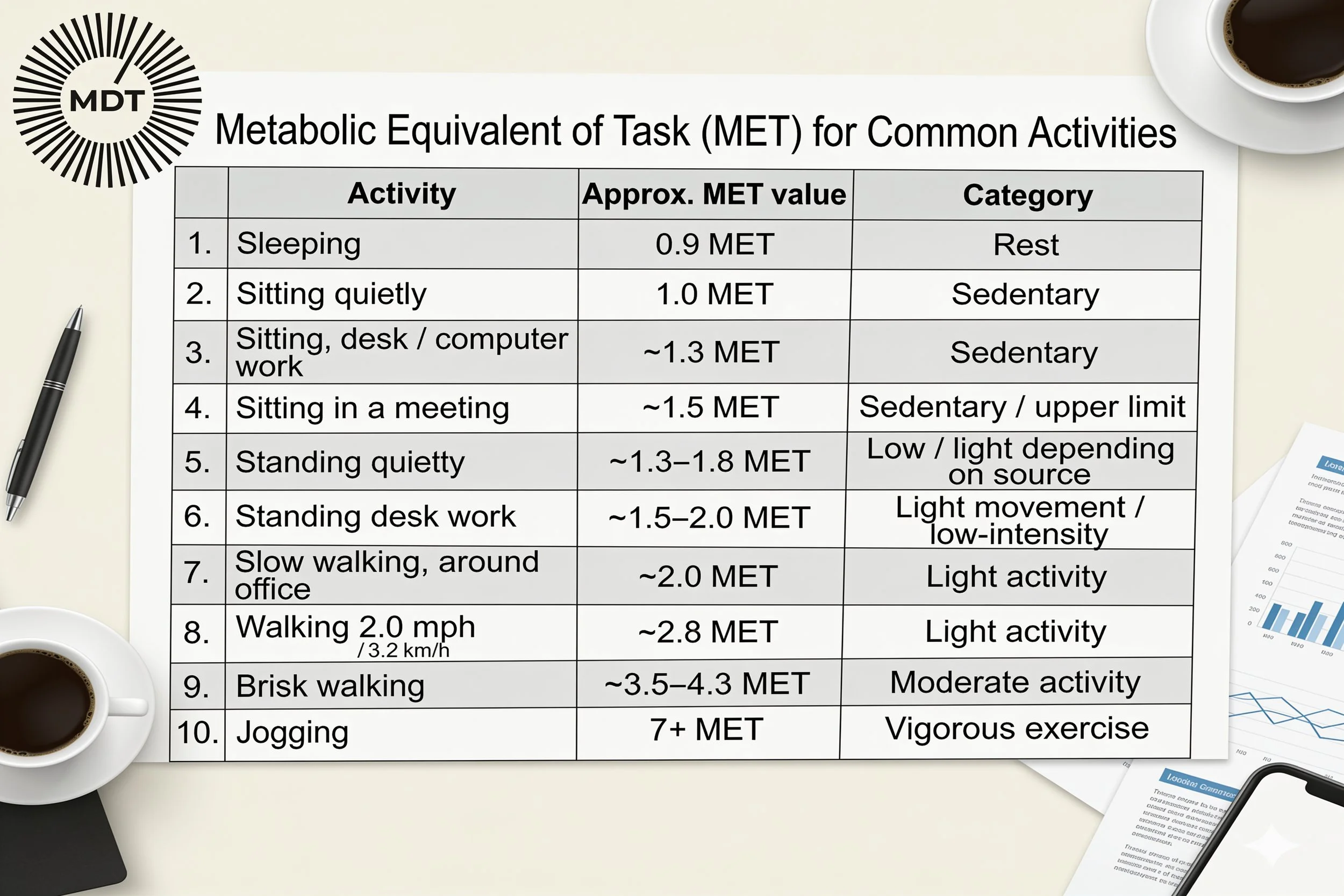
Pic 1. (generated with Gemini)
Walking to refill a water bottle
Walking to speak with a colleague instead of sending a message
Taking a short walk around the office
Walking during a phone call
Using the stairs instead of the elevator
Performing 5/10 sit-to-stands from a chair
Heel raises or calf pumps
Standing up for 1–2 minutes
Slow marching in place
Shoulder rolls or neck rotations
Seated or standing trunk rotations
Gentle hip-flexor stretches
Desk push-ups
Wall squats
Carrying light objects around the workplace
Tidying or organizing your workstation
The specific actions matter less than the principle:
Break up prolonged sitting with brief periods of movement whenever possible.
Many people assume a movement break must be a formal exercise session. In reality, simply changing posture, walking a short distance, or performing a few mobility exercises may be enough to interrupt sedentary time and increase daily movement.
Scientific references:
Tremblay, M. S., (2017): Sedentary Behavior Research Network (SBRN) Terminology Consensus Project process and outcome.
How often should you take a movement break?
This is one of the most practical questions for desk workers.
Research has traditionally measured movement breaks in different ways, which can make recommendations confusing. A large 2024 meta-analysis (1) highlighted an important distinction between frequency and density.
Frequency refers to how many times you move during the day. For example, taking 16 movement breaks during an 8-hour workday.
Density refers to the amount of sitting time between movement breaks. For example, taking a movement break every 30 minutes.
The researchers found that density may be the more useful measure because it directly reflects how long a person remains sedentary between activity bouts.
They classified movement breaks into two categories:
High-density breaks: less than 30 minutes of sitting between activity bouts.
Low-density breaks: more than 30 minutes of sitting between activity bouts.
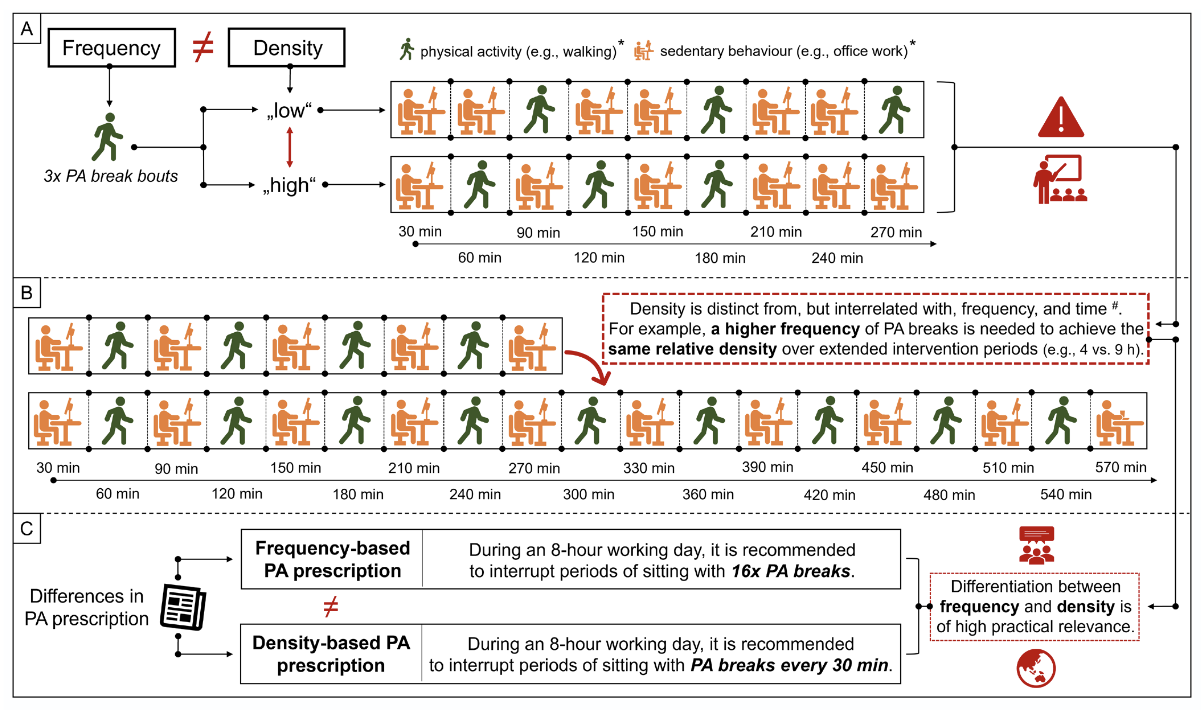
For practical workplace recommendations, the authors argued that telling someone to move every 30 minutes is often easier to understand and follow than telling them to achieve a specific number of breaks per day.
Want the science behind this recommendation? Read our in-depth guide: “How often should you take movement breaks at work”?

A second large-scale review published in 2026 analyzed 144 studies involving 2,216 participants to determine how the frequency, duration, and intensity of movement breaks influence cardiometabolic health (2).
The findings suggest that different movement strategies produce different benefits:
Short, frequent bouts of light or moderate activity were particularly effective for improving blood sugar control.
Improvements in blood fats generally required either longer activity bouts (more than 30 minutes) or higher-intensity exercise.
Light, moderate, and vigorous activity were all associated with reductions in blood pressure.
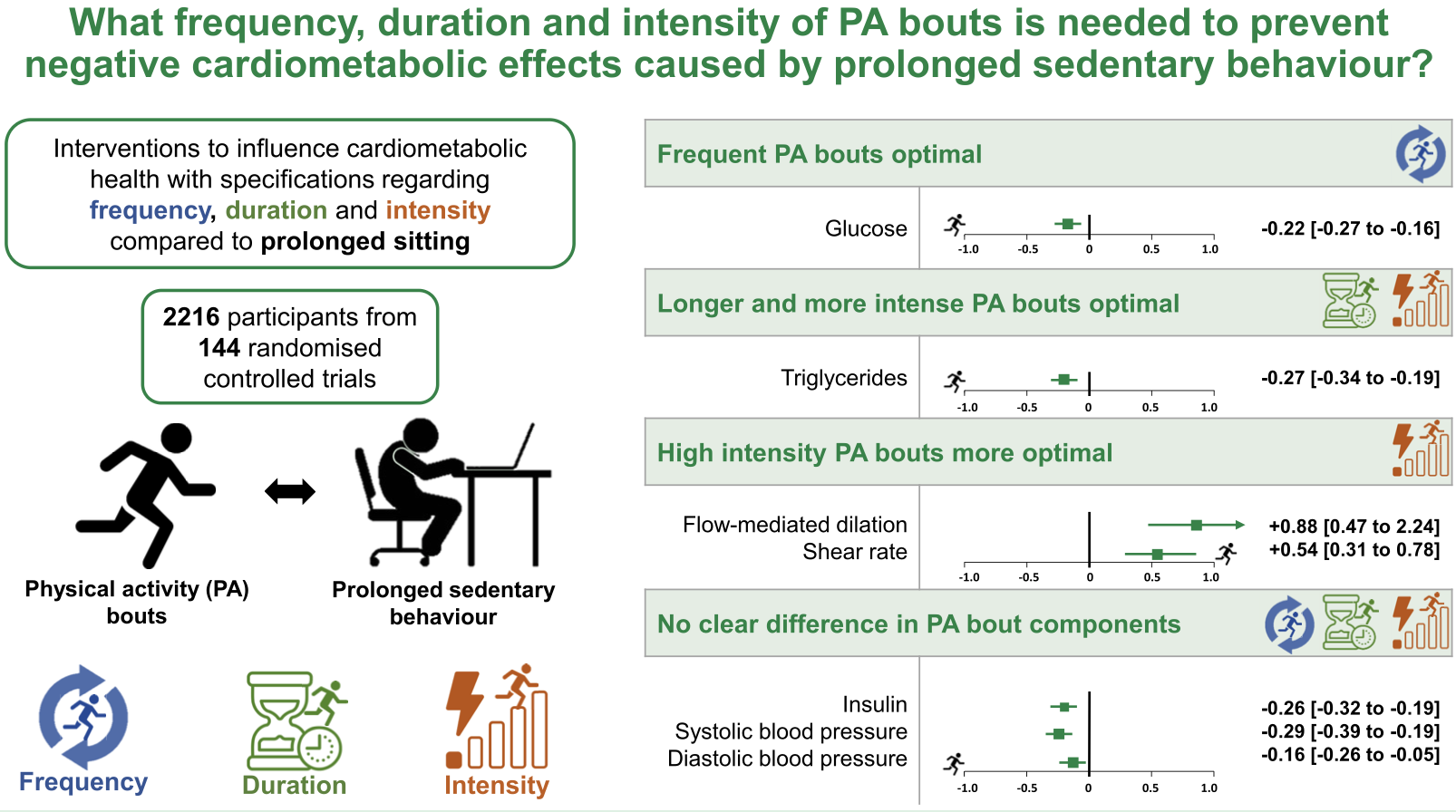
Several practical findings stand out:
Simply standing up was generally not enough to significantly improve blood sugar, blood fats, or blood pressure.
Light walking was consistently effective, particularly for improving blood sugar regulation and diastolic blood pressure.
Brief vigorous activity may provide meaningful benefits. Some studies reported that just 2–3 minutes of vigorous movement per day was associated with lower cardiovascular risk among people who sit for long periods.
The practical takeaway is simple:
If possible, interrupt sitting every 30 minutes with at least 1–3 minutes of movement. Walking is one of the most effective options, but any activity that gets the body moving is likely better than remaining seated.
This recommendation aligns well with the idea of exercise snacks: small doses of movement distributed throughout the day rather than a single session performed before or after work.
Scientific references:
Fabian. H., (2024): Differentiating Physical Activity Frequency and Density.
Jen Vanherle., (2026): Optimizing physical activity bouts to interrupt sedentary behaviour for cardiometabolic health.
How to actually remember to take movement breaks
Knowing that movement breaks are useful is easy. Remembering to take them during a busy workday is much harder.
The most effective strategy is not to rely on motivation. Instead, build simple cues and routines into your environment.
Behavior-change research supports the use of prompts, cues, implementation intentions, habit formation, and environmental design to reduce sedentary behavior and increase physical activity.
Habit stacking
One of the easiest ways to remember movement breaks is to attach them to something you already do.
For example, stand after every meeting, walk after every phone call, or perform five sit-to-stands before lunch. This turns movement into a cue-based habit rather than another task you have to remember.
Use specific triggers such as:
“After I finish a meeting, I will stand up and walk for one minute.”
“After I send an email, I will do five shoulder rolls.”
“After I refill coffee, I will stretch my hips for 30 seconds.”
“After every bathroom break, I will take the long route back.”
Researchers often refer to these plans as implementation intentions: a simple “if X happens, then I will do Y” strategy that helps turn intentions into actions.
Environment design
Your workspace can either encourage sitting or remind you to move.
Environmental design means arranging your surroundings so that movement becomes the easy default rather than something that requires willpower.
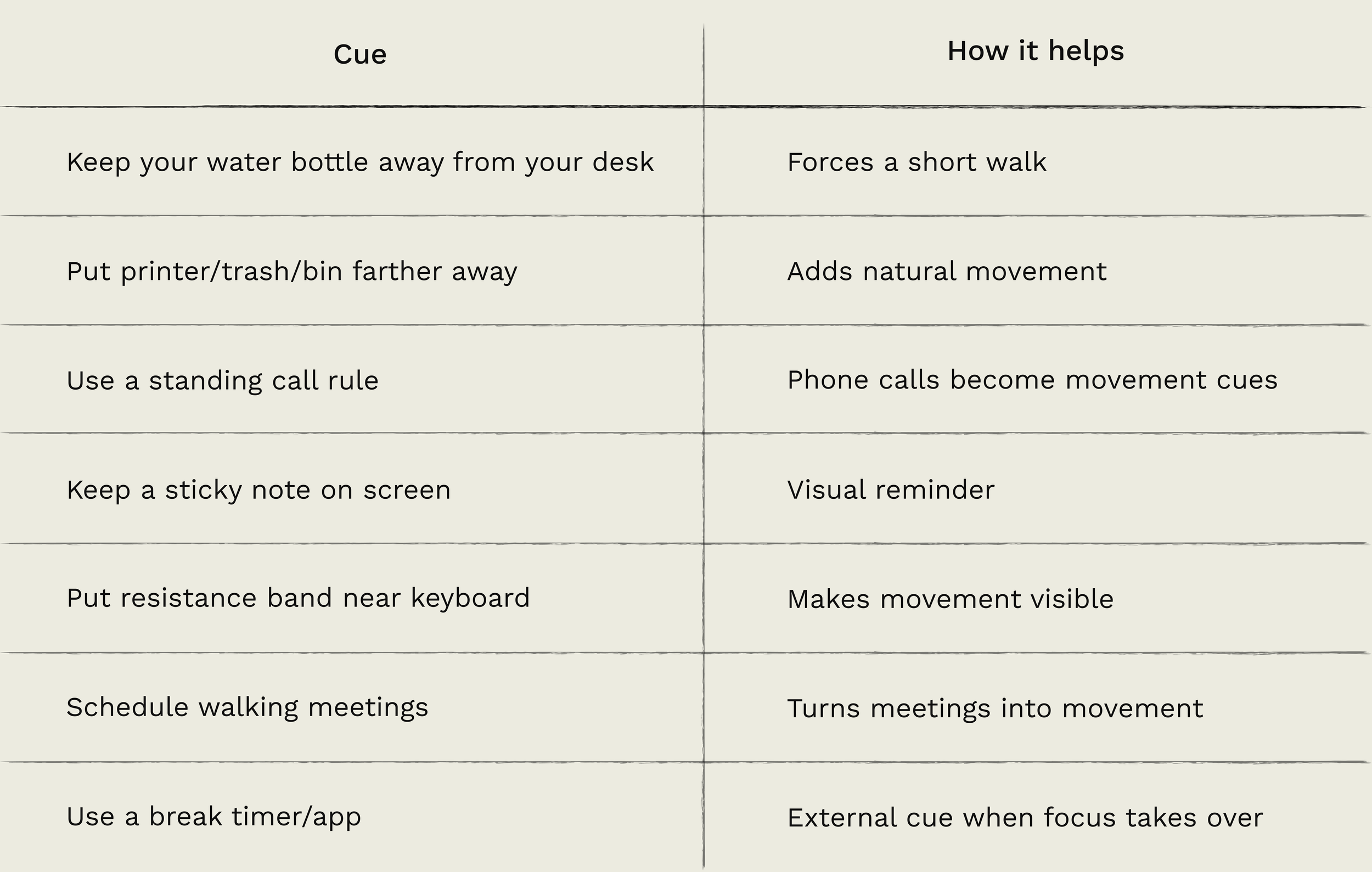
Low-friction rule
A movement break should feel easy enough that you do not resist doing it.
Start small:
Stand up for 30 seconds.
Do three shoulder rolls.
Walk to the door and back.
Perform five sit-to-stands.
Move one joint: neck, shoulders, spine, or hips.
The easier the action, the more likely it is to become a habit. Consistency is often more important than intensity when building a long-term movement routine.
Scientific references:
Zhu, Y., (2024): Digital behavior change intervention designs for habit formation.

Movement breaks for remote vs. office workers
Movement breaks for working from home
Many people assume that working from home makes it easier to maintain healthy habits. Surprisingly, the research is not always supportive of this idea.
A large systematic review published in 2025 examined how working from home (WFH) affects sedentary behavior and physical activity compared to onsite work. The review analyzed 38 studies involving 282,264 participants.
The findings were striking.
On average, people working from home spent 31 additional minutes sitting per workday compared to those working onsite. Some studies also suggested that sitting periods were longer and less frequently interrupted, with remote workers taking approximately two fewer sitting breaks during the workday.
Working from home was also associated with an average reduction of 2,564 steps per day.
One major reason is the loss of the active commute - the walking involved in getting to a train station, bus stop, parking lot, or office building.
On the other hand, remote work provides greater flexibility and privacy, making it easier to incorporate movement breaks throughout the day.
Floor-based mobility exercises in prone or supine positions
Bodyweight movements such as squats or lunges
Short walks around the house or neighborhood
Stretching between meetings
Walking during phone calls
Using household tasks as movement opportunities
In other words, working from home may require more intentional planning. Creating movement cues, scheduling exercise snacks, or incorporating regular sessions can help offset the reduction in daily activity.
For a practical routine, see our guide to improve circulation while working from home with a 3-part movement break system.
A better workstation setup can make your workday feel more comfortable. When your laptop, desk, or chair position feels awkward, you may end up holding extra tension in your neck, shoulders, back, or hips.
Ergonomics will not replace movement breaks, but it can make your workspace easier to manage.
Learn how to set up your space in our post: “Home office ergonomics: how your setup affects your body.”
Movement breaks for office workers
Office environments often provide less freedom but more natural opportunities to move.
Walking to speak with a colleague instead of sending a message
Taking the stairs instead of the elevator
Walking to refill a water bottle
Using distant printers, restrooms, or break rooms
Standing during phone calls (a classic approach)
Performing desk-friendly mobility exercises
The main challenge is often social rather than physical. Some employees may feel self-conscious about moving at work or worry that movement breaks appear unproductive.
In reality, most movement breaks take only one or two minutes and can easily fit between meetings, calls, and focused work sessions.
The key message for both environments is the same:
The best workplace for movement is not necessarily home or the office - it is the one where movement is intentionally built into the day.
Scientific references:
Common mistakes
Waiting until you feel stiff
Many people only move once discomfort appears. The problem is that stiffness is often a sign that you have already spent a long time in the same position.
Movement breaks work best as a preventive strategy rather than a treatment. Instead of waiting for your neck, back, or hips to feel tight, try moving at regular intervals throughout the day.
Trying to do too much
One reason people abandon healthy habits is that they make them too time-consuming. A 30-second walk, a few shoulder rolls, or a short mobility drill is often enough to interrupt sedentary time. The goal is not to complete a workout every hour, but to create regular opportunities for movement.
Remember: consistency beats intensity when it comes to movement breaks.
Choosing awkward exercises
Complex routines, floor exercises in a crowded office, or movements that require changing clothes create unnecessary friction.
Choose exercises that fit your environment and can be performed comfortably at home or at work. The best movement break is usually the one you are willing to do consistently.
Ignoring reminders
Reminders only work when they lead to action.
If pop-up notifications are easy to ignore, try habit stacking instead. Attach movement to an existing behavior such as finishing a meeting, taking a phone call, or refilling your water bottle.
Treating a standing desk as enough
Research suggests that simply standing provides fewer benefits than activities such as walking, mobility exercises, stair climbing, or light bodyweight movements. A standing desk should be viewed as one tool, not a complete solution. The goal is not just to sit less.
The goal is to move more often throughout the day.
FAQs
-
Movement breaks are short periods of physical activity used to interrupt prolonged sitting during the workday. They can include standing, walking, stretching, mobility exercises, bodyweight movements, or simple posture changes. The goal is not to complete a workout, but to reduce uninterrupted sedentary time and reintroduce movement throughout the day.
-
Current research suggests that prolonged sitting should be interrupted regularly. A practical recommendation is to move every 30–60 minutes, even if only for 1–3 minutes. Studies comparing different movement patterns suggest that shorter sitting periods between movement breaks may be more beneficial than accumulating all activity in a single session later in the day.
-
Most workplace movement breaks last between 1 and 3 minutes. The exact duration is less important than consistency. A brief walk, a few mobility exercises, or a short bodyweight sequence can be enough to interrupt sedentary behavior. The goal is to create regular opportunities for movement rather than waiting for a long exercise session.
-
Any activity that interrupts sitting and gets the body moving can count as a movement break. Examples include walking to refill a water bottle, taking the stairs, standing during a phone call, performing shoulder rolls, doing a few sit-to-stands, stretching, or completing a short mobility routine. The specific activity matters less than breaking up prolonged sitting.
-
No. Movement breaks and structured exercise serve different purposes. Movement breaks help reduce sedentary time and encourage movement throughout the day, while workouts are typically designed to improve fitness, strength, endurance, or performance. For best results, combine regular exercise with frequent movement breaks during work hours.
-
The most effective approach is to rely on cues rather than motivation. Try attaching movement to existing habits, such as finishing a meeting, sending an email, taking a phone call, or refilling your water bottle. Timers, calendar reminders, sticky notes, and the MicroDosing Training (MDT) approach can also help make movement a consistent part of your daily routine.
The Exercise Snacks approach to movement breaks
Rather than relying on motivation, Exercise Snasks provide a practical structure with calendar integration, that helps you distribute movement throughout the day.
Ready to get started?