The "Sedentary Exerciser" paradox: you exercise but still sit for 8 hours

“You don’t need a 30-minute walk to see benefits.”
I started asking myself why I stay lean over long periods of time, while many of my clients and people I see in the gym struggle with fat loss. This post might help answer that question.
The astronaut’s lesson (the bedrest model)
To understand the hidden impact of modern lifestyles, scientists often turn to the bedrest model a classic tool used by space agencies to simulate the effects of microgravity. In these studies (1,2), healthy participants with no history of chronic disease remain in bed 24 hours a day, 7 days a week, making them both physically inactive and highly sedentary. Honestly, I can hardly imagine this personally, even staying still for 10 minutes is a challenge.
From this research (1), a unique profile has emerged: the “sedentary exerciser.” In some experiments, participants complete structured exercise sessions but spend the rest of the day in bed. This creates a striking paradox. They are physically active because they meet exercise targets, yet metabolically sedentary because they lack the constant “background noise” of everyday movement.
At this point, it’s worth referring to my previous post, “The Silence of the Muscles,” to better understand this concept.
The key lesson from these “astronauts on Earth” is clear: sedentary behavior has effects on health that are independent of exercise. Findings from Bergouignan et al. (2011) (2) show that inactivity by itself even without overeating is enough to drive metabolic inflexibility. This is the state where the body’s “biological switch” breaks, making it difficult to burn fat efficiently.
The four pillars of metabolic failure
Muscle Insulin Resistance: Inactivity rapidly reduces insulin sensitivity in the muscles, forcing the body to produce higher levels of insulin to manage blood glucose.
Hyperlipidemia: Inactive muscles stop effectively clearing fats from the bloodstream, leading to a rise in plasma triglycerides.
Fuel Shift: The body shifts away from burning fat and relies more on glucose (carbohydrates), leaving excess fat circulating in the blood.
Ectopic Fat Storage: This excess fat is redirected and stored where it doesn’t belong such as the liver (steatosis), bone marrow, and even inside muscle fibers.
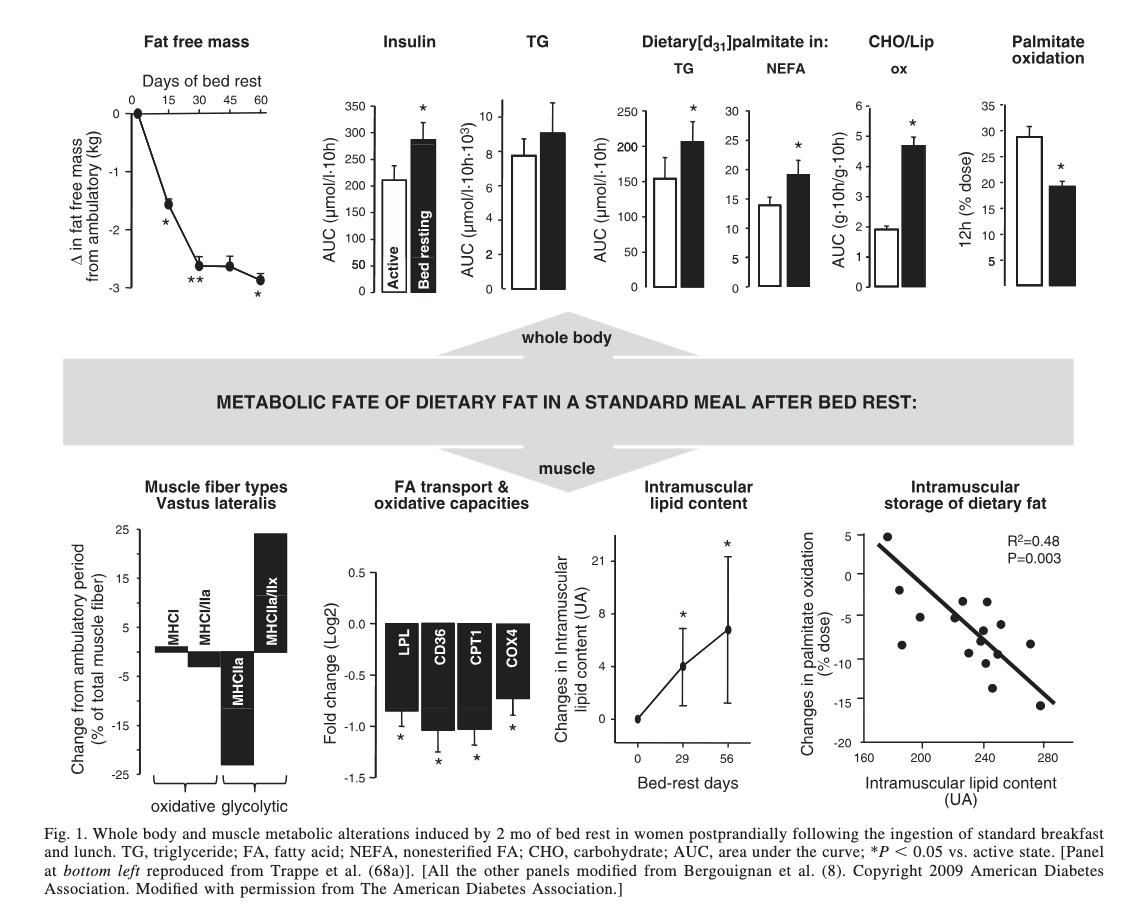
While exercise training can preserve muscle mass, even large volumes of intense movement are not enough to fully counteract the metabolic shutdown caused by prolonged inactivity.
‘‘In other words, “fighting fat” isn’t just about what happens in the gym it’s about what happens during the other 23 hours of your day.’’
If those hours are spent without the constant “spark” of Light Physical Activity (LPA), your body drifts back into biological silence.
The biological "background noise"
You might think that hitting the WHO (World Health Organization) recommendation of 150–300 minutes of moderate-to-vigorous physical activity (MVPA) each week is enough. But this review (1) highlights a frustrating paradox: the “sedentary exerciser.”
The data is striking. When total energy expenditure is the same, replacing sitting with high volumes of light physical activity (LPA) is actually more effective for improving glucose control, insulin sensitivity, and blood lipids than a single, continuous workout.
Intense exercise is excellent for cardiorespiratory fitness. But LPA is what keeps your metabolic “switch” turned on throughout the day.
And the barrier to entry is low. You don’t need a 30-minute walk to see benefits. Short, intermittent bouts of movement just 2 to 5 minutes of walking spread across the day are enough to significantly reduce post-meal glucose and insulin levels.
To stay lean and metabolically healthy, the goal isn’t just to “work out” more. It’s to make sure your muscles are never silent for long.
The "busy bee" vs. the "sedentary exerciser"
To understand why your morning workout might not be enough, it helps to look at Total Energy Expenditure (TEE), the total amount of energy your body burns in a day. TEE is made up of four main components:
Resting Metabolic Rate (RMR): this is the largest component of TEE for most people, representing the baseline energy required to keep your body functioning while at rest.
Diet Induced Thermogenesis (DIT): the energy your body uses to digest, absorb, and process the food you eat.
Non-exercise activity Energy Expenditure (NEAE): this refers to the energy spent on all activities of daily living. These are essentially light physical activities (LPA), such as standing, walking around the office, taking the stairs, or doing household chores.
Exercise activity Energy Expenditure (EAE): this is the energy used during structured workouts or moderate-to-vigorous physical activity (MVPA).
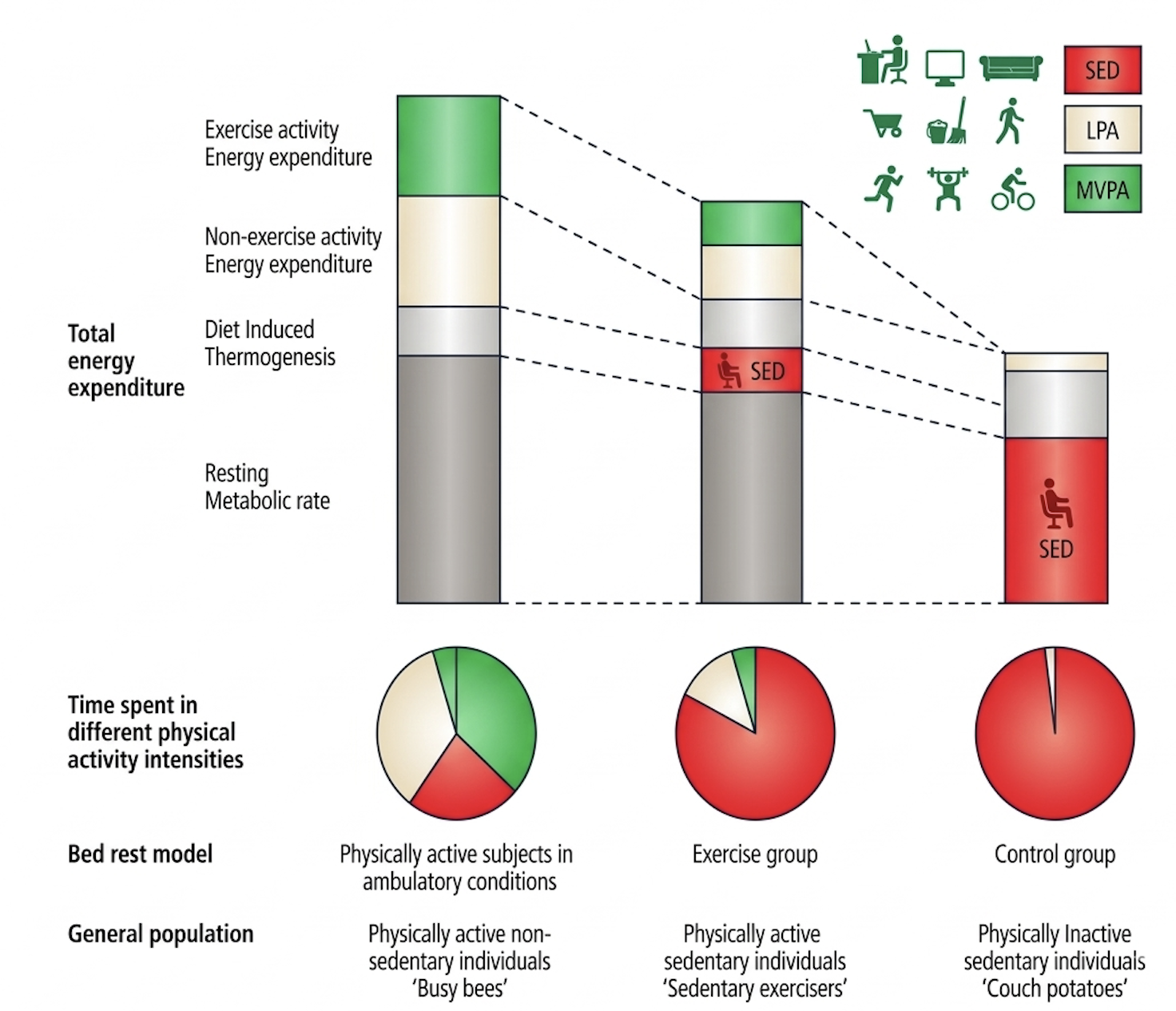
The study compares three distinct types of people:
The "Couch Potato": low exercise (MVPA) and low daily movement (LPA). This group has the lowest total energy expenditure and the highest risk.
The "Sedentary Exerciser": someone who trains hard in the gym (high MVPA) but spends most of the day sitting. Their “exercise energy” is high, but their “non-exercise energy” is close to zero.
The "Busy Bee": these individuals may not even "exercise" in a gym, but they have high volumes of light physical activity throughout the day.
The data shows that the "Busy Bee" often has a higher total daily energy expenditure than the "Sedentary Exerciser". More importantly, because the Busy Bee is constantly "sparking" their muscles, they avoid the metabolic inflexibility and fat storage that happens when muscles are silent for 10 hours at a time.
The behavioral trap: compensation
There is also a hidden psychological trap. Research suggests that increasing intense exercise (MVPA) can sometimes trigger spontaneous behavioral compensations. In other words, if you push yourself too hard in a CrossFit class, you might unconsciously move less and sit more for the rest of the day because you feel you've "earned" the rest.
This compensation can actually reduce your total daily energy expenditure, keeping you in a state of biological silence despite your hard work in the gym.
How to stay lean in a digital world?
So, here’s the answer to the big question: why do I stay lean while others struggle? It’s not just because of intense workouts. It’s because I avoid the biological silence of the “sedentary exerciser.” In simple terms I keep moving throughout the day. Whether I’m working in the gym, traveling, or even writing this post, I always interrupt my sitting whenever I can.
The science is clear: moving frequently matters more than moving intensely when it comes to metabolic health. The gym builds strength and fitness, but it cannot “fix” a metabolic switch that’s been turned off by 8–9 hours of sitting.
To stay lean, you need to think like a “Busy Bee.” Not more hours of sweat, but more moments of movement. Just 2 to 5 minutes every hour is enough. Stand during a call, take the stairs, walk around the office. These small “activity snacks” keep your muscles active and your metabolic engine running.
This is what MicroDosing Training is all about.
References:
Read more posts: