What happens to your muscles when you sit all day

“We have become a sedentary civilization. This is the price we pay for advanced technology and automation and with the rapid rise of AI.”
For the past decade, almost all my private lessons in the gym have been with desk workers. As I’ve mentioned in previous posts, the data is clear: we have become a sedentary civilization. This is the price we pay for advanced technology and automation and with the rapid rise of AI, I believe this trend will only accelerate.
In our digital world, we’ve learned to value “flow” that state of deep, uninterrupted focus where time seems to disappear. But while your mind is fully engaged, racing from one task to another, your body is doing the opposite. It slips into a state of biological silence.
This is one of the defining features of sedentary behavior. It’s not just about sitting. It’s about what happens beneath the surface: a dramatic reduction in the electrical activity of your muscle fibers.
The muscle silence threshold
We often rely on wrist-worn trackers or accelerometers to monitor our health. But these devices have a major blind spot: they measure movement and posture, yet they cannot detect the electrical shutdown happening deep inside our muscle fibers.
To uncover this hidden reality, Lamberg, S., et al. (2024) used wearable electromyography (EMG), the gold standard for measuring the actual electrical activity of muscles. Their research (1) combined two different approaches to capture a more complete picture of muscle silence.
In the first, the Habitual Study, scientists tracked 172 healthy adults in their everyday environments over one to two days. Participants wore EMG shorts with textile electrodes that monitored their quadriceps and hamstrings as they went about their normal routines.
In the second, the Laboratory Study, a smaller group of 12 adults was observed in a controlled setting. Researchers compared 60 minutes of continuous sitting with different types of “active breaks,” including standing, walking, and simple resistance exercises such as squats, calf raises, and leg kickbacks.
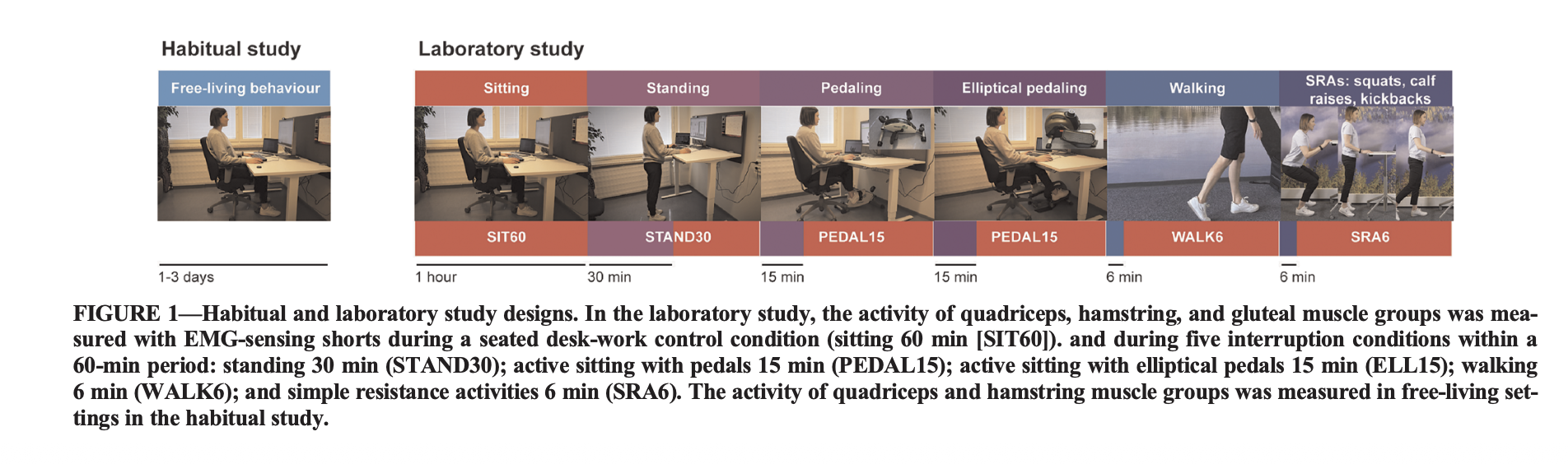
To make this measurable, the researchers defined a clear reference point. In this study, the Muscle Silence Threshold was set at an absolute baseline of 3 μV. This level was chosen because it offers the best sensitivity, while remaining largely unaffected by differences in body composition or fat tissue thickness.
A near-total shutdown
When the electrical signal in your large lower-body muscles drops below the 3 μV threshold, the fibers are considered physiologically silent. This isn’t just rest, it’s a metabolic void.
The findings from the habitual study reveal a new reality for the modern desk worker. Even in healthy adults, the quadriceps and hamstrings are active for only 25% and 30% of the day, respectively. This means that for the remaining 70% to 75% of our waking hours, our largest muscle groups are essentially switched off.
Perhaps even more surprising is what the researchers call the Capacity Gap. During normal daily life, the hamstrings and quadriceps use only 2.6% and 2.0% of their total contractile capacity*. When muscle activity stays below the silence threshold, the essential “background noise” of muscle excitation needed for healthy glucose regulation and blood flow is effectively shut down.
*Contractile capacity refers to how much of a muscle’s full strength and activity potential is actually being used.
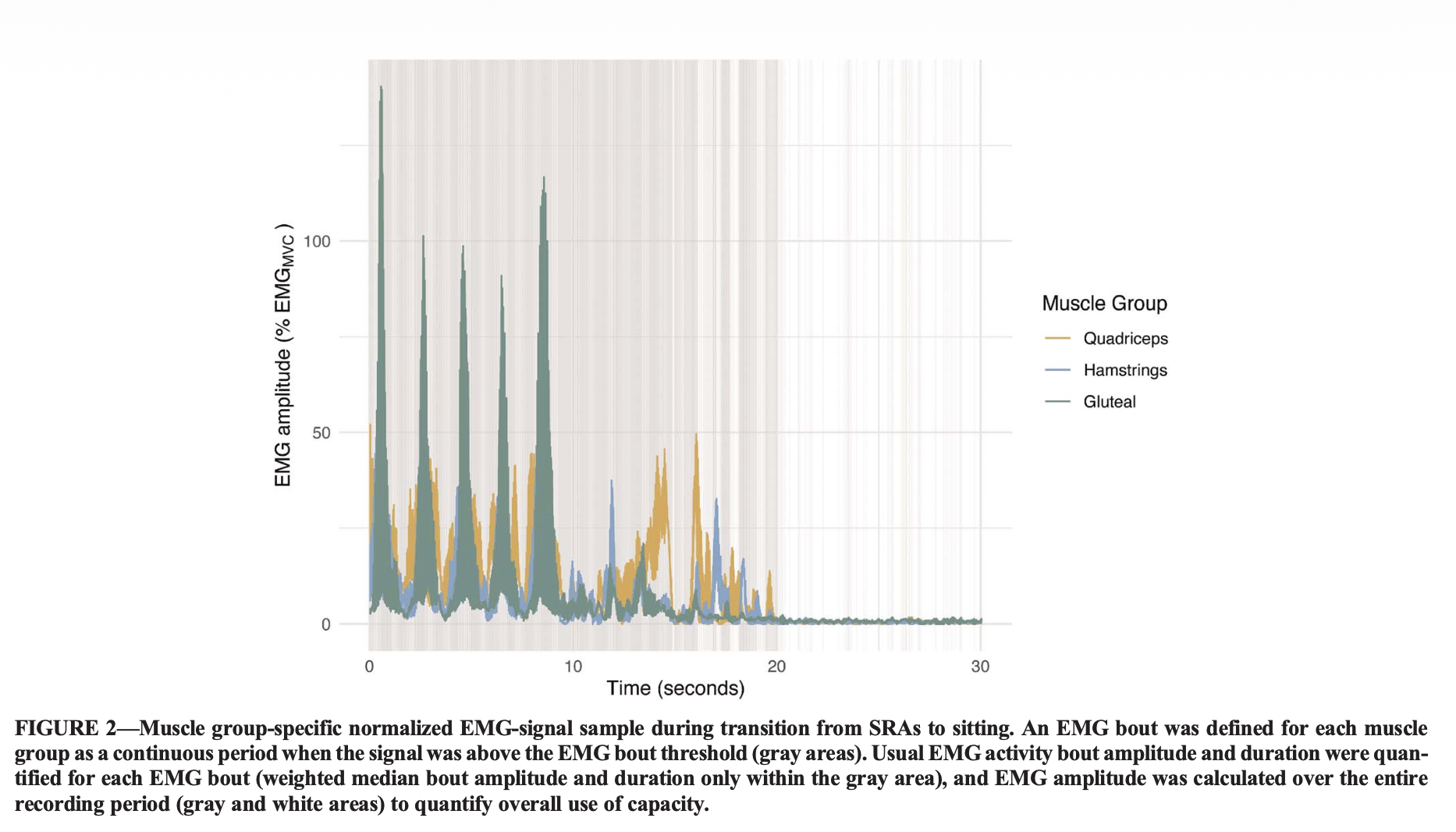
This figure shows a snapshot of electrical signals (EMG) from the quadriceps, hamstrings, and gluteal muscles. It captures the shift from simple resistance activities (SRAs), like squats and calf raises, back into a sitting position.
The vertical spikes are EMG bouts, brief flashes of activity where the muscle turns “on,” and the signal rises above the 3 μV silence threshold. Think of them as bursts of life in the muscle.
Around the 20sec. mark those spikes disappear. The gray shading fades, and the lines flatten into near stillness. This is muscle silence, the moment the muscles go quiet and electrical activity drops away.
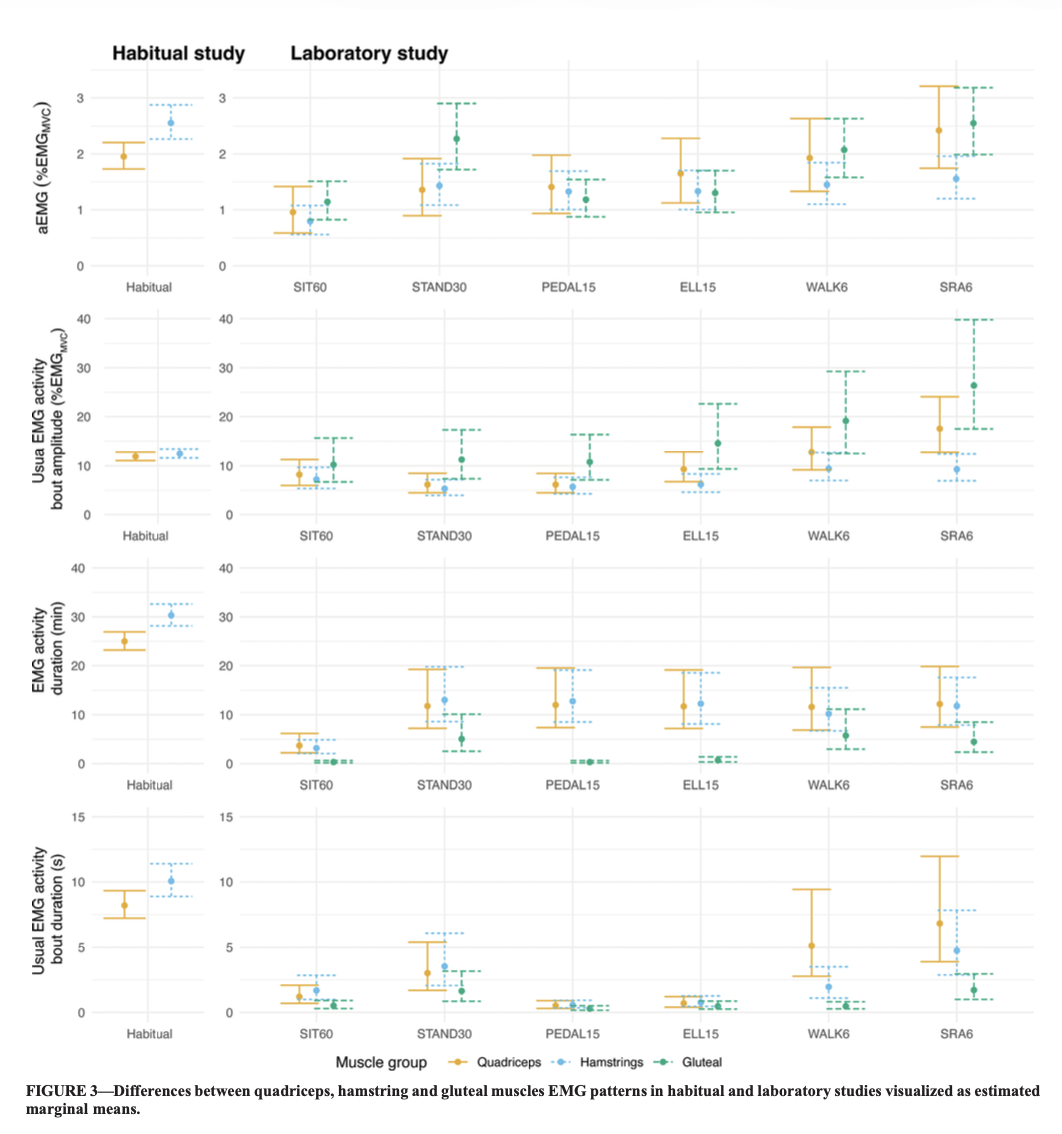
Let’s take a closer look at another figure from the research. It’s divided into four rows, each showing a different way of measuring muscle “noise”:
aEMG: the total electrical activity accumulated over time.
Usual bout amplitude: how “loud” or intense the muscle signals are when they switch on.
EMG activity duration: how long the muscles stay “awake,” above the silence threshold.
Usual bout duration: how long each burst of activity lasts before fading out.
On the left side, you see the Habitual Reality, the everyday state of 172 healthy adults. One pattern stands out immediately: the hamstrings (blue dots) are consistently more active than the quadriceps (yellow dots) during daily life.
Now shift your focus to the WALK6 (walking) and SRA6 (squats and calf raises) columns. The dots jump noticeably higher than in any other condition. These are clear spikes in muscle activity. In fact, the study found that Simple Resistance Activities (SRA) were the only intervention that matched the muscle activity levels seen in a naturally active day.
Compare that with STAND30 (30 minutes of standing). Yes, it increases activity compared to sitting (SIT60), but the dots remain relatively low and flat. You don’t see the same sharp bursts the same “amplitude spikes” that appear with walking or squats.
‘‘Standing helps, but it works slowly. It may take much longer to produce the same metabolic effect as a short, 6-minute “activity snack.’’
The takeaway is hard to ignore: to truly break the silence of a desk-bound day, we need movement with intent. Dynamic, upright actions like walking or squats are what bring muscle activity back to the levels our bodies were designed for.
Research Summary
Understanding this silence is the first step toward reclaiming our health. Because even if you meet the standard definition of “active,” your body may still be inactive where it matters most at the muscular and metabolic level. More about it in this post ..
And here’s the key: how you break that silence directly shapes your internal health.
More hamstring activity is linked to a smaller waist, lower body fat, and higher “good” HDL cholesterol.
More time spent activating the quadriceps is associated with lower fasting blood glucose.
Simple resistance movements like squats, calf raises and walking are the most effective ways to switch muscles back on.
Standing and pedaling help, but they’re not enough. The body responds best to dynamic, upright movement.
At the end of the day, the issue isn’t just that we sit too much it’s that our muscles spend most of their time in silence. Quiet, inactive, and disconnected from the systems that keep us healthy.
The solution isn’t extreme workouts or more hours at the gym. It’s simple, frequent moments of activation throughout the day. Small interruptions. Brief signals that remind the body it’s still meant to move. Because health, in this context, isn’t built in intensity it’s built in consistency.
References:
Read more posts: