MicroDosing Training foundation - part 2

“Do we naturally resist exercise? The uncomfortable answer might seem to be yes. But the real explanation is biological.”
Why don't we want to exercise?
Open your eyes. It’s already 5:30 a.m. You feel the cold air as you get out of bed – and immediately question your decision. On your way to the gym, you regret not having another cup of coffee. A lonely barbell waits for you, cold and silent. What do you feel in that moment?
Most likely, you are not thinking about your warm-up routine. You are wondering why you are doing this at all.
Is it weak motivation?
A lack of discipline?
A willpower problem?
In MicroDosing Training part 1, I presented global inactivity data and suggested that we have become a sedentary civilization.
But is it really that simple? Are we just lazy? Do we naturally resist exercise? The uncomfortable answer might seem to be yes. But the real explanation is biological.
Before we go further, we need to define what we mean by exercise. In scientific terms, exercise is not the same as physical activity.
According to the American College of Sports Medicine (ACSM), exercise is defined as (1):
“Planned, structured, and repetitive bodily movement done to improve or maintain one or more components of physical fitness.”
This definition highlights three key elements:
Planned – it is intentional.
Structured – it follows a program or specific format.
Repetitive – movements are performed repeatedly to produce adaptation.
By contrast, physical activity is a broader and more inclusive term. The World Health Organization (WHO) defines physical activity as (2):
“Any bodily movement produced by skeletal muscles that requires energy expenditure.”
You are not lazy. You are an evolutionary survivor
To truly understand this, we need to examine the science of human metabolism and the daily reality of contemporary hunter-gatherers. For years, a common assumption in the fitness world was that because Western lifestyles are sedentary, we must burn significantly fewer calories than our highly active ancestors.
However, a groundbreaking study on the Hadza people of Northern Tanzania, a traditional hunter-gatherer population whose lifestyle resembles that of our Pleistocene ancestors, challenged this assumption (3).
The Hadza do not use modern tools, vehicles, or guns; they hunt and gather entirely on foot. They are incredibly active, with men walking an average of 11.4 km per day and women walking 5.8 km per day just to secure wild foods like tubers, berries, and game. As a result, their daily physical activity levels are substantially higher than those of typical Western populations.
But here is the scientific plot twist: when researchers measured the Total Daily Energy Expenditure (TEE) of the Hadza using the doubly labeled water method, the gold standard for measuring energy expenditure in free-living humans, they found that after controlling for body size, the daily energy expenditure of these traditional foragers was remarkably similar to that of sedentary adults living in industrialized, market-based societies.
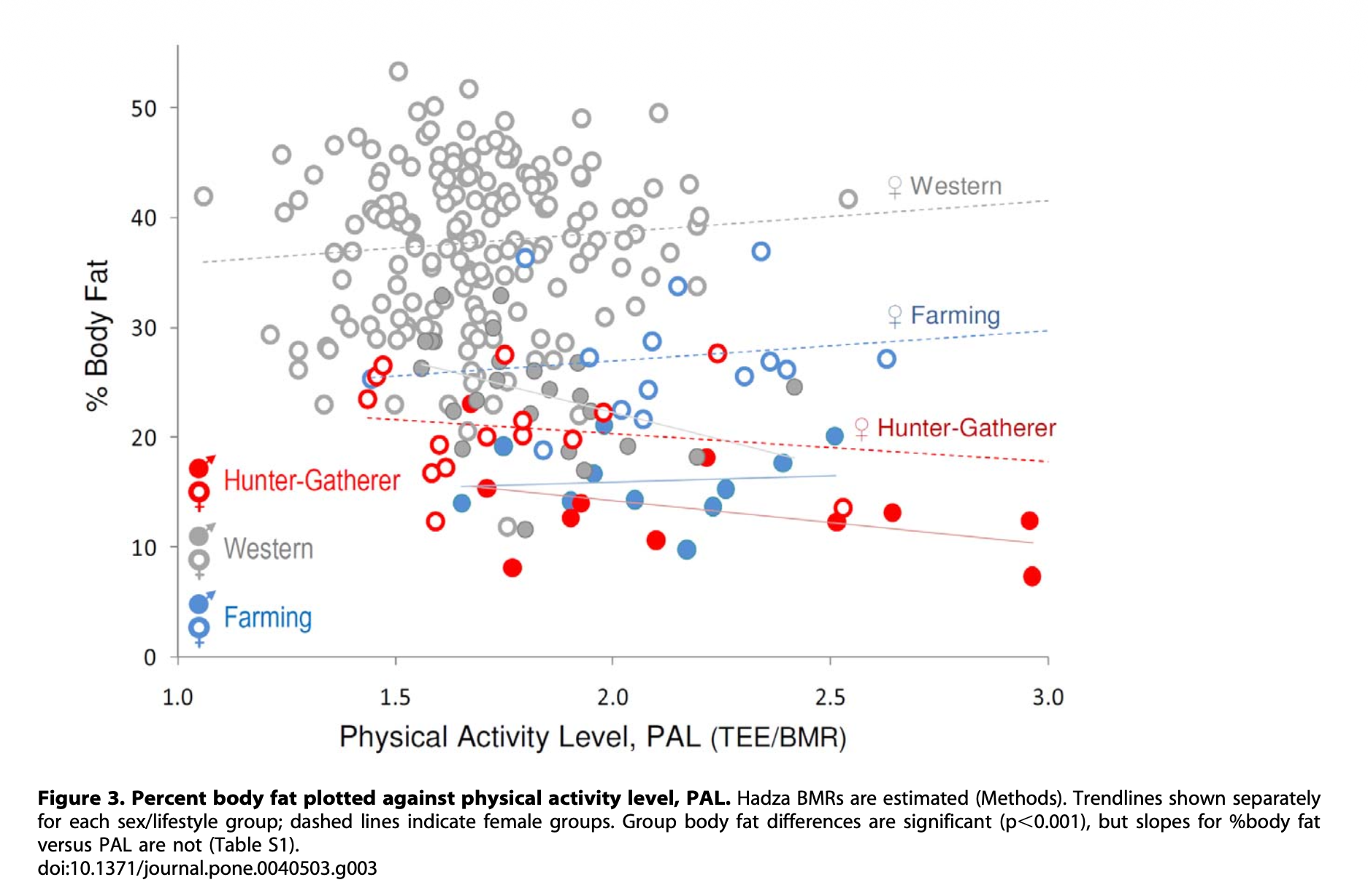
Let that sink in. Despite a substantially more active lifestyle, a hunter-gatherer may burn a similar total number of calories per day as a modern office worker.
The researchers concluded that human daily energy expenditure appears to be a constrained physiological trait shaped by evolution. It appears relatively stable and less variable than previously assumed, even across different cultural and activity contexts. This means our bodies possess a complex, dynamic metabolic strategy that meticulously manages and constrains how much energy we burn, even when activity levels differ substantially.
This biological reality helps explain why the idea of going to the gym can feel so unnatural. If total daily energy expenditure is biologically constrained, then energy has always functioned as our ultimate survival currency.
Your body requires a constant supply of energy to power the brain, maintain immune function, and repair tissues. If an early human repeatedly expended energy without a clear survival benefit, it could reduce survival chances during periods of food scarcity.
Because of this intense pressure, natural selection shaped the human brain to conserve energy efficiently with our constrained energy reserves. We evolved neural reward systems that tend to favor rest and energy conservation when survival demands are absent.
You are the direct, living descendant of those remarkable survivors, and you inherited their exceptionally efficient, energy-conserving neurology. When your brain evaluates a treadmill session, it may interpret it as unnecessary energy expenditure.

Your brain is attempting to protect you from unnecessary energy expenditure, unaware that modern environments provide constant food availability.
So, when you feel intense resistance to working out, you are not failing a test of moral character. Your reluctance is not a failure of willpower, it is the result of evolutionary mechanisms that once improved survival.
The environmental mismatch: It’s how we rest, not how much
A logical question arises: if we are biologically predisposed to seek rest, why is modern sedentary behavior associated with increased health risks? Did our highly active ancestors simply never sit still?
To answer this, we have to look at another fascinating piece of research on the Hadza people, focusing this time on the evolutionary biology of human inactivity (4).
Because we live in an industrialized society where we sit in cars, at desks, and on couches, we naturally assume that hunter-gatherers are constantly on the move, never resting for long. But when researchers attached accelerometers to the thighs of Hadza adults to objectively measure posture and movement, the data revealed another important finding: hunter-gatherers spend a comparable amount of time in non-ambulatory postures as adults in industrialized societies.
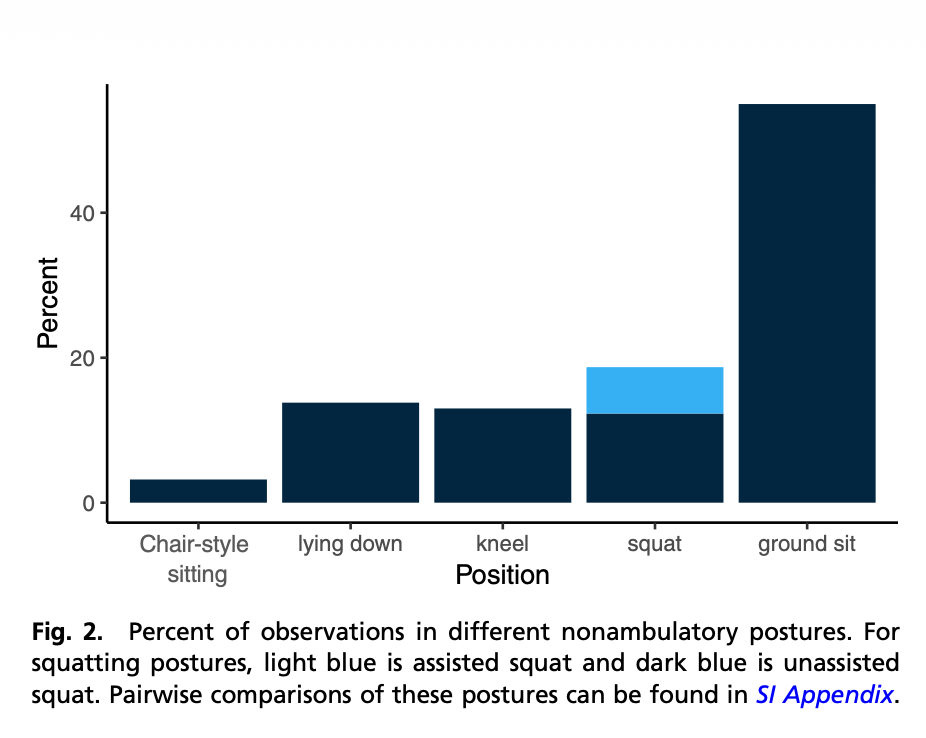
On average, Hadza adults spend nearly 9.9 hours a day in non-ambulatory (resting) postures.This duration of resting time is comparable to that reported in office workers in the US, Europe, and Australia. However, despite resting for 10 hours a day, the Hadza show very low prevalence of the biomarkers associated with cardiovascular disease and metabolic syndrome that plague sedentary Westerners.
How is this possible? The answer lies not in how much time they spend resting, but in how they rest.
In our modern world, we rest by completely disengaging our bodies. We sink into ergonomic office chairs and plush couches that fully support our weight, reducing muscular effort to very low levels. But hunter-gatherers do not have chairs. When they rest, they often adopt what researchers describe as “active rest” postures. Observational data shows that the Hadza spend roughly 18% of their resting time squatting and another 12.5% kneeling.
When researchers tested these specific postures using electromyography (EMG) to measure muscle contractions, the physiological difference was significant. Squatting requires substantially higher lower-limb muscle activity, reaching approximately 20–40% of the activation observed during walking. Chair-sitting, by contrast, requires minimal lower-body muscle activity.
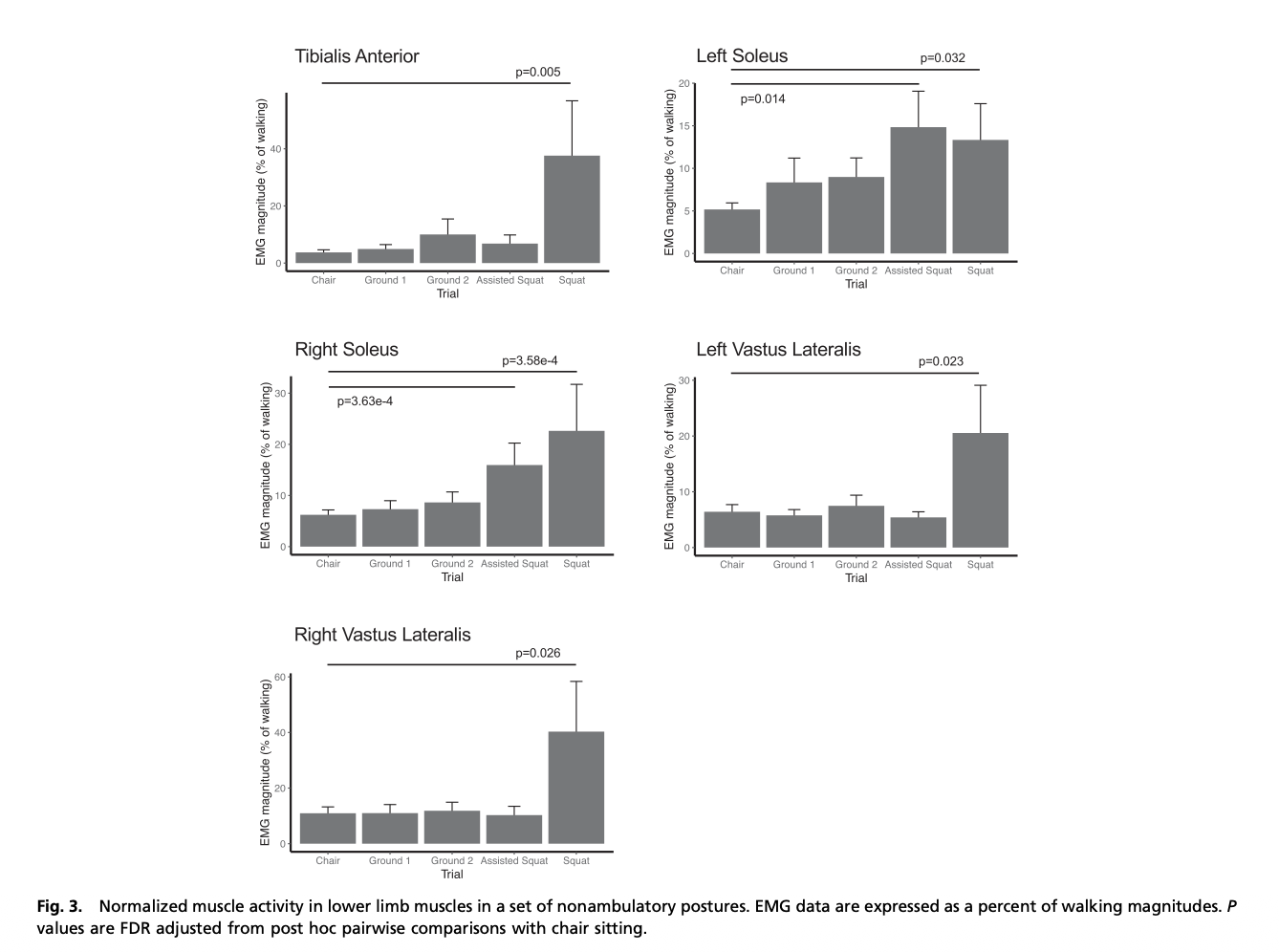
This brings us to what scientists call the Inactivity Mismatch Hypothesis. Human physiology did not evolve under conditions of prolonged, uninterrupted muscular inactivity. When you sit in a chair for hours, the slow oxidative postural muscles in the lower limbs become largely inactive.
Because local energy demand in these muscles drops significantly, your body reduces the activity of enzymes such as lipoprotein lipase (LPL), which is critical for clearing triglycerides (fats) and managing glucose in your blood. Human physiology appears to be adapted to a baseline level of low-intensity muscle activity distributed throughout the waking day, even when we are resting.
The true danger of modern life isn’t just that we rest, it is that the widespread use of chairs has removed most muscular effort from our resting behavior.
We need to reintroduce movement into the structure of our day. By introducing small, frequent, strategically placed bouts of muscular activation, brief mobility work, or standing tension, we break the dangerous cycle of muscular silence.
MicroDosing Training Foundation
In Part 1, we examined the uncomfortable reality of modern life. Despite millions of gym memberships and growing fitness culture, physical inactivity continues to rise globally. Even those who exercise regularly spend most of their day sitting. We are not just insufficiently active, we are structurally sedentary.
Exercise is not the same as physical activity, and sedentary behavior is not simply the opposite of being active. A person can meet all recommended exercise guidelines and still accumulate eight to ten hours of muscular inactivity per day. This creates a biological paradox short bursts of intense training surrounded by prolonged stillness.
Evolution did not shape us to voluntarily burn energy without purpose. Our metabolism appears to be tightly regulated, and our brains evolved to conserve energy whenever possible. The resistance many people feel toward exercise is not a moral weakness, it is an evolutionary inheritance. Humans evolved to experience frequent, low-level muscular activity throughout the day, even during rest.
MicroDosing Training is not simply another fitness trend, but a strategy aligned with our biological design.
Continue to part 3…
References:
Read more posts: