How often should you take movement breaks at work?

“For most desk workers, a 5-minute walk every 60 minutes appears to be the practical sweet spot.”
Humans spend an enormous amount of their lives on biological autopilot.
Our bodies constantly regulate thousands of processes without asking for permission: breathing, hormone release, body temperature, blood pressure, muscle activity, and countless others. We rarely think about them, and in reality, we control far less than we often imagine.
Take your heart, for example. While you are reading this article, it is quietly pumping around 5 liters of blood every minute, more than 7,000 liters every day without a single conscious decision from you.
Yet we also have a tendency to step in and take control where biology gives us a choice.
How we eat. How we train. How much we sleep. And, increasingly, how often we should move during the workday.
Most desk workers already know that regular movement is a good idea. The harder question is:
How often do I actually need to move?
Every 30 minutes?
Every hour?
Only when I start feeling stiff?
The answer is more nuanced than you might expect, and recent research suggests that when you move may be almost as important as how much you move.
In this article, we’ll look at what the evidence says about movement break frequency and how to apply it in a real workday.
For a complete guide, see “Movement breaks at work: a 1-minute system for desk workers”.
How often should desk workers take movement breaks?
Until recently, most recommendations were based on laboratory studies. Researchers would ask participants to interrupt sitting every 20, 30, or 60 minutes and then measure blood sugar, fatigue, or circulation.
But would people actually follow these routines during a normal workday?
The Body Electric Study (2026) tried to answer that question.
More than 19,000 adults took part in a real-world workplace intervention. Participants chose one of three schedules:
a 5-min walk every 30 min of sitting
a 5-min walk every 60 min of sitting
a 5-min walk every 120 min of sitting
The researchers wanted to know two things:
Which schedule made people feel better?
Which schedule could people realistically maintain?
The good news: you’ll probably notice a difference quickly.
Regardless of which schedule they followed, participants reported feeling less fatigued and more positive after taking regular walking breaks.
Interestingly, the improvements were noticeable almost immediately rather than only after weeks of practice.
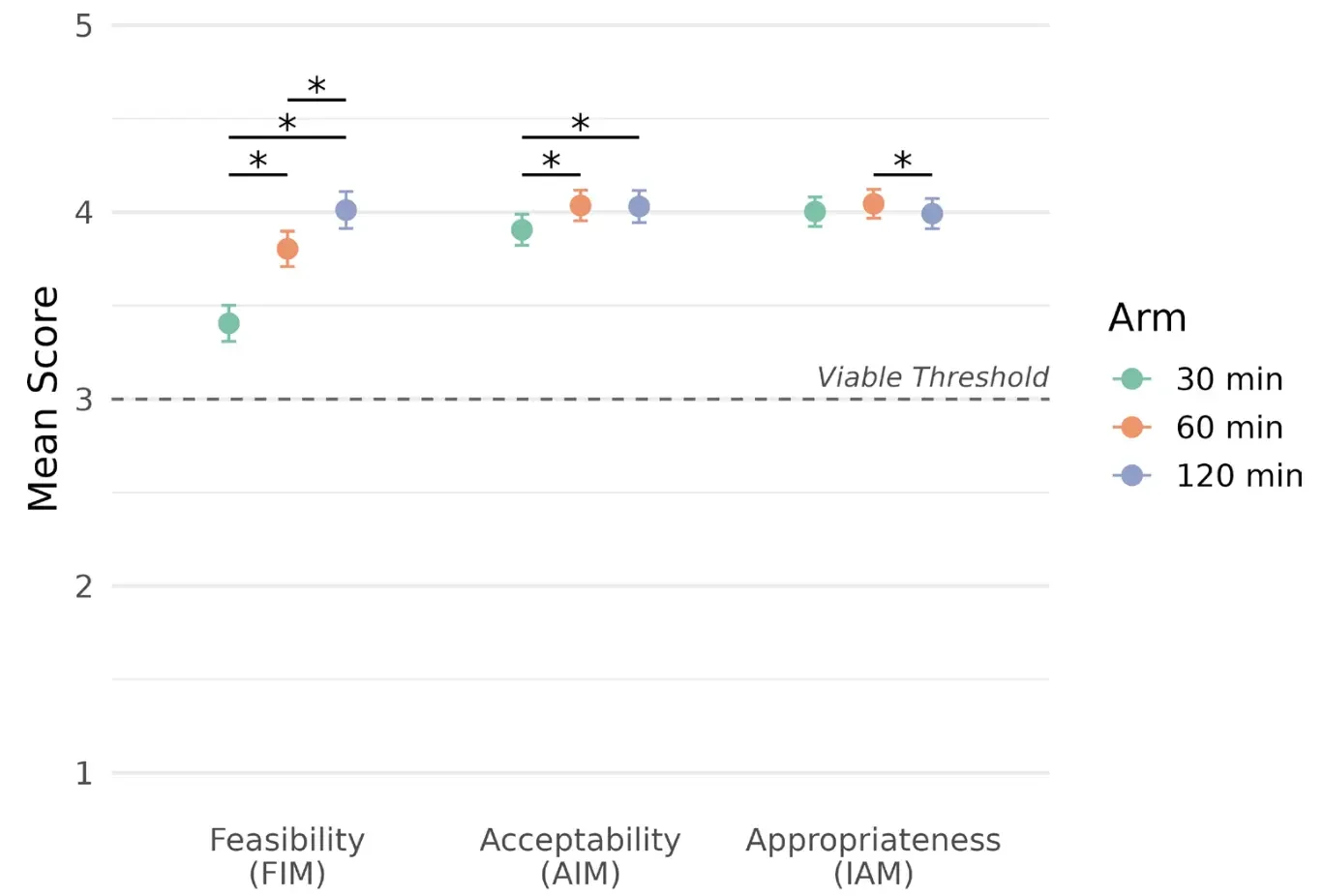
However, the results also showed a clear pattern.
Walking every 30 minutes produced the greatest improvements in mood and was the only schedule that significantly reduced negative emotions.
Both the 30-minute and 60-minute schedules improved fatigue and well-being enough for participants to notice a meaningful difference in everyday life.
Perhaps most importantly for employers, work performance did not decline. Participants actually reported 1–3% higher productivity and 4–7% greater work engagement.
Here comes the interesting part.
The schedule that produced the greatest benefits was also the hardest to maintain. Only 10.1% of participants consistently followed the 30-minute plan.
By comparison, almost 46% managed to stick with taking a break every 120 minutes, but this was also the least effective option.
This is a great example of something we often see in behavior-change research: the most effective intervention isn’t always the one people can sustain.
Practical recommendation
For most desk workers, a 5-minute walk every 60 minutes appears to be the practical sweet spot. It delivers meaningful improvements in mood and fatigue while remaining much easier to maintain than moving every 30 minutes.
Another large review points in the same direction.
A 2026 meta-analysis combining 144 studies and more than 2,200 participants provides an even broader picture.
Rather than asking whether movement breaks work, the researchers examined which timing and duration produced the greatest cardiometabolic (heart and metabolic) health benefits for office workers.
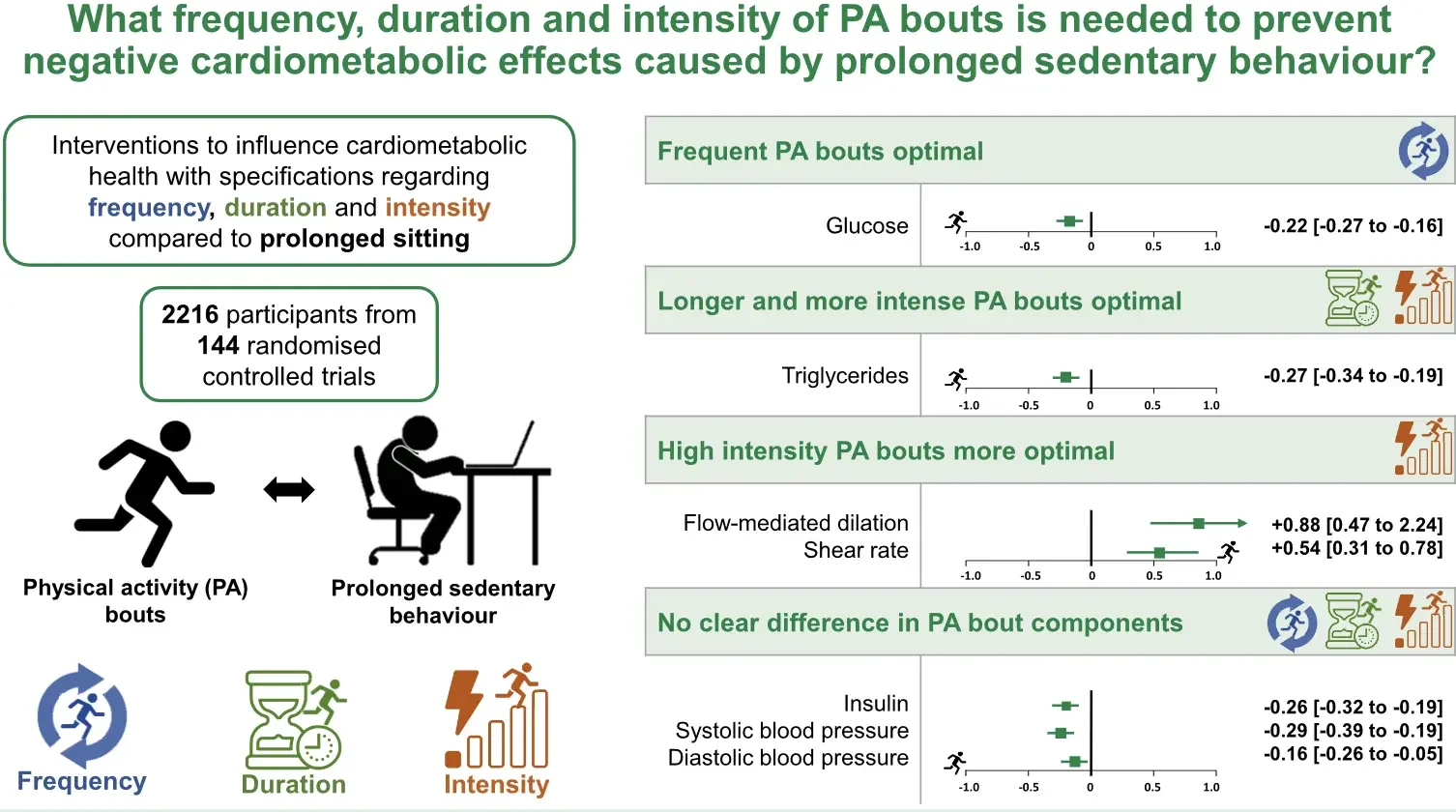
Their conclusions were remarkably consistent.
Blood sugar control benefited most from frequent, short bouts of light activity, typically around 5 minutes every 30–60 minutes.
Improvements in blood fats generally required either longer activity sessions (30 minutes or more) or shorter bouts performed at higher intensity, such as stair climbing.
Practical takeaway
Looking across these studies, the common denominator is surprisingly consistent. For most office workers, a 5-minute movement break every 30–60 minutes seems to be the sweet spot. It is frequent enough to interrupt prolonged sitting and support metabolic health, while still being realistic to fit into a normal workday. As always, consistency beats perfection.
If your priority is improving energy, mood, and breaking up prolonged sitting at work, aim for 5 minutes every 30–60 minutes.
If moving every 30 minutes feels unrealistic, every 60 minutes appears to provide an excellent balance between effectiveness and sustainability.
Many of us now use standing desks, but the research provides an important reality check. Standing is better than uninterrupted sitting, but it does not produce the same metabolic benefits as walking or other light movement. If your goal is improving health, don’t just stand, move.
Movement breaks complement exercise, they don’t replace it. Continue doing regular exercise, especially if your goal is improving cardiovascular fitness, strength, or long-term health.
The best schedule isn’t just the healthiest one it’s the one you’ll still be following six months from now.
Why movement break frequency matters more than you think
When researchers talk about movement breaks, they often mention frequency - the total number of times you move during the day.
At first, this sounds logical. More movement should be better, right?
The problem is that frequency alone doesn’t tell us when those breaks happen.
Imagine taking all 10 movement breaks during the first two hours of your workday and then sitting continuously for the next six hours. On paper, your daily frequency looks excellent, but your body still experiences one very long period of uninterrupted sitting.
This is why researchers have become increasingly interested in another concept: density.
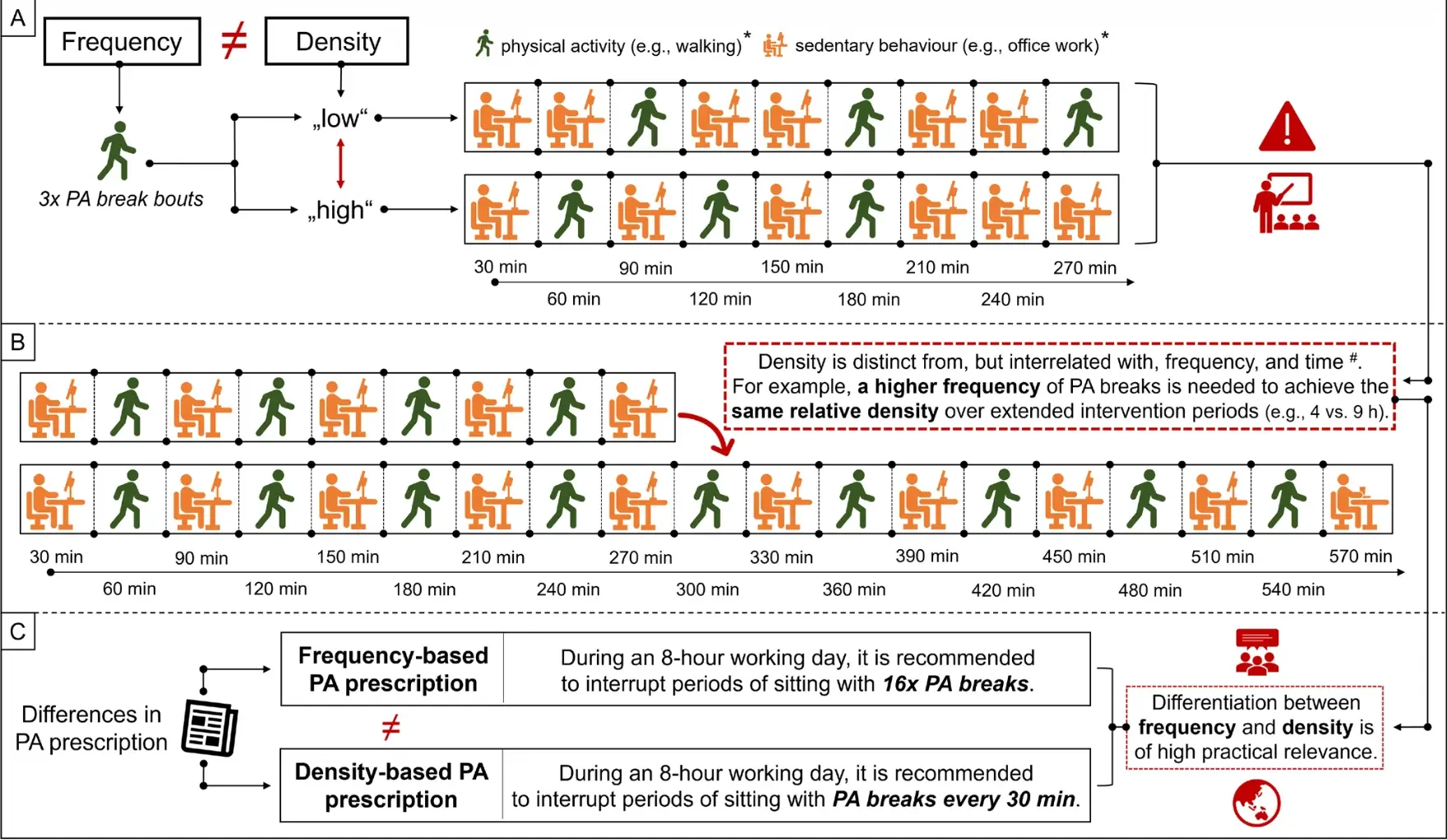
The figure above explains why this matters.
Panel A shows that taking the same number of movement breaks can produce very different sitting patterns. In the upper example, long periods of sitting separate each break (low density). In the lower example, movement is distributed more evenly throughout the day, keeping sitting intervals much shorter (high density).
Panel B shows that frequency and density are related. A longer workday naturally requires more movement breaks to maintain the same spacing between them.
Panel C compares two ways of giving advice. Instead of telling someone to take “16 movement breaks per day,” it is usually much simpler to say “move every 30 minutes.”
So what’s the difference?
Frequency refers to the total number of movement breaks performed during a given period, for example, 16 breaks during an 8-hour workday.
Density refers to the amount of sitting time between those breaks, for example, one movement break every 30 minutes.
Although “density” sounds like scientific jargon, it has several practical advantages.
It allows researchers to compare studies using the same sitting intervals.
It makes it easier to identify which timing produces the greatest health benefits.
Most importantly, it is much easier for people to remember. Very few desk workers count how many breaks they have taken, but almost everyone can remember a simple rule such as “stand up every 30 minutes.”
Practical takeaway
The evidence suggests that keeping sitting intervals short is more useful than simply counting the total number of movement breaks.
Instead of aiming for a certain number of breaks each day, think about how long you stay seated between them.
For most desk workers, taking a movement break approximately every 30 minutes represents a high-density movement pattern, which current research consistently associates with the greatest health benefits.
Movement break frequency for different work styles
Not every desk job looks the same.
A software developer may spend three hours writing code tools with few interruptions, while a manager moves between meetings all day. Someone working from home faces different challenges than a receptionist or customer-service representative.
This is why there is no single movement-break schedule that fits everyone.
One thing to remember is this: the goal is always the same - avoid long periods of uninterrupted sitting whenever possible. How you achieve that depends on the type of work you do and in what environment.
Deep, focus work. Move every 60–90 minutes between concentration blocks. A 2–5 minute walk before returning to work often feels more natural than interrupting every 30 minutes.
Meeting-heavy days. Stand up or walk for 1–3 minutes after each meeting. Use the end of one meeting as the cue before starting the next.
Phone or call-based work. Walk whenever possible during phone calls or stand for the first few minutes of longer conversations.
Home office. Set a timer every 30–45 minutes or use habit cues such as refilling your water bottle or making coffee.
Working from home? Read: “Home office ergonomics: how your setup affects your body”.
Hybrid work. Use your office days to build movement into your routine by walking to colleagues or taking the stairs. At home, rely more on reminders and habit stacking.
Highly demanding workdays. If moving every 30 minutes is unrealistic, aim for one movement break every hour. Consistency matters more than following a perfect schedule.
There will always be busy days
One thing I have learned from reading sedentary-behavior research is that the “perfect” schedule rarely survives contact with a real calendar.
Some days you’ll spend hours in meetings. Other days you’ll become so absorbed in a project that you won’t notice time passing.
That doesn’t mean the habit has failed.
If you miss one movement break, simply take the next opportunity to stand up, walk, or change your posture. Long-term consistency is far more important than achieving a perfect score every day.
A movement-break schedule should fit your workday, not force your workday to fit the schedule.
Looking for a structured routine? Read: “Exercises for sitting all day: the complete guide for desk workers”.
How to actually remember to move every 30–60 minutes
It always comes down to the same problem, right? How do you actually remember?
The biggest challenge is not motivation. It is attention, and your attention is already fully occupied by work. When you become absorbed in a project, answering emails, or preparing for a meeting, it is surprisingly easy to sit for two or three hours without even noticing.
It would be easy for me to simply say, “Come on, it’s time to move.” But that rarely works.
The real trick is to attach a new habit to one you already perform automatically. This idea, often called habit stacking, has been studied extensively in both behavior-change research and real-world settings.
The principle is simple:
When I do X, I immediately do Y.
For example:
After every meeting - walk for one minute.
Before starting a new task - perform five sit-to-stands.
After refilling your water bottle - stretch your shoulders.
After making coffee - walk one extra lap before returning to your desk.
After finishing a long email → stand up before opening the next task.
Your environment also matters.
A workspace can either encourage movement or make sitting effortless. Small changes often create natural opportunities to move without relying on willpower.
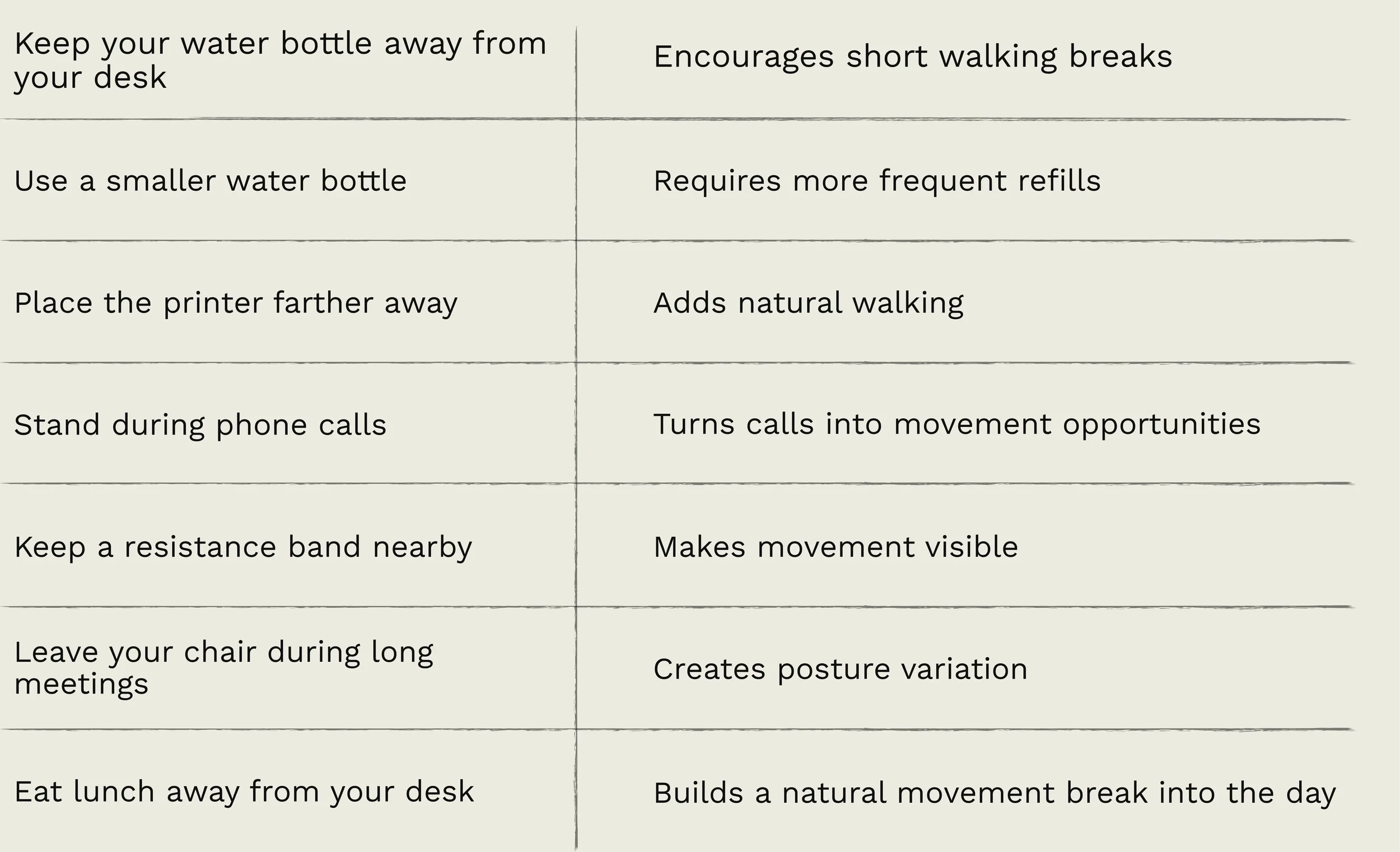
Finally, start with a schedule you can actually maintain.
One movement break every hour is infinitely better than aiming for perfection and giving up after two days.
The best movement reminder is not the smartest app or the most advanced watch. It is the cue that reliably gets you out of your chair.
A simple movement break schedule for an 8-hour workday
Theory is useful, but what does this actually look like during a normal workday?
This is not a schedule that everyone needs to follow. Think of it as an example that can be adjusted around your meetings, workload, and personal preferences. The exact timing is less important than the principle.
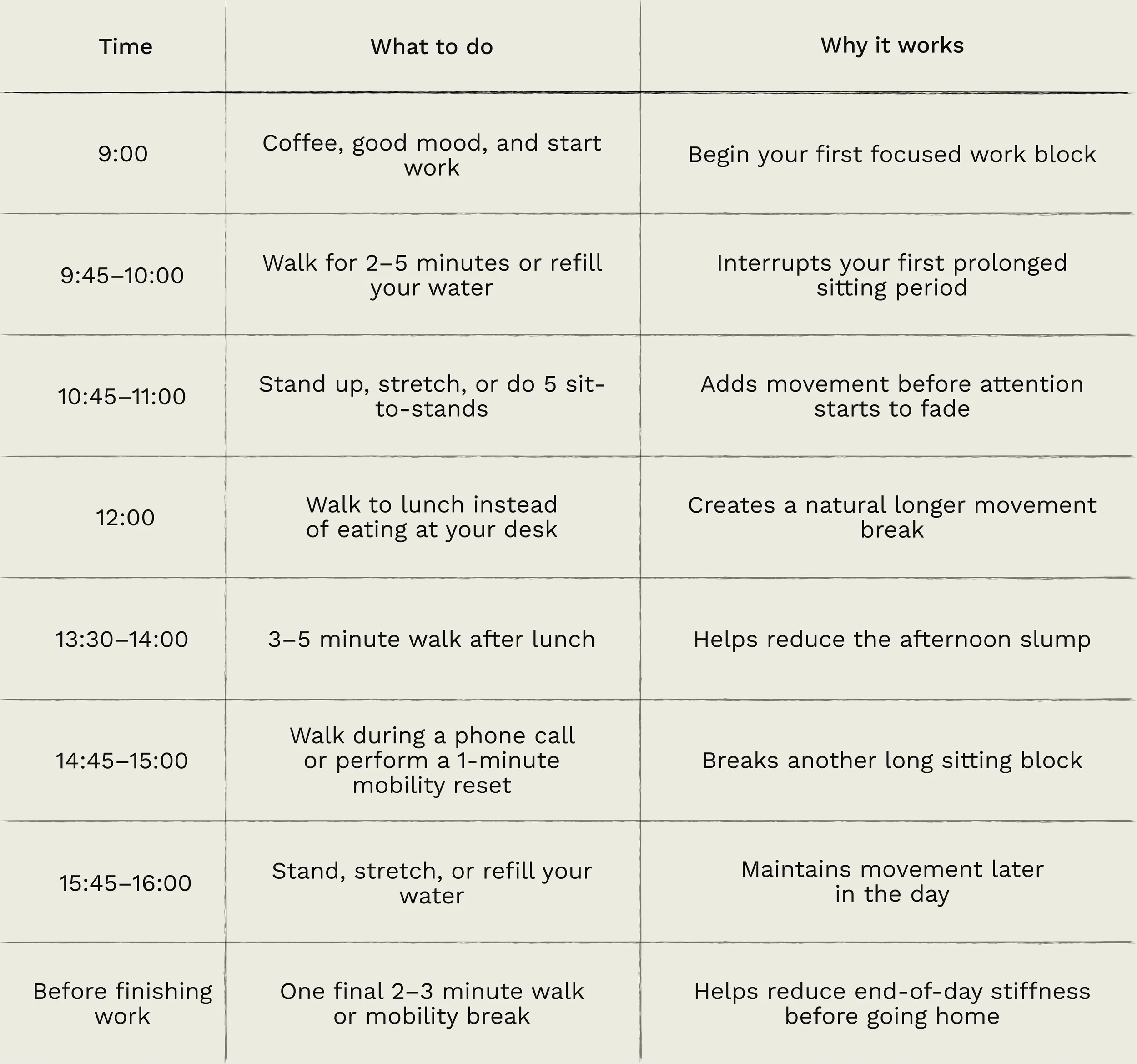
Prefer a more flexible approach? Try using workday cues instead of the clock.
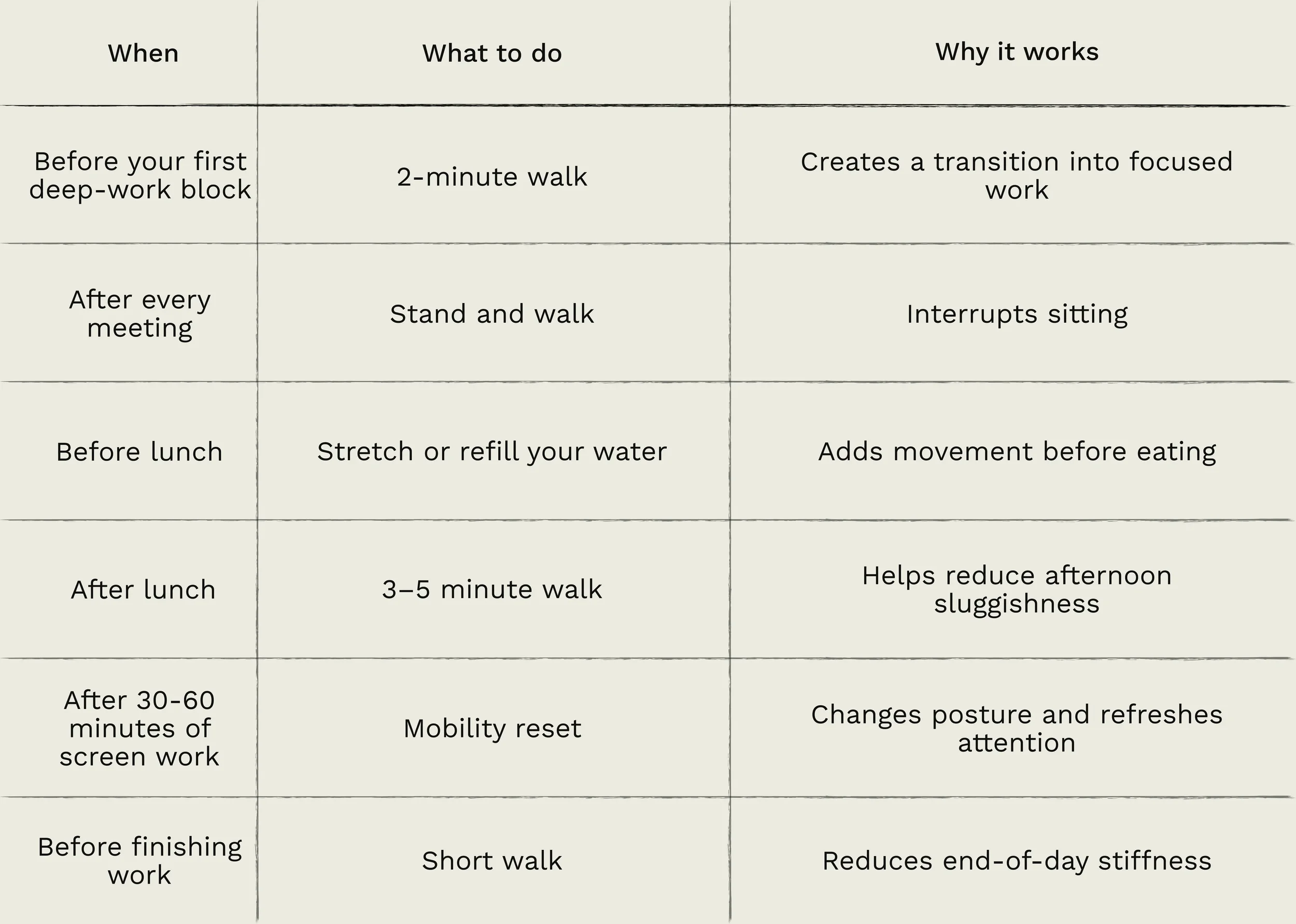
Whether you prefer fixed times or natural workday cues, the goal is exactly the same: reduce long periods of uninterrupted sitting.
Common Mistakes
Waiting until you feel uncomfortable
If you only stand up once your back feels stiff or your concentration has already disappeared, you’ve probably been sitting for quite a while. Movement breaks work best when they interrupt prolonged sitting before discomfort or fatigue has a chance to build. If I can save you one mistake, it’s this: don’t wait until your body asks for movement.
Chasing the perfect schedule
Don’t let one missed break convince you that the whole day is ruined. Simply move at the next opportunity and continue your routine.
Counting breaks instead of watching sitting time
Many people focus on how many movement breaks they have taken without thinking about how long they remained seated between them.
Remember the concept of density. Two people might both take eight movement breaks, but the one who avoids long uninterrupted sitting periods is likely following the healthier pattern.
Forgetting that workdays are different
Some days are filled with meetings. Others require long periods of deep concentration. Your movement strategy should adapt to your workload rather than forcing every day into the same schedule.
Thinking standing is enough
Standing is certainly better than remaining seated for hours, but it is not always the same as moving.
Whenever possible, add a short walk, a few sit-to-stands, stair climbing, or simple mobility exercises. Even one minute of light movement introduces more variation than standing still.
Giving up after missing a few breaks
This is probably the easiest trap to fall into.
You planned to move every 30 minutes, then a meeting ran long, your phone rang, and suddenly two hours had passed.
It happens. Don’t wait until tomorrow to “start again.” Simply take your next movement break and carry on. Long-term consistency will always matter more than one perfect day.
FAQ
-
Current research suggests that interrupting prolonged sitting every 30–60 minutes is a practical target for most desk workers. If moving every 30 minutes feels unrealistic, aim for at least one short movement break every hour.
-
Generally, yes.
Studies suggest that more frequent movement breaks may provide greater benefits for blood sugar regulation, mood, and reducing prolonged sitting. However, they are also harder to maintain. For many people, moving every 60 minutes offers a realistic balance between effectiveness and consistency.
-
Most workplace movement breaks last 2–5 minutes, although even standing up or walking for one minute is better than remaining seated. The goal is to interrupt prolonged sitting rather than complete a workout.
-
Nothing terrible happens.
Simply take your next opportunity to stand up and move. Missing one or two breaks is far less important than maintaining the habit over weeks, months, and years.
-
For many people, yes.
Timers, smartwatch reminders, and desktop apps can help, especially while you’re building the habit. Over time, many desk workers naturally switch to cues such as finishing a meeting, refilling a water bottle, or taking a phone call.
-
Not if your goal is to interrupt prolonged sitting.
Research suggests that breaking up long periods of sitting is more beneficial than accumulating all your movement into one part of the day. A short walk every hour is generally preferable to taking several breaks back-to-back and then sitting for the next four hours.
-
Standing is certainly better than uninterrupted sitting, but light movement generally provides greater benefits. Walking, climbing stairs, mobility exercises, or a few sit-to-stands activate more muscles and create greater movement variety.
-
Start with something that already happens every day.
For example, stand up after every meeting, walk while making coffee, refill your water bottle once an hour, or perform five sit-to-stands before beginning a new task. The best reminder is usually one that already exists in your daily routine.
-
That’s completely understandable. Some jobs involve long meetings, customer interactions, or periods of uninterrupted concentration. If moving every 30 minutes isn’t realistic, aim for every 60 minutes or simply move whenever a natural break appears. The goal is to reduce prolonged sitting, not create another source of stress during your workday.
The Exercise Snacks approach helps you build a simple movement-break routine with structured weekly plans, calendar integration, and short, practical exercises designed to fit around real work.
References:
Keith M Diaz., (2026): Evaluating movement breaks as a public health strategy to mitigate the harms of prolonged sitting: a large-scale pragmatic intervention.
Jen Vanherle., (2026): Optimizing physical activity bouts to interrupt sedentary behaviour for cardiometabolic health.
Fabian. H., (2024): Differentiating Physical Activity Frequency and Density.
Read more posts: