Movement breaks for focus: a simple workday reset for desk workers
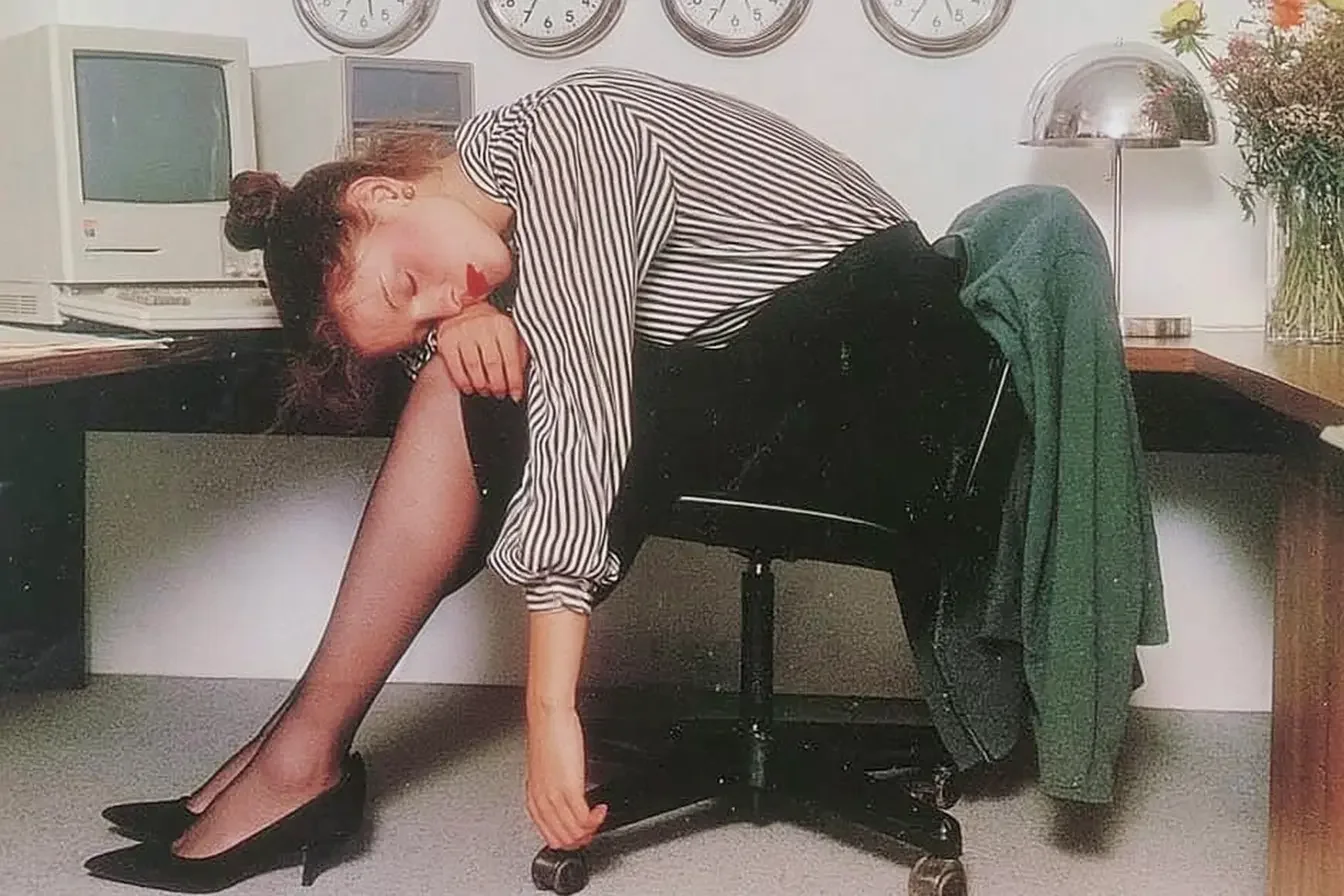
“The longer we stay awake and mentally engaged, the stronger the physiological pressure to rest becomes, contributing to mental fatigue and reduced cognitive performance.”
Imagine it’s Tuesday afternoon. You’ve been at your desk since 9:00 AM. Let’s assume the morning was productive, but now the screen is starting to blur. You find yourself reading the same email three times without absorbing a single word.
It’s easy to blame a heavy lunch, low motivation, or lack of willpower. But what you may be experiencing reflects normal human biology rather than a personal failure.
Research shows that our cognitive performance is not constant throughout the day. It is influenced by several biological processes, including the circadian rhythm our internal 24-hour biological clock, which regulates alertness, body temperature, hormone release, and the sleep-wake cycle. For many people, alertness naturally declines during the early afternoon, making sustained concentration more difficult.
At the same time, researchers describe a second biological rhythm known as the basic rest-activity cycle (BRAC). Approximately every 90 minutes, the brain moves through natural fluctuations in alertness and mental performance. Trying to maintain the same level of focus for hours without interruption often means working against these natural rhythms.
Another process is also taking place. Throughout the day, the body’s homeostatic sleep drive gradually increases. The longer we stay awake and mentally engaged, the stronger the physiological pressure to rest becomes, contributing to mental fatigue and reduced cognitive performance.
Movement breaks cannot eliminate these biological processes, but they may help us work with them rather than against them.
Standing up, walking for a minute, or performing a few simple mobility exercises creates a brief interruption in prolonged sitting while providing a natural transition between periods of focused work. Instead of viewing movement as a distraction, it may be more accurate to think of it as a way to reset attention and prepare the brain for the next block of cognitive effort.
In this article, we’ll explore what research says about movement breaks, attention, and how strategically timed movement may help support focus throughout the workday.
Why your focus fades during long work blocks
Focus is not simply about “trying harder.” It is the ability to stay on one task, ignore distractions, and maintain enough mental energy to continue. In research, focus overlaps with concepts such as sustained attention and executive function, the mental skills that help us stay on task, control impulses, and complete work despite interruptions.
Losing focus during a long work session is not simply a matter of being lazy or unmotivated. Several physiological changes occur when we remain seated and mentally engaged for extended periods.
Prolonged sitting reduces movement variety, increases physical discomfort, and contributes to mental fatigue. Together, these factors can make it progressively harder to maintain attention, even when the task itself has not changed.
Prolonged sitting can reduce brain blood flow
Although sitting often feels like a passive resting position, it is far from physiologically inactive.
Research suggests that prolonged sedentary behavior may influence how efficiently blood, oxygen, and glucose are delivered to the brain. Because brain cells rely on a continuous supply of these resources, even small changes in cerebral blood flow may influence alertness and cognitive performance.
One proposed mechanism involves glycemic regulation. Long periods of uninterrupted sitting can impair post-meal glucose control, which has been associated with reduced cerebral blood flow.
In healthy desk workers, four hours of uninterrupted sitting reduced middle cerebral artery blood-flow velocity by approximately 3–4%, suggesting that prolonged sitting may subtly reduce the circulatory support needed for sustained attention.
Interestingly, research also suggests that regular exercise alone may not completely offset these effects. Sedentary behavior appears to have its own physiological consequences, meaning it is possible to meet physical activity guidelines while still spending too much of the day sitting.
For this reason, many researchers now distinguish between being physically active and avoiding prolonged sedentary behavior. Both appear to be important for long-term brain and body health.
Learn more: “The Sedentary Exercise Paradox: you exercise but still sit for 8 hours.”
Fatigue and cognition during prolonged sitting
After several hours at the computer, concentration starts to drift. You reread the same sentence, lose your train of thought, or feel mentally tired even though the task itself hasn’t changed.
This is sometimes described as postural stagnation, remaining in the same seated position with very little movement for a prolonged period. While the term is used more often in ergonomics and rehabilitation than neuroscience, it reflects an important idea: the body and brain generally function better when posture and movement change throughout the day.
Research suggests that prolonged sitting may contribute to mental fatigue, although it’s effects on cognitive performance appear to vary between individuals.
One observational study followed 334 Swedish office workers, using wearable devices to measure their daily movement patterns. On average, participants spent 59% of their waking hours sitting.
Interestingly, the relationship between movement and attention differed according to participants fitness levels.
Among workers with lower cardiorespiratory fitness, longer continuous bouts of physical activity (at least 10 minutes) were associated with better attention.
Among highly fit individuals, this relationship was less clear, suggesting that baseline fitness may influence how movement affects cognitive performance.
Other experimental studies provide additional context.
Short walking breaks of 2–3 minutes may not immediately improve performance on complex cognitive tests, but they consistently reduce fatigue and the feeling of mental fog during prolonged sitting.
For example, Wennberg et al. (2016) found that interrupting prolonged sitting helped reduce fatigue, while Chrismas et al. (2019) reported better attention and executive-function performance when prolonged sitting was regularly interrupted with walking.
Taken together, these findings suggest that movement may support focus through more than one pathway.
Longer bouts of activity may provide greater benefits for attention in some people, while short movement breaks appear particularly effective for reducing fatigue and helping people feel mentally refreshed during the workday.
What does this mean in practice?
If your goal is to sharpen concentration before a demanding task, a 10-minute brisk walk may provide a stronger cognitive stimulus than a single 1-minute movement break, particularly if your baseline fitness is lower.
However, during a busy workday, taking a 10-minute walk every time your focus drifts is rarely practical.
Short 1–3 minute movement breaks are much easier to repeat throughout the day. While they may not produce the same cognitive effects as a longer walk, the evidence suggests they can reduce fatigue, interrupt prolonged sitting, and help you return to work feeling more mentally refreshed.
What are movement breaks?
Movement breaks are short interruptions of prolonged sitting, typically lasting 1–3 minutes, during which you stand up, walk, stretch, or perform a few simple mobility exercises.
Unlike traditional workouts, movement breaks are not designed to improve fitness or build strength. Their purpose is to interrupt prolonged sitting, reduce physical stagnation, and help you reset between work blocks so you can return to your desk feeling more alert.
For focus, timing may be just as important as the activity itself. A brief movement break after 60–90 minutes of concentrated work can act as a natural transition, reducing the feeling of mental fatigue before it builds into the familiar afternoon slump.
Practical takeaway:
Walking appears more effective than standing breaks.
Standing is still preferable to uninterrupted sitting.
Many successful studies used protocols lasting only 2–5 minutes every 20–30 minutes.
For a complete overview of movement breaks, including frequency, examples, and implementation strategies, see our guide: “Movement Breaks at Work: A 1-Minute System for Desk Workers.”
How movement breaks may help you refocus
Movement breaks may help you refocus by supporting two systems the brain relies on: circulation and energy regulation.
Brain regions involved in attention, working memory, and self-control particularly the prefrontal cortex require a continuous supply of oxygen and glucose to function efficiently.
Research suggests that prolonged sitting may reduce cerebral blood-flow velocity and cerebral oxygenation. Interrupting sitting with short bouts of movement may help maintain these responses, while also activating the large muscles of the legs, improving glucose regulation, and increasing overall physiological arousal.
One experimental study provides an interesting example.
After 2 hours of uninterrupted sitting, participants did not become noticeably slower at completing cognitive tasks. However, they became less accurate on tasks requiring sustained attention and inhibitory control - the ability to ignore distractions and suppress automatic responses.
The researchers also measured cerebral oxygenation and found that it declined during prolonged sitting. Interestingly, physically active participants experienced a larger reduction than less active participants, possibly because they started from a higher physiological baseline. The authors suggested that blood pooling in the legs during prolonged sitting may contribute to these changes.
Perhaps the most practical finding was that just two hours of uninterrupted sitting - about the length of a long meeting, lecture, or movie was enough to reduce cerebral oxygenation in healthy young adults.
What does this mean in practice?
Regular exercise remains essential for long-term health, but it does not eliminate the immediate physiological effects of sitting still for hours at a time.
If your work requires prolonged concentration, regularly standing up, walking, or performing a brief movement break may help maintain the physiological conditions that support attention throughout the day. The goal is not to eliminate fatigue completely, but to avoid spending hours in the same physical and mental state.
Movement breaks vs. coffee, scrolling, and passive breaks
Coffee, scrolling, passive rest, and movement breaks can all feel like ways to reset during the workday, but they work through different mechanisms.
Coffee primarily improves alertness by stimulating the central nervous system. Scrolling through social media changes what you are looking at, but it may also keep the brain in a high-input, attention-switching state. Passive rest can reduce mental effort, but if you remain seated in the same posture, it does little to interrupt prolonged sitting.
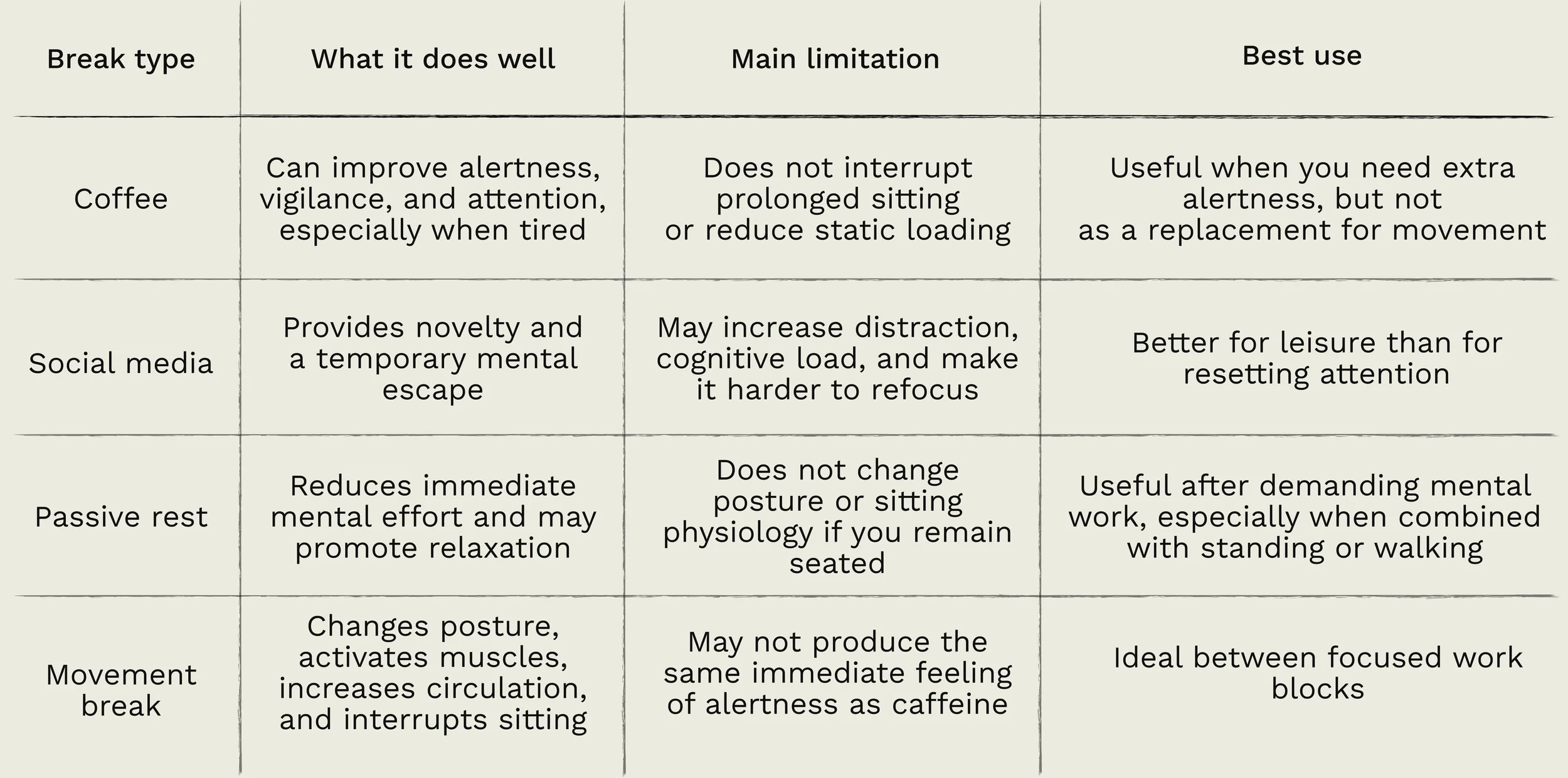
Movement breaks are different because they change the body’s physiological state. They interrupt prolonged sitting, activate muscles, increase movement variety, support circulation, and provide new sensory input. That is why a short walk, a few sit-to-stands, or one minute of mobility may provide a more complete reset than simply drinking another coffee or scrolling for five minutes.
The best reset is not the same for everyone. For some people, coffee improves alertness. For others, quiet rest helps reduce overstimulation. Some people benefit from stepping away from the screen, while others need light movement to wake up the body.
In practice, the most effective reset is often a combination: a short walk, a glass of water, a few deep breaths, and coffee if needed.
The goal is not simply to take a break - it is to return to work feeling more focused than when you left.
Movement breaks to try when you feel unfocused
Most of these activities take 30 seconds to 2 minutes and can be performed without special equipment. The goal is not to complete every exercise, but to choose one or two that fit naturally into your workday.
1. Walk to refill your water
A short walk naturally interrupts sitting while also encouraging hydration. Placing your water bottle away from your desk creates a simple habit cue that promotes movement several times throughout the day.
2. Take one lap around the room
Walk for one or two minutes at a comfortable pace. Even a brief walk activates the leg muscles, changes posture, and gives both your eyes and attention a break from the screen.
3. Do 10 calf raises
Rise onto your toes and slowly lower back down.
Calf raises activate the lower-leg muscles, encourage circulation, and are easy to perform beside your desk while waiting for a meeting or document to load.
4. Try 5 sit-to-stands
Stand up from your chair and sit back down under control.
This simple exercise activates the hips and legs, slightly elevates heart rate, and interrupts prolonged sitting without requiring much space.
5. Walk during a phone call
Whenever possible, take phone or video calls while standing or walking.
This is one of the easiest ways to accumulate steps without adding extra time to your workday.
6. Do shoulder rolls and neck rotations
Perform slow shoulder rolls followed by gentle neck rotations and side bends.
These movements help change upper-body posture after long periods of keyboard and mouse use and may reduce the feeling of stiffness around the neck and shoulders.
7. Step outside or take the stairs for 1–2 minutes
If you have a few extra minutes, step outside for fresh air or walk up and down one flight of stairs.
Changing your environment can also provide an additional psychological reset, while stair climbing increases whole-body muscle activity.
8. Reach overhead and stretch
Stand tall and reach both arms overhead before gently stretching side to side.
This helps reverse the prolonged flexed posture common during computer work and encourages movement through the shoulders and upper back.
9. Perform a 60-sec mobility reset
Spend one minute moving your:
Neck
Shoulders
Upper back
Hips
The goal is not to stretch as far as possible, but to move your joints through different movement directions before returning to work.
For a simple desk routine, read our guide: “Range of motion exercises for sitting all day”.
10. March in place
March slowly for 30–60 seconds while swinging your arms naturally.
This light whole-body movement increases circulation and is a practical option when you cannot leave your workstation.
There is no single “best” movement break. Walking generally has the strongest evidence for improving blood sugar regulation and reducing prolonged sitting, but the most effective option is usually the one that fits naturally into your workday and can be repeated consistently.
Looking for a complete desk routine? See our guide: “Exercises for Sitting All Day: The Complete Guide for Desk Workers.”
When to take movement breaks: timing & habit stacking strategy
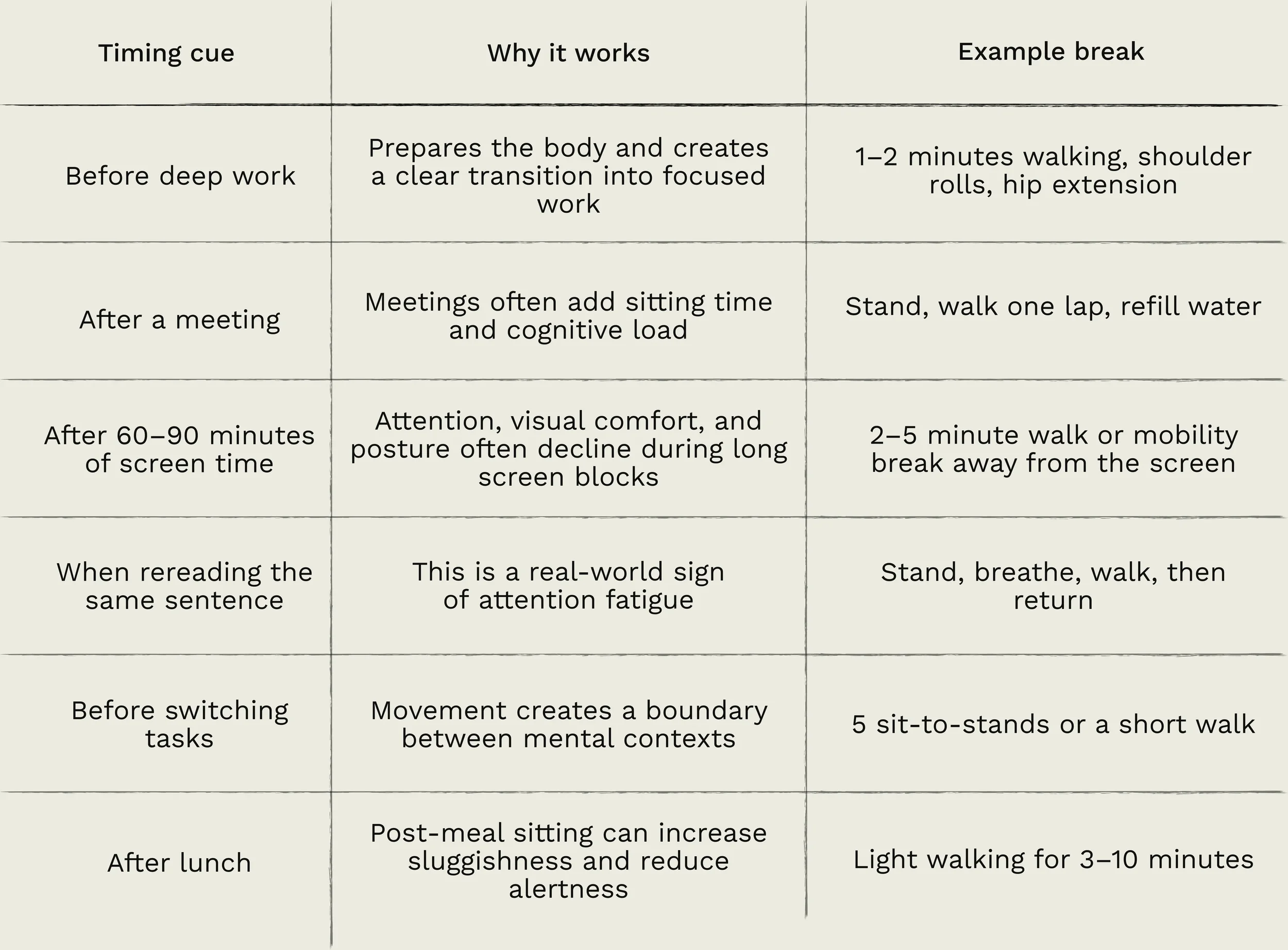
Movement breaks work best when they are tied to natural moments in the workday. Instead of waiting until your focus has completely faded, use movement as a reset before mental fatigue starts to build.
A good strategy is to stack movement onto existing cues: before deep work, after meetings, before switching tasks, after lunch, or whenever you notice yourself rereading the same sentence without absorbing it.
This approach is supported by both sedentary-behavior research and habit-formation science. Studies on prolonged sitting often test breaks every 30–60 minutes, because long uninterrupted sitting is the pattern researchers are trying to interrupt. Habit-formation research also shows that behaviors are more likely to stick when they are attached to stable cues in your environment or daily routine.
In other words, the best movement break is not only the one that works physiologically, it is the one you remember to do.
Practical recommendation
For most desk workers, aim to take a short movement break every 30–60 minutes, or at least after every major work block.
If that feels unrealistic, use 60–90 minutes as the upper limit for sustained desk work. Interestingly, this also aligns reasonably well with the natural fluctuations in alertness described by the basic rest-activity cycle (BRAC), although individual rhythms vary.
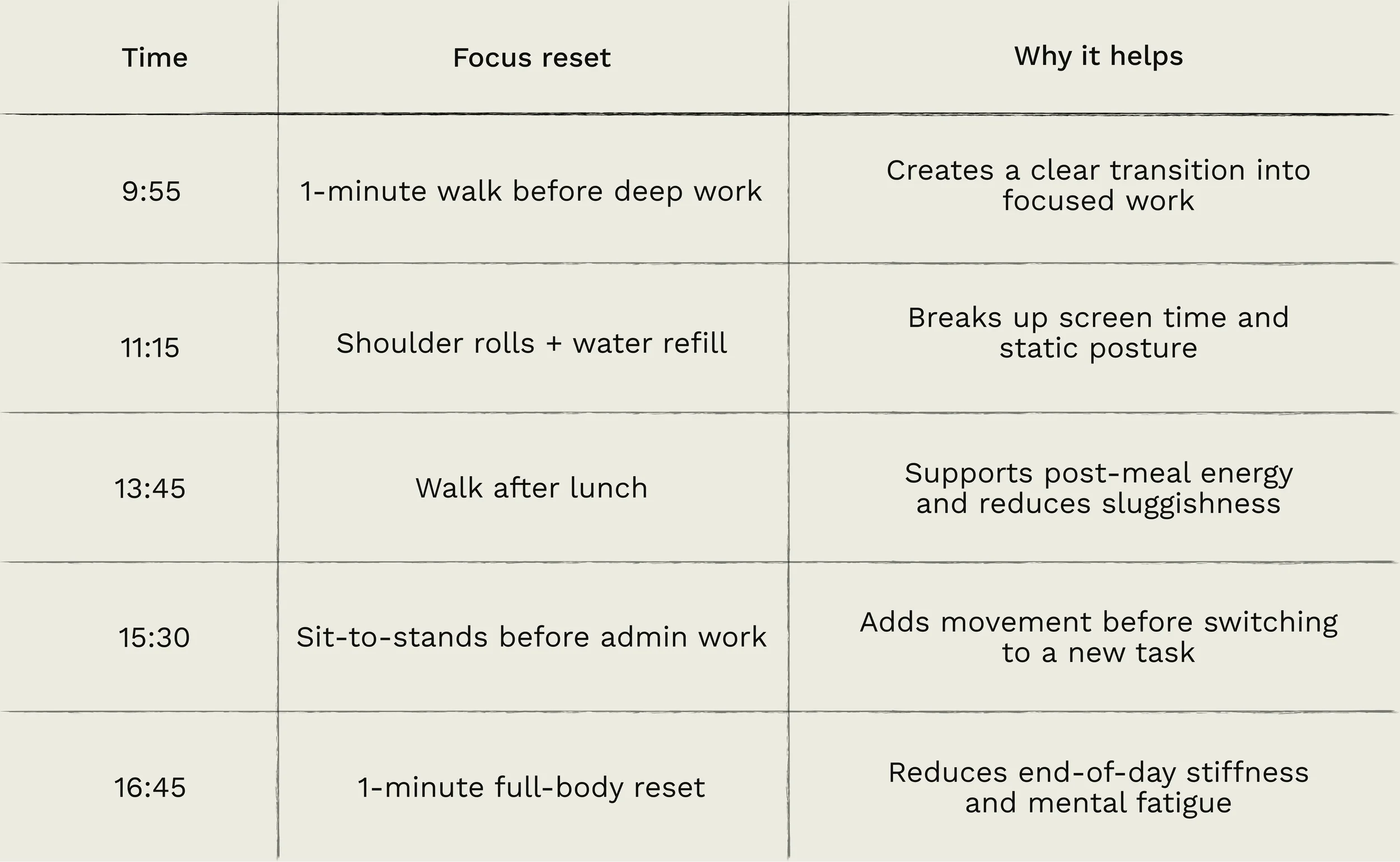
Example: a real workday reset schedule
This isn’t a schedule that everyone needs to follow. Think of it as an example of how movement breaks can fit naturally into a typical workday. Adjust the timing to match your own workload, meetings, and energy levels.
Common Mistakes
Waiting until you hit the afternoon wall
Don’t wait until your concentration has completely disappeared. Take a short movement break when you first notice your attention drifting or your posture becoming uncomfortable.Thinking the break has to be a workout
A movement break does not need to be intense.
Standing up, walking, stretching, performing shoulder rolls, or doing a few sit-to-stands is often enough to interrupt prolonged sitting and reset your attention.Only using coffee as a reset
Coffee can improve alertness, but it does not replace movement.
If you’re making a coffee anyway, turn it into a movement break by walking to the kitchen, stretching while the kettle boils, or taking a short walk before returning to your desk.Scrolling and calling it a break
Replacing your computer screen with your phone does not always give your brain a chance to recover.
Whenever possible, step away from the screen entirely. A short walk or a few mobility exercises often provide a more effective reset than a few minutes of social media.Making the break too complicated
Complex routines create unnecessary friction. They’re harder to remember and much less likely to become daily habits.
Choose one or two simple resets that fit naturally into your workday, for example, walking to refill your water bottle, doing five sit-to-stands, or spending one minute moving your neck, shoulders, spine, and hips.Sitting through the break
Even if you need a quiet moment, try to change your posture.
Standing up, walking, or simply looking away from the screen gives both your body and your eyes a chance to reset.Relying only on motivation
Motivation changes from day to day.
Instead, use habit stacking by attaching movement to existing routines:
After every meeting
Before deep work
After lunch
After a long phone call
FAQ
-
A practical target is every 30–60 minutes of sitting. The break does not need to be long. Even 1–3 minutes of standing, walking, stretching, or sit-to-stands can help interrupt prolonged sitting.
-
Research suggests they can. Studies have found that interrupting prolonged sitting may help support attention, reduce mental fatigue, and maintain cerebral blood flow during long periods of desk work. Results vary between studies, but movement breaks appear to create better physiological conditions for sustained focus.
-
Coffee can improve alertness, but it does not interrupt sitting. It does not change static posture, activate large muscles, or reduce long sedentary bouts. A better strategy is to pair coffee with movement: walk to get it, stand while drinking it, or do a 1-minute reset first.
-
Scrolling may feel like a break, but it often keeps the brain in a high-input state. It can add more information, novelty, and attention switching. For focus recovery, a screen-free movement break is usually a better reset.
-
The best movement break is one you can repeat. Good options include a short walk, water refill, 5–10 sit-to-stands, shoulder rolls, trunk rotations, heel raises, or a 1-minute full-body mobility reset.
-
Yes. A short movement break before deep work can create a clear transition into a period of focused work. It also helps interrupt sitting before a long concentration block begins, making it easier to maintain attention over time.
-
You can still move. Try seated ankle pumps, shoulder rolls, neck rotations, seated trunk rotations, glute squeezes, or simply stand beside your chair for 30–60 seconds. Even small posture changes are better than remaining completely still.
Looking for a complete desk routine? See our guide: “Exercises for Sitting All Day: The Complete Guide for Desk Workers.”
-
No. Movement breaks and exercise solve different problems. Exercise improves fitness and long-term health, while movement breaks interrupt prolonged sitting during the workday. Ideally, use both.
-
If you notice yourself rereading the same sentence, losing your train of thought, or feeling mentally sluggish, it is often a good time to stand up and move for a minute or two. You do not need to wait until you feel completely exhausted. Early movement breaks are generally easier to build into your routine and may help restore attention before fatigue becomes overwhelming.
Want your focus resets planned for you?
Exercise Snacks gives you a structured system of 1-minute movement breaks, with weekly PDFs and calendar prompts to help you move more consistently during the workday.
References:
Monika Wiłkość-Dębczyńska., (2023): Time of day and chronotype in the assessment of cognitive functions.
Prabha Siddarth., (2018): Sedentary behavior associated with reduced medial temporal lobe thickness in middle-aged and older adults.
Bojsen-Møller., (2019): Relationships between physical activity, sedentary behaviour and cognitive functions in office workers.
Baker, B. D., (2024): Prolonged sitting reduces cerebral oxygenation in physically active young adults.
Read more posts: