Long-term benefits of movement breaks for desk workers

“If you take five 1-minute movement breaks during each workday, you accumulate more than 20 hours of additional movement over the course of a year.”
Most tiny actions we perform during the day feel too small to matter, right?
Standing up for a minute, walking to refill a water bottle, performing a few squats, or stretching your shoulders hardly seems like enough activity to change your health.
Yet many of the biggest outcomes in life do not come from a single action or one productive week.
Think about earning a university degree. The result doesn’t come from attending one lecture or reading one chapter. It emerges from hundreds of small actions: studying, reading, writing, practicing, and remembering - repeated consistently over months and years.
If you take five 1-minute movement breaks during each workday, you accumulate more than 20 hours of additional movement over the course of a year. Over a decade, that becomes hundreds of hours spent walking, stretching, mobilizing joints, and interrupting prolonged sitting.
In finance, this idea is called compound interest. In physiology, a similar principle applies: small actions accumulate.
The value of a movement break is not in the individual minute. It is in what happens when that 1 minute is repeated thousands of times.
This article explores what research says about the long-term benefits of regularly interrupting sitting and why small movement habits may produce effects far beyond their size.
For a practical system, see our guide: “Movement breaks at work: a 1-minute system for desk workers.”
3 ways movement breaks may support long-term health
Can a few minutes of movement really make a difference? The answer depends on what outcome you’re measuring.
Movement breaks are not designed to maximize strength, muscle growth, or cardiovascular fitness in the same way a structured gym exercise program does. Their role is different.
Instead, this approach works by repeatedly interrupting long periods of muscle inactivity and creating small physiological responses across multiple body systems. Over time, these responses may accumulate and contribute to meaningful health benefits.
Many of the long-term benefits discussed in this article begin with measurable short-term changes in the body. When these changes are repeated day after day, they may contribute to meaningful improvements in health, comfort, and workplace well-being.
They may support metabolic health markers
One reason researchers are interested in movement breaks is their effect on post-meal metabolism.
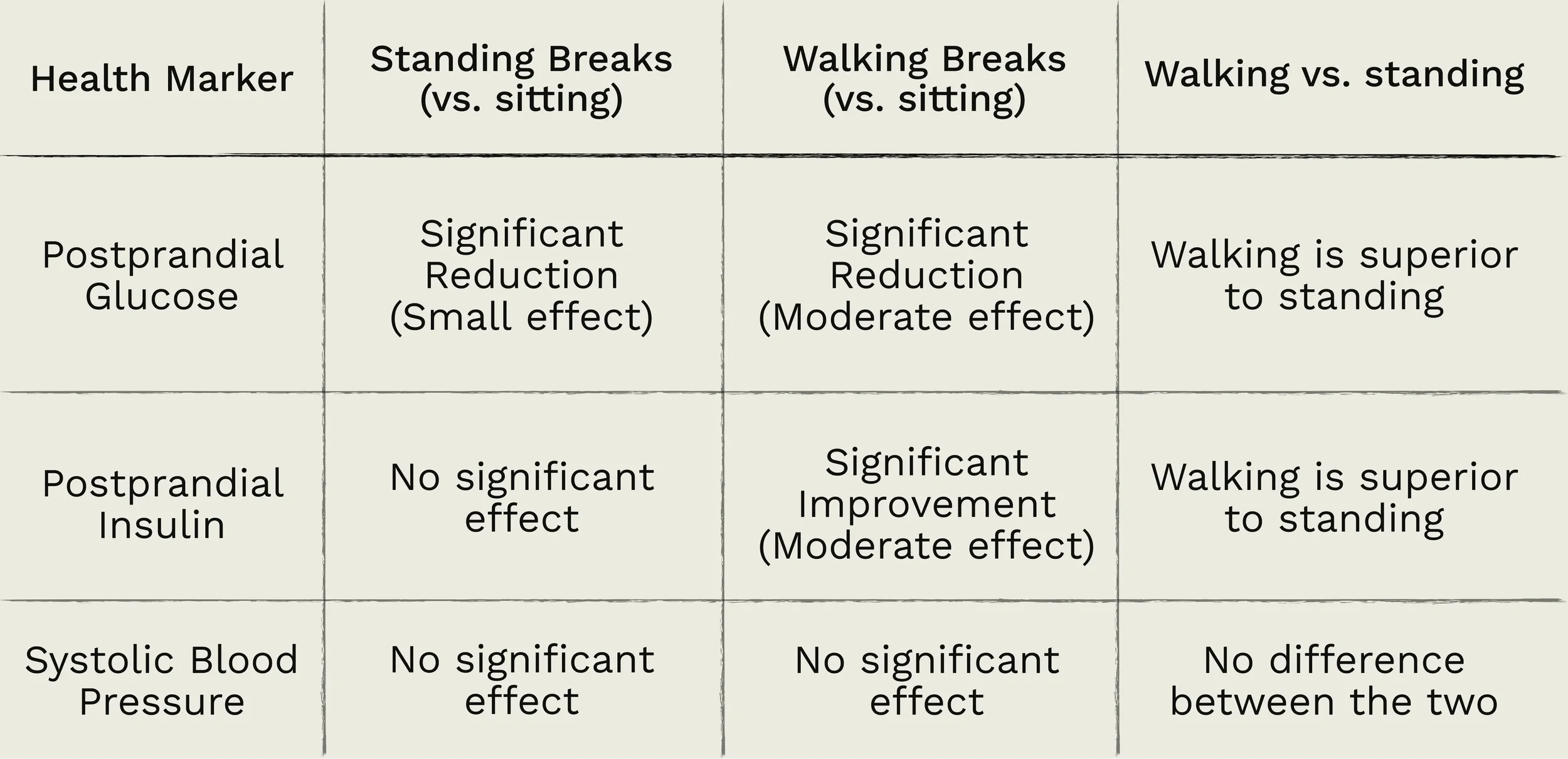
A 2022 meta-analysis compared standing and walking with uninterrupted sitting and examined several markers of metabolic health. The table below summarizes the main findings.
Blood sugar management
Postprandial glucose refers to blood sugar levels after eating.
The review found that both standing and walking breaks improved blood sugar responses compared with continuous sitting. However, walking was consistently more effective. No surprise here.
Light walking produced approximately twice the improvement observed with standing, suggesting that even modest muscle activity can help the body manage glucose (sugar) more efficiently.
Insulin response
Insulin helps move glucose from the bloodstream into tissues where it can be used or stored.
Standing showed little effect on insulin levels, while walking produced moderate improvements. Researchers believe this occurs because repeated contractions of the leg muscles increase glucose uptake and improve insulin sensitivity (and you want this).
Cardiovascular health and other metabolic markers
Short-term changes in blood pressure were generally small, although some studies reported improvements in vascular function when standing breaks were performed regularly throughout the day.
The review also found limited immediate effects on cholesterol and triglycerides, which is not surprising because these markers often require longer periods of physical activity and observation to change.
What does this mean long term?
A single 2-minute walk will not transform metabolic health.
However, if movement breaks repeatedly improve glucose and insulin responses throughout the day, the cumulative effect may help support healthier metabolic function over time.
This is one reason researchers encourage breaking up inactivity rather than remaining sedentary for hours at a time.
Practical takeaway:
Walking appears more effective than standing breaks.
Standing is still preferable to uninterrupted sitting.
Many successful studies used protocols lasting only 2–5 minutes every 20–30 minutes.
They reduce continuous static loading
Static loading occurs whenever you hold the same posture for a prolonged period. Common examples include sitting at a desk, leaning toward a laptop screen, or keeping the arms in a fixed typing position.
Although these postures may feel relatively effortless, they place a low but sustained load on muscles, tendons, ligaments, joints, and connective tissues. Over time, this continuous stress can contribute to discomfort and musculoskeletal disorders (MSDs).
If you work from home, you may also find our guide helpful: “Home office ergonomics: how your setup affects your body”.
Recent research suggests that the cumulative effect of static loading is an important risk factor for pain and injury:
For every one-point increase in a person’s postural load score (measured using the Rapid Upper Limb Assessment, or RULA), the risk of developing lower-back MSDs increased by 1.49 times.
Individuals classified in high postural-load categories were 4.27 times more likely to experience lower-back problems than those with lower postural loads.
Prolonged static loading may alter how muscles respond to mechanical stress, eventually causing tissue demands to exceed the body’s ability to recover.
Researchers also observed greater pain sensitivity among people exposed to higher postural loads, potentially due to increased levels of inflammatory mediators.
Why does this matter?
Unlike a gym or Pilates workout, which applies stress for a limited period and is followed by recovery, desk work often exposes the body to low-level loading for hours at a time.
Movement breaks help interrupt this process.
Standing up, walking, stretching, or simply changing posture temporarily reduces the mechanical demands placed on the same tissues and introduces movement variability into the system.
The body generally tolerates changing loads better than constant loads.
Breaking stillness may support energy and mood
One reason movement breaks are easier to maintain than traditional exercise is that they often feel good immediately.
Research involving university employees found that brief 3-minute sedentary breaks improved both mood and perceived energy levels without disrupting work or requiring intense physical effort.
Specifically, participants reported:
Higher levels of positive mood (valence)
Greater energetic arousal (feeling more awake and energized)
Reduced feelings of prolonged stillness and mental fatigue.
Interestingly, the study did not find a significant immediate improvement in working memory. However, it also found no evidence that taking a short movement break impaired cognitive performance.
This is an important finding for desk workers.
Many people avoid taking movement breaks because they worry that stepping away from work will interrupt concentration or reduce productivity.
The evidence suggests the opposite may be true: brief movement breaks can provide a small mental reset without making it harder to return to focused work.
Researchers have also linked regular movement to lower occupational fatigue and higher levels of perceived mental energy.
Movement breaks vs. exercise: why you need both
One of the most common questions about movement if they can replace traditional exercise.
The short answer is no.
Movement breaks and exercise serve different purposes, and the research suggests that combining them is more effective than relying on either strategy alone.
Exercise is primarily used to improve fitness, strength, endurance, and cardiovascular capacity. Movement breaks, on the other hand, are designed to reduce prolonged sedentary time and reintroduce activity throughout the day.
In other words:
Exercise helps you get fitter.
Movement breaks help you sit less.
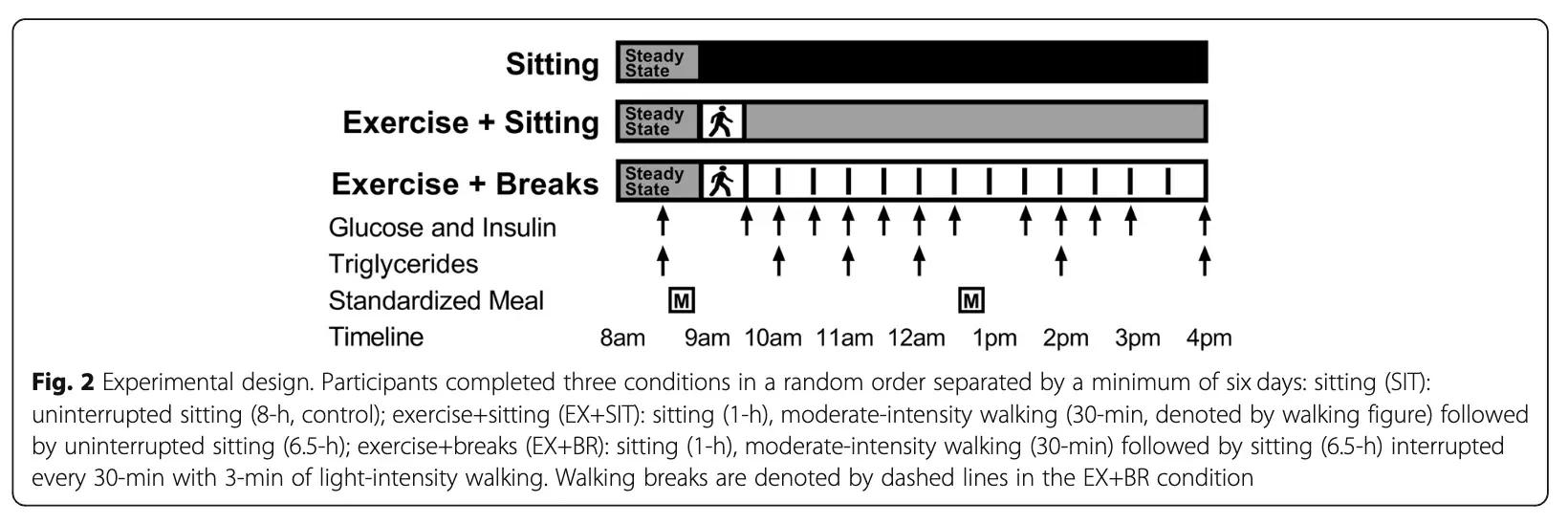
Research suggests these strategies may work synergistically. One study found that combining a daily exercise session with frequent walking breaks throughout the day produced better metabolic outcomes than exercise alone.
Key findings included:
A 30-minute morning walk reduced daily insulin levels by approximately 18% compared with sitting all day.
When that same exercise session was combined with 3-minute walking breaks every 30 minutes, insulin levels were reduced by approximately 25%.
Continuous exercise followed by 6.5 hours of uninterrupted sitting did not significantly reduce triglyceride levels compared with sitting all day.
However, when exercise was combined with regular movement breaks, triglyceride levels decreased by approximately 6%.
Researchers believe this additional benefit occurs because repeated bouts of movement continue to activate the leg muscles throughout the day, helping them act as a metabolic “sink” that uses circulating glucose and fatty acids.
The combination appears to be particularly beneficial for individuals with higher levels of insulin resistance, including many overweight and obese adults.
How often should you take movement breaks for long-term results?
A reasonable question is whether movement breaks are sustainable over the long term.
The answer appears to be yes.
Evidence from a one-year workplace study involving Japanese office workers suggests that incorporating short activity breaks into the workday is both practical and sustainable in real-world settings.
Interestingly, adherence improved rather than declined over time:
At the start of the study, 62.1% of workers reported participating “almost always.”
After 12 months, that figure increased to 66.9%.
Participants reduced their sedentary time during work hours by an average of 24.4 minutes per day.
Daily work-time step counts increased by an average of 1,171 steps compared with the control group.
These findings suggest that it can become a lasting habit rather than a short-lived workplace initiative.
After reviewing numerous studies on sedentary behavior and workplace movement, a fairly consistent pattern emerges:
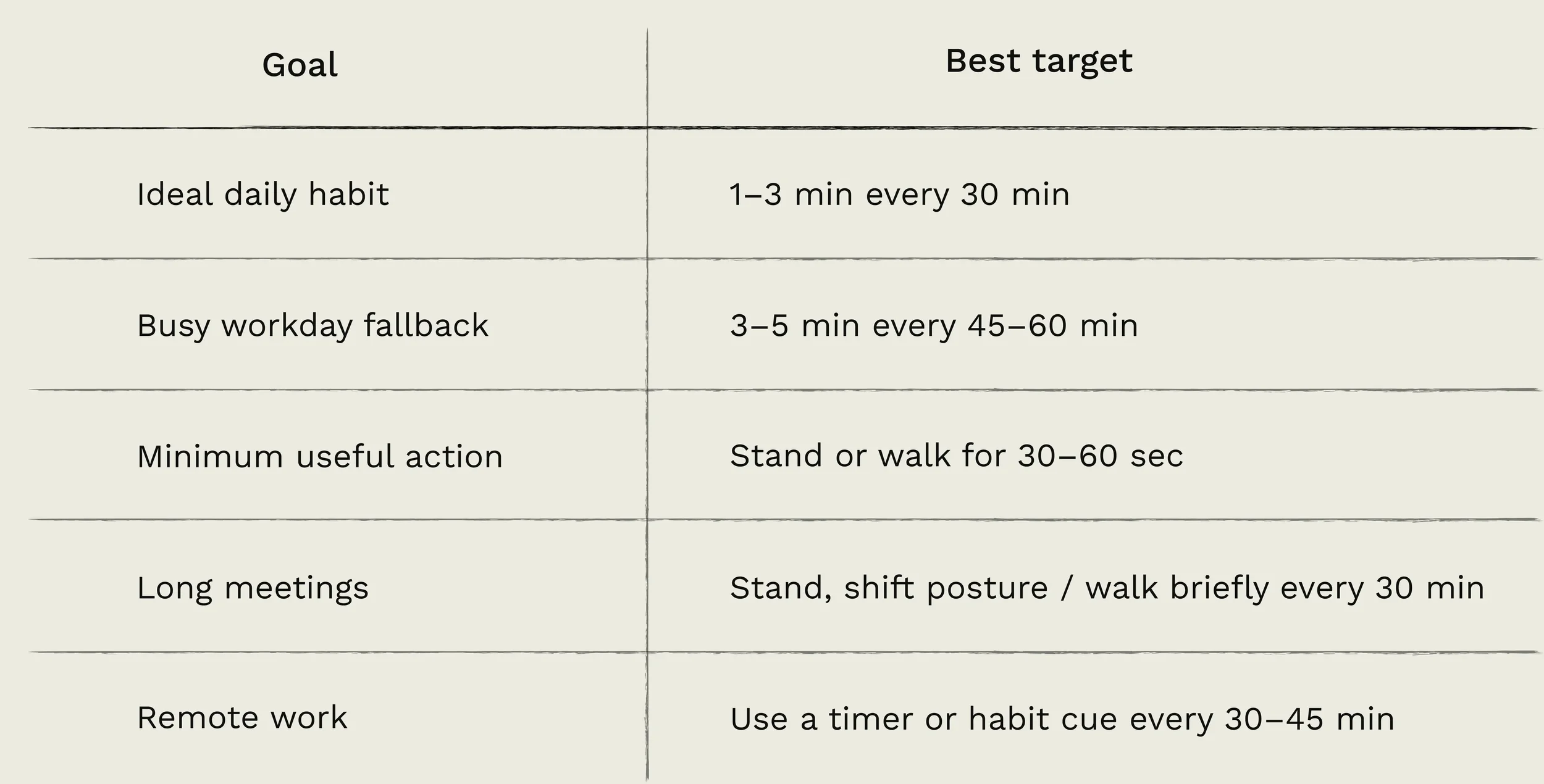
The evidence suggests that a short movement break approximately every 30 minutes is a reasonable target for most desk workers.
The break does not need to be long or intense. Standing, walking, stretching, or performing a few mobility exercises for 1–3 minutes is often enough to interrupt prolonged sitting.
If moving every 30 minutes feels unrealistic, a practical fallback is 3–5 minutes every 45–60 minutes.
For long-term success, consistency matters more than intensity. The best movement break is the one you can repeat every workday.
Examples of movement breaks you can repeat daily
Movement breaks do not need to look like workouts.
They can be as simple as standing up, walking to refill a water bottle, stretching a tight area, or performing a few bodyweight movements between tasks. The goal is to interrupt sitting, change posture, activate muscles, and add movement variety throughout the day.
The list below shows examples that can be performed in most home-office and workplace environments:
Stand up from your chair
Walk around the room/office
Walk to refill your water
Walk to the bathroom using a longer route
Walk during a phone call
Take one lap around the office or home
Walk to a coworker instead of messaging
Walk to the printer or another room
Do 5–10 sit-to-stands
Stand and shift weight side to side
March gently in place
Do 10 heel raises
Do ankle circles
Do ankle pumps under the desk
Stretch the calves against a wall
Do standing hip extensions
Do a standing hip-flexor stretch
Squeeze the glutes for 5–10 reps
Do gentle side steps
Do a few bodyweight mini-squats
Rotate your neck left and right (see ROM exercises)
Tilt your head gently side to side
Do shoulder rolls
Do shoulder blade squeezes
Reach both arms overhead
Open the chest by clasping hands behind the back
Do wrist circles
Stretch the forearms
Open and close the hands/fingers
Do seated or standing trunk rotations
Do side bendsExtend your upper back over the chair
Stand and gently arch backward
Do a seated cat-cow movement
Step one foot back and lengthen the front of the hip
Walk up and down one flight of stairs
Stand during the first minute of a meeting
Do a 60-second reset: neck, shoulders, spine, hips
Put your water, phone, or notebook away from your desk
Finish every long work block with one minute of light movement
Taking the stairs instead of the elevator
Move or carry light objects around the office
The specific exercise matters less than the habit. The best option is usually the one that fits naturally into your workday and can be repeated consistently over time.
For a practical structural movement system, see our guide: “Exercises for sitting all day: the complete guide for desk workers”.
Common mistakes
Waiting until you feel stiff
Many people treat movement breaks as a reaction to discomfort rather than a preventive habit.The problem is that stiffness, fatigue, or soreness often appears after you have already spent hours in the same position.
It works best when they are scheduled throughout the day rather than used only when discomfort appears.
Trying to make every break a workout
Some people start with ambitious plans: burpees every hour, long exercise routines between meetings, or intense circuits—and quickly abandon them when work becomes busy.
Remember, the goal is not to maximize effort. The goal is to interrupt prolonged sitting and create a habit that can be repeated consistently.
Relying on motivation instead of cues
Motivation fluctuates.
If movement depends on remembering them or feeling inspired, they are easy to skip during busy periods. Instead, attach it to existing behaviors:
After a meeting.
After a phone call.
After refilling a water bottle.
Every 30 minutes on a timer.
Simple cues often outperform willpower.
Thinking exercise cancels out sitting
Your morning gym session is beneficial, but it does not eliminate the effects of sitting for the next eight hours.
Research suggests that prolonged sedentary time and insufficient physical activity are related but distinct behaviors.
The most effective strategy is to combine regular exercise with breaks throughout the day.
Doing the same movement every time
Standing up is a good start, but the body benefits from variety.
Walking, stretching, rotating the spine, mobilizing the hips, climbing stairs, and changing posture expose different muscles and joints to different demands.
Over time, variety helps reduce the amount of continuous stress placed on the same tissues.
FAQ
-
A single 1-minute break is unlikely to produce a dramatic change on its own. The benefit comes from repetition. Five 1-minute movement breaks per workday can add up to more than 20 hours of additional movement per year. Research suggests that regularly interrupting prolonged sitting may support metabolic health, reduce static loading, and help build sustainable movement habits.
-
Some effects can occur immediately. Studies have shown improvements in blood sugar responses, mood, and perceived energy after a single day of using movement breaks. Other benefits, such as reducing sedentary time, building movement habits, and improving workplace comfort, are more likely to develop over weeks and months of consistent practice.
-
They may help reduce the continuous static loading associated with prolonged sitting, which is a known risk factor for musculoskeletal discomfort. However, pain is complex and can have many causes. Movement breaks should be viewed as one part of a broader strategy that may also include ergonomics, strength training, regular exercise, and professional assessment when needed.
-
Not necessarily. The goal is not to follow a rigid rule but to reduce long periods of uninterrupted sitting. Research often uses 30-minute intervals because they are practical and easy to remember. Over time, many people naturally develop movement habits that fit their day, whether through walking breaks, standing meetings, hydration routines, or the MicroDosing Training approach.
-
Yes. Research suggests that regular exercise and movement breaks provide different benefits. Exercise improves fitness, strength, and cardiovascular capacity, while movement breaks help reduce prolonged sedentary time. Studies have shown that combining exercise with frequent activity breaks may produce better metabolic outcomes than exercise alone.
-
Not necessarily. Standing desks can reduce sitting time, but standing itself is still a relatively static posture. Research generally shows that walking, mobility exercises, and other forms of light activity provide greater physiological benefits than simply standing in one place. Many experts recommend combining standing with regular movement throughout the day.
Turn 1 minute a day into a lasting habit
The Exercise Snacks plan gives you a structured system — 1-minute exercises, weekly PDFs, and calendar reminders so the habit actually sticks.
References:
Aidan J. Buffey., (2022): The Acute Effects of Interrupting Prolonged Sitting Time in Adults with Standing and Light-Intensity Walking on Biomarkers of Cardiometabolic Health in Adults: A Systematic Review and Meta-analysis
Yidan Dong., (2022): Association between long-term static postures exposure and musculoskeletal disorders among university employees: A viewpoint of inflammatory pathways.
Giurgiu., (2024): Causal effects of sedentary breaks on affective and cognitive parameters in daily life: A within-person encouragement design.
Read more posts: