Range of motion exercises for sitting all day: a 1-minute desk routine
“The problem begins when movement variety disappears.”
The human body is designed to move. Our muscles, nervous system, and skeleton work together to produce movement, giving us the freedom to perform everything from simple daily tasks, such as drinking a morning cup of coffee, to complex athletic activities.
In biomechanics, movements are commonly categorized by how they change the angle of a joint or the direction of a body segment. Examples include flexion and extension, abduction and adduction, rotation, circumduction, and pronation and supination.
We can also think about movement through fundamental movement patterns such as the squat, hinge, push, pull, rotation, plank, and gait
The problem begins when movement variety disappears.
When we spend long periods in a static position, especially sitting, the body receives less movement input and gradually adapts to that environment. Muscles remain inactive, joints move through fewer ranges, and posture becomes increasingly repetitive.
Six hours of computer work is a long time to remain in essentially the same position. Research suggests that prolonged sitting may reduce movement variety and contribute to stiffness across multiple regions of the body, not just the hips.
The good news is that restoring movement does not require a full gym workout. Sometimes, a simple 1-minute movement break is enough to expose the body to different joint positions, encourage circulation, and reintroduce movement variety throughout the day.
What is range of motion, and why does sitting reduce it?
In simple terms, range of motion (ROM) refers to the amount of movement available at a joint.
ROM can be measured in two ways:
Passive ROM – when a joint is moved by an external force, such as a physical therapist, trainer, or gravity.
Active ROM – when you move the joint yourself by contracting your muscles.
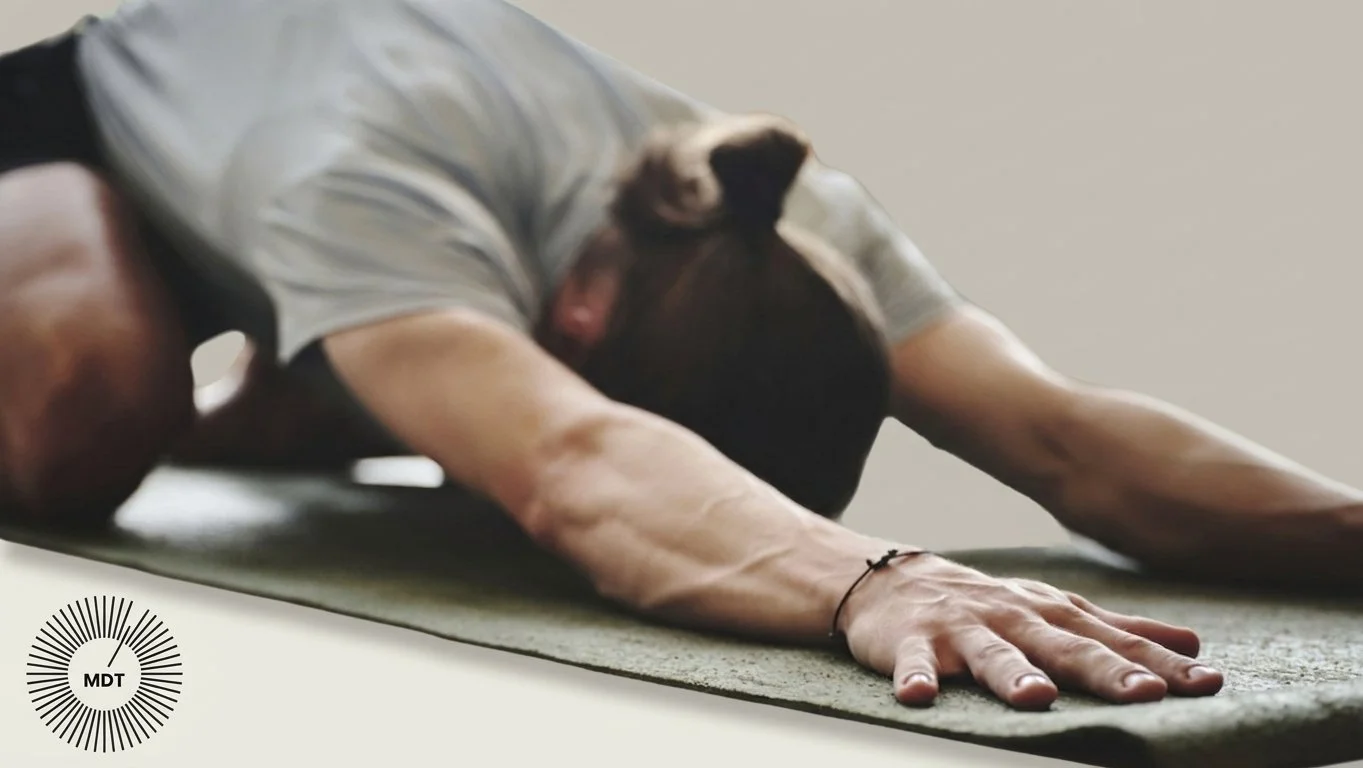
Pic 1. (generated with Gemini)
Hip extension ROM
Boukabache et al. (2021) found that prolonged sitting and physical inactivity were associated with reduced passive hip extension, suggesting that people who sit for long periods may gradually lose access to part of their hip extension range of motion (1).
Thoracic spine mobility
Heneghan et al. (2018) examined the relationship between prolonged sitting, physical activity, and thoracic spine mobility. Their findings support the idea that long periods of sitting may influence upper-back mobility (2).
Lumbar spine ROM after prolonged sitting
Phimphasak et al. (2015) found that prolonged sitting and seated lumbar postures affected spinal height and lumbar range of motion, suggesting that sitting posture can influence lower-back mobility measures (3).
Shoulder ROM in sitting posture
Bullock et al. (2004) reported that slouched sitting reduced shoulder range of motion and increased symptoms in people with shoulder impingement, suggesting that seated posture can directly influence shoulder movement (4).
Similarly, Kanlayanaphotporn et al. (2014) found that changes in sitting posture affected shoulder range of motion, highlighting the close relationship between thoracic posture and shoulder mobility (5).
Neck ROM
Kuligowski et al. (2024) found that cervical and thoracic range of motion was associated with neck pain severity in young white-collar workers, suggesting that neck and upper-back mobility may be important targets for desk workers (6).
Together, these findings suggest that prolonged sitting may influence mobility across multiple regions of the body. For this reason, an effective desk routine should include movement for the hips, spine, shoulders, and neck, rather than focusing solely on achieving “perfect posture.”
A quick range of motion check you can try at your desk
We do not always need a formal flexibility assessment to notice where sitting has made us feel restricted. A simple desk check can help identify whether the neck, shoulders, upper back, lower back, or hips feel stiff after long periods of sitting.
This is not a diagnosis. It is a quick self-assessment designed to increase awareness. Compare the left and right sides, notice whether movement feels smooth, and use any discomfort or restriction as a cue to move more often.
Neck rotation
Sit tall and slowly turn your head to the right, then to the left.
Ask: Can you turn comfortably in both directions, or does one side feel tighter?
Shoulder reach
Reach both arms overhead. Then place one hand behind your head and the other behind your back. Switch sides.
Ask: Does one shoulder feel more restricted, pinchy, or difficult to move?
Upper-back rotation
Sit tall, cross your arms over your chest, and gently rotate your upper body to the right and left while keeping your hips still.
Ask: Can you rotate comfortably and evenly in both directions?
Low-back extension
Stand up, place your hands on your hips, and gently lean backward a small amount.
Ask: Does your lower back feel stiff or restricted after sitting?
Hip extension
Stand beside your desk and lightly hold it for balance. Step one leg backward without arching your lower back, then squeeze the glute of the back leg. Switch sides.
Ask: Can you move the thigh behind your body without compensating through the lower back?
What to do next?
If one or more movements feel restricted, that does not necessarily indicate a problem. It simply suggests that those joints and muscles may benefit from more regular movement throughout the day.
The goal is not to achieve perfect mobility. The goal is to notice where your body feels stiff and use movement breaks to regularly explore those ranges of motion.
6 Range of Motion Exercises: build your own 1-minute routine
Range-of-motion exercises are a subcategory of flexibility training. Their goal is to move a joint through its available range and expose the body to different movement directions.
These exercises can be performed actively, using your own muscles, or passively, with assistance from another person, gravity, or an external object. For desk workers, active ROM exercises are usually the most practical because they require no equipment and can be performed almost anywhere.
The exercises below focus on the areas most commonly affected by prolonged sitting: the neck, shoulders, spine, and hips.
We suggest using the MicroDosing Training (MDT) approach:
Pick one exercise pair (block) and perform it for 60 seconds (30 seconds per exercise). Switch to another block later in the day. Aim for three 1-minute blocks throughout your workday.
Or combine all three blocks for a 3-minute desk mobility reset.
The goal is not to stretch as far as possible. The goal is to regularly expose your joints to different positions and maintain movement variety. This is where the concept of exercise snacks becomes useful: small doses of movement performed frequently rather than one large session.
Block 1: Spine and neck (60 sec)
Neck rotations and tilts (30 sec)
(a) Slowly turn your head right and left. Gently bring your ear toward your shoulder on each side.Seated spinal twist (30 sec)
(a) Cross your arms over your chest and rotate right and left.
(a+) Advanced option: place your hands behind your head and rotate right and left.
Block 2: Shoulders and upper body (60 sec)
Shoulder rolls and swings (30 sec)
(a) Roll your shoulders backward and forward in large controlled circles.
(b) Stand and swing your arms forward and backward.Standing cat-cow (30 sec)
(a) Stand tall with your hands on your thighs or hips. Gently round and extend your upper back in a controlled rhythm.
Block 3: Hips, ankles, and lower body (60 sec)
Standing leg circles with gluts activation (30 sec)
(a) Shift your weight onto one leg. Slowly draw small circles with the opposite leg. Squeeze the glute of the standing leg to maintain balance.Ankle circles and calf pumps (30 sec)
(a) Slowly rotate the ankles in both directions while standing. Rise onto your toes and lower under control.
Common mistakes to avoid
Moving too fast
ROM exercises are not meant to be rushed. Fast, uncontrolled movements often reduce the amount of movement occurring at the target joint. Move slowly and deliberately, paying attention to how each joint feels throughout the motion.Forcing the movement
The goal is to explore your available range of motion, not push beyond it. Stretching or rotating aggressively may cause discomfort and can lead to compensation from other joints. Mild tension is acceptable; pain is not.Only doing it once at the end of the day
One mobility session is better than none, but ROM work is most effective when distributed throughout the day. Short movement breaks help interrupt prolonged sitting and expose the body to more movement variety.Ignoring the upper body
Many desk workers focus on hips and legs while neglecting the neck, shoulders, and upper back. Prolonged computer work affects the entire body, so mobility routines should address multiple regions.Treating range-of-motion work as a replacement for all exercise
Think of ROM work as a supplement to movement, not a replacement for it. ROM help maintain mobility and reduce stiffness, but they are not a substitute for strength training, cardiovascular exercise, walking, or other forms of physical activity.
FAQ
-
Although the two terms are often used interchangeably, they are not exactly the same. Stretching primarily aims to lengthen muscles and improve flexibility, while range-of-motion (ROM) exercises focus on moving a joint through its available movement path. ROM exercises are often active, meaning you create the movement yourself. In practice, many desk-friendly mobility exercises combine elements of both stretching and ROM training.
-
They may help. Prolonged sitting reduces movement variety and keeps many joints in similar positions for hours at a time. ROM exercises encourage the neck, shoulders, spine, hips, and ankles to move through different ranges, which can help reduce the sensation of stiffness and make movement feel more comfortable. They are especially useful as short movement breaks during the workday.
-
The answer depends on the joint, your starting mobility, and how consistently you practice. Some people notice reduced stiffness immediately after a ROM session, while longer-term improvements in mobility may take several weeks of regular practice. In general, frequent short movement sessions performed throughout the week are more effective than occasional long sessions.
-
Yes. Many ROM exercises can be performed while seated, including neck rotations, shoulder rolls, arm swings, seated spinal twists, and upper-back mobility drills. However, standing movements allow you to include the hips, ankles, and lower body, which are often heavily affected by prolonged sitting. Ideally, use a combination of seated and standing exercises throughout the day.
-
Research suggests that prolonged sitting may influence mobility in several regions of the body, particularly the hips, thoracic spine, shoulders, neck, and ankles. Because sitting reduces movement variety, an effective desk routine should include exercises for multiple joints rather than focusing on a single area. If hip tightness is your primary concern, see our “Hip flexor stretches for sitting all day guide”. For a broader approach to desk-worker health, check out “Exercises for sitting all day: a complete guide for desk workers”.
-
No. The purpose of this routine is to increase movement variety throughout the day, not to complete a rigid workout. You can choose the block that targets the area that feels most restricted and rotate between neck, shoulder, spine, hip, and ankle exercises as needed.
Range-of-motion exercises work best when combined with regular movement throughout the day.
The MicroDosing Training program gives you a structured 30-day routine 1-minute sessions, 5 times a day, helping you break up sitting time.
References:
Boukabache et al., (2021): Prolonged sitting and physical inactivity are associated with limited hip extension: A cross-sectional study.
Heneghan, et al., (2018): What is the effect of prolonged sitting and physical activity on thoracic spine mobility? An observational study of young adults in a UK university setting.
Phimphasak, et al., (2015): Effects of seated lumbar extension postures on spinal height and lumbar range of motion during prolonged sitting.
Bullock, et al., (2004): Shoulder impingement: The effect of sitting posture on shoulder pain and range of motion.
Kanlayanaphotporn, R. et al., (2014). Changes in sitting posture affect shoulder range of motion.
Kuligowski, et al., (2024): Influence of sagittal cervical and thoracic range of motion on neck pain severity in young white-collar workers: A cross-sectional study.
Read more posts: