Mental fatigue at work: how movement breaks can help you reset

“Mental fatigue can build quietly, even while you are still performing well.”
To understand mental fatigue, it helps to compare it with physical work. Imagine you are moving house. None of the boxes is especially heavy, and at first the work feels easy. But after several hours of lifting, carrying, and unpacking, your body begins to respond differently. Your muscles tire, the work slows down, and even a light box feels heavier than it did at the start.
Mental fatigue develops in a similar way.
Your brain has not simply “run out of energy,” but the same cognitive work begins to feel more demanding. Decisions take longer. Simple tasks feel heavier. Maintaining attention requires more control.
A useful way to think about it is: your brain becomes less efficient and less willing to sustain the same level of effort.
This is why you can feel mentally drained by 3 p.m., even after a productive morning. You may still be able to concentrate. The difference is that concentration now costs more.
Mental fatigue can build quietly, even while you are still performing well. The problem is not always that you have lost focus. Sometimes, you have been focused for too long without enough recovery.
In this post, we will look at what mental fatigue is, why it develops during the day and how short movement breaks may help you reset before exhaustion takes over.
If you're new to the concept, our guide to movement breaks at work: a 1-minute system for desk workers covers the full framework this post builds on.
What is mental fatigue?
Researchers describe mental fatigue as a psychobiological state, meaning it affects both how you feel and how you perform. You may feel tired, sleepy, low in energy, or less motivated. At the same time, your thinking may become slower, less accurate, and harder to sustain.
It can also be understood as a change in wakefulness. Rather than switching suddenly from alert to exhausted, you gradually move along a spectrum toward lower arousal and a greater need for recovery.
This state can develop during tasks that require sustained mental effort, including:
focused attention;
problem-solving;
complex decision-making;
monitoring information;
and working without enough breaks.
Some studies have found signs of declining performance after around 30 minutes of continuous cognitive work. That does not mean everyone becomes exhausted after exactly half an hour at a computer. The timing depends on the difficulty of the task, sleep quality, stress, motivation, and the working environment.
It does suggest, however, that the process may begin earlier than many people realise. One area commonly affected is executive function: the set of mental skills used to plan, make decisions, switch between tasks, and maintain attention.
Mental fatigue may also weaken what researchers call top-down control. This is the brain’s ability to use goals, expectations, and context to guide what you notice and how you respond.
For example, when you read a sentence containing a small typo, your brain can usually identify the intended word without much effort. As fatigue builds, this kind of control becomes less reliable. It may become harder to ignore distractions, follow a plan, or recognise which information matters most.
Incoming signals can also be processed less effectively. Sounds, warnings, visual changes, or details on a screen may take longer to register. This is especially important in work that involves driving, operating equipment, monitoring systems, or making repeated decisions. Even small declines in attention and reaction time can increase the likelihood of errors.
Why does mental fatigue happen?
Think of mental fatigue as the brain’s “low battery” warning: a biological signal that continued effort is becoming harder to sustain. Several processes may contribute to that warning.
The brain’s chemical “brake”
As the brain remains active for long periods, a chemical called adenosine begins to accumulate.
Adenosine acts like a natural brake. It reduces alertness, increases sleepiness, and encourages the body to rest. It also interacts with dopamine, a neurotransmitter involved in motivation, reward, and the sense that effort is worthwhile.
As this balance changes, the drive to continue can weaken. Work that felt manageable earlier may start to feel less rewarding and more difficult to begin. This helps explain why motivation often drops before you are physically exhausted.
Changes in energy availability
Some researchers have also linked mental fatigue with changes in phosphocreatine, a rapidly available energy source used by brain cells.
The brain makes up only around 2% of body weight but uses approximately 20% of the body’s energy. Because neurons cannot store large reserves, they depend on a continuous energy supply and use phosphocreatine to meet short-term increases in demand.
If this readily available supply becomes reduced during sustained mental work, the brain may need to operate less efficiently. This does not mean it has completely run out of fuel. It means maintaining the same level of performance may require more resources than before.
Changes in brain activity
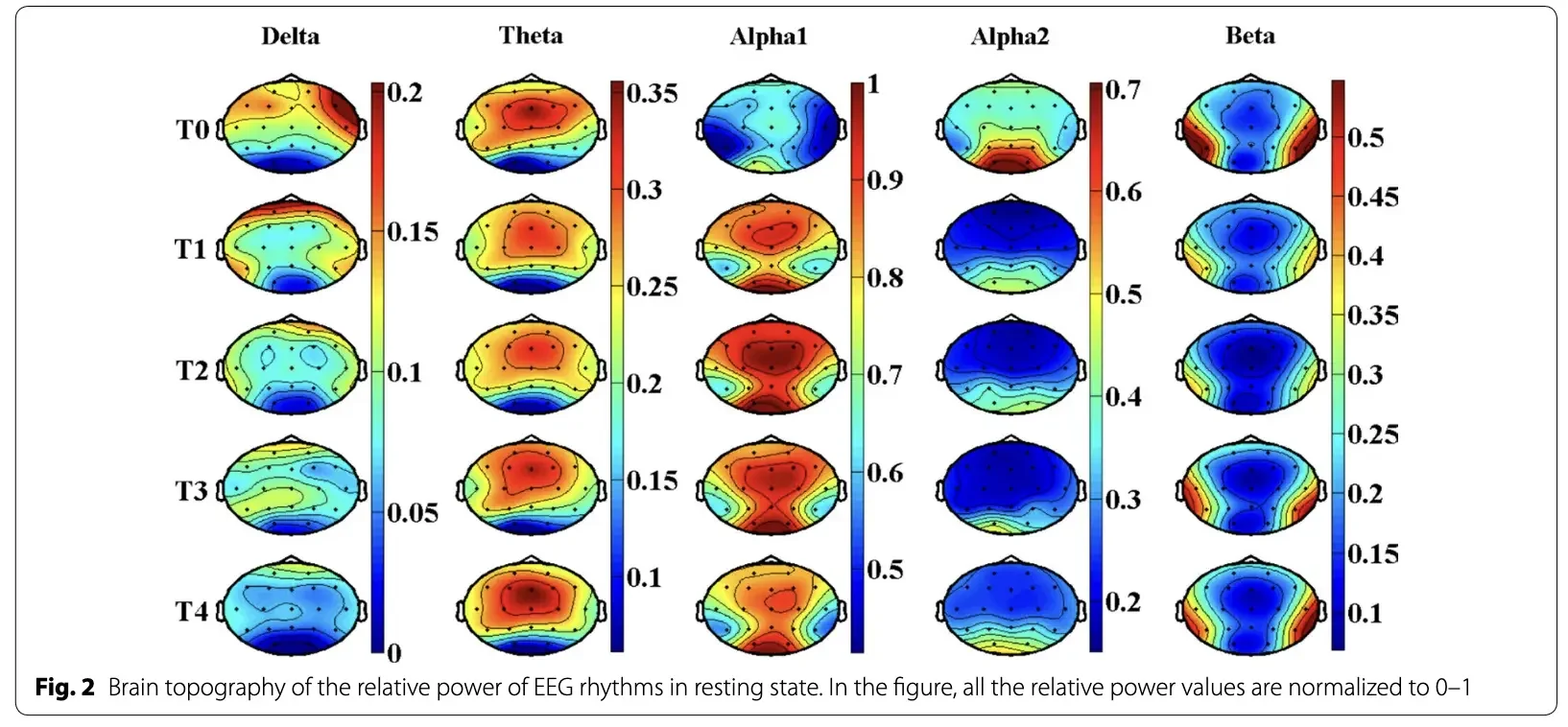
Mental fatigue can also be observed in the brain’s electrical activity.
Researchers measure this using electroencephalography, or EEG. Although the patterns vary between people and are not unique to fatigue, two changes appear regularly in studies.
One is an increase in theta-wave activity, measured between 4 and 8 Hz, particularly in frontal areas of the brain. Higher frontal theta activity is often associated with greater cognitive demand and the increasing difficulty of maintaining attention.
Researchers also commonly observe changes in alpha-wave activity, measured between 8 and 13 Hz. Alpha activity is thought to reflect the suppression of irrelevant information. As mental demands continue, the brain may rely more heavily on this filtering process to protect attention from distractions.
Example of a resting state
Example after prolonged mental effort
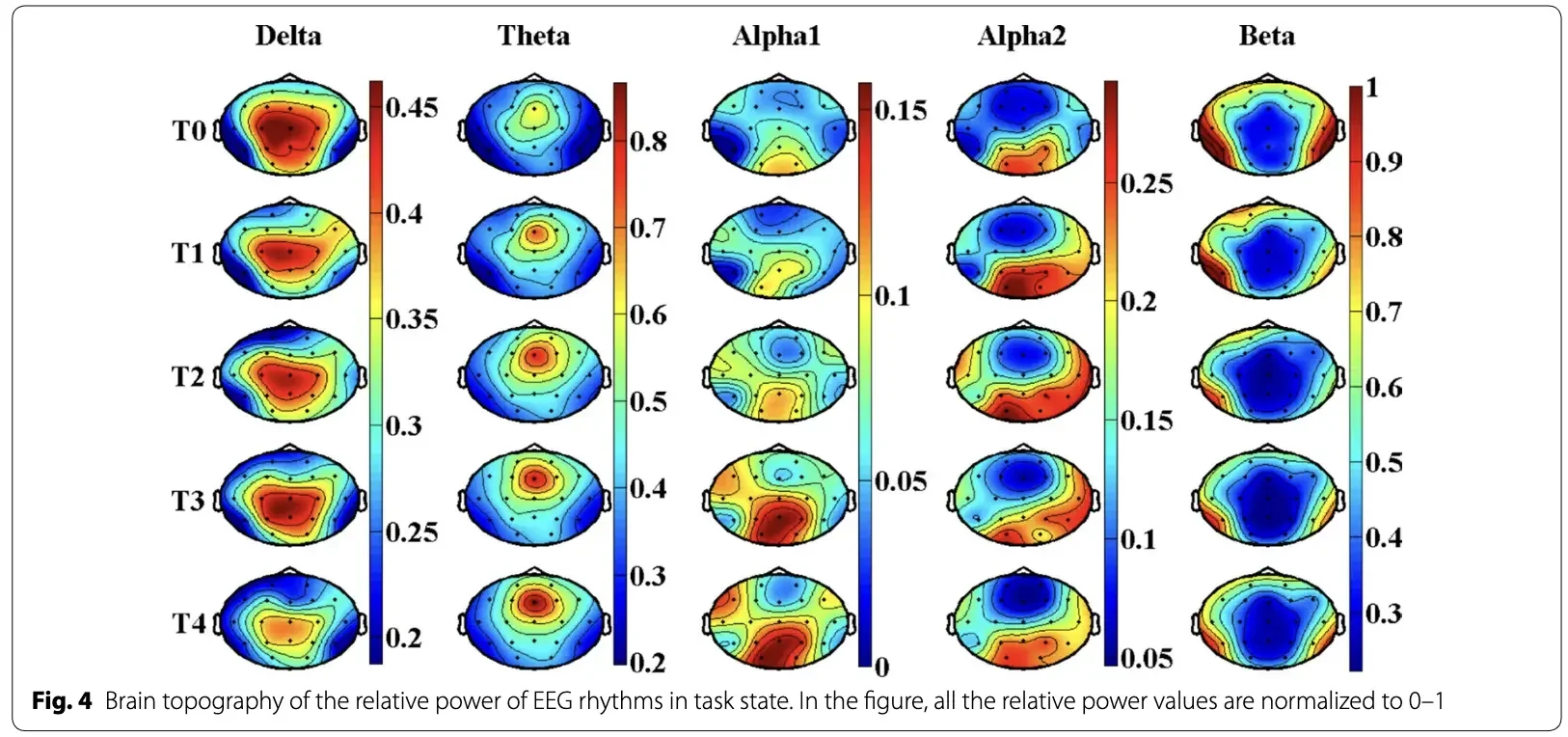
These changes do not prove that the brain is simply “running out of energy.” They show that its pattern of activity changes as sustained work becomes more difficult to manage.
Mental fatigue can also carry over into physical activity. Your muscles may still be capable, but exercise can feel harder than expected. Motivation may fall, perceived effort may rise, and performance can decline before the muscles themselves are fatigued.
That is why an evening workout may feel unusually difficult after a long day of concentrated desk work, even though you have spent most of the day sitting.
Mental fatigue vs. loss of focus
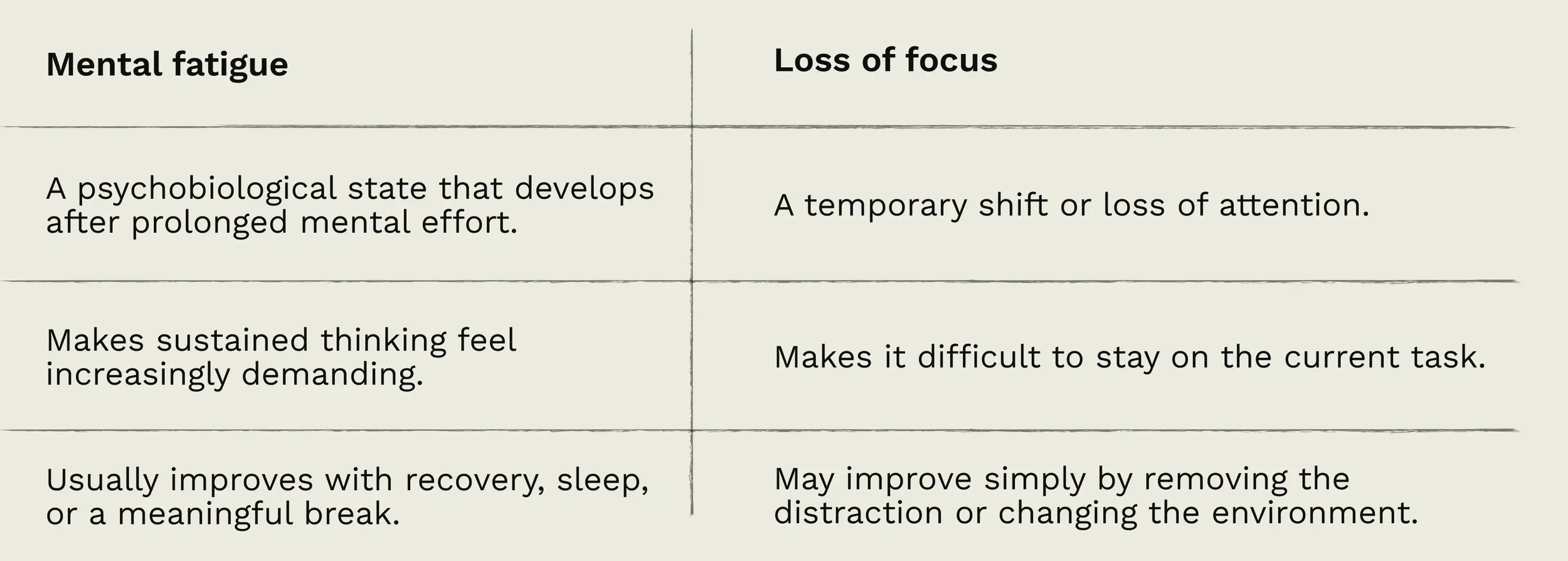
Mental fatigue and loss of focus often appear together, but they are not the same thing.
Mental fatigue is the underlying state. It develops after prolonged cognitive effort and makes continuing to work feel progressively more demanding.
Loss of focus is one possible consequence. It describes the moment your attention drifts away from the task, whether because of mental fatigue, poor sleep, stress, boredom, interruptions, or an overstimulating environment.
This means you can lose focus without being mentally fatigued. A phone notification can distract you within seconds, even when you feel fresh. The opposite is also true. You can remain focused while mentally fatigued, but maintaining that focus requires much more effort than it did earlier in the day.
Read also “Movement breaks for focus: a simple workday reset for desk workers”.
Signs you may be mentally fatigued

Mental fatigue rarely arrives all at once. More often, it builds gradually.
You may still answer emails, attend meetings, and complete your work, but the quality of the experience begins to change. Tasks feel heavier, patience becomes shorter, and maintaining the same standard takes more effort.
The signs usually appear in three areas: how you feel, how you perform, and how your body responds.
How you may feel
Weariness. A general sense of feeling mentally drained or low in energy.
Drowsiness. Feeling sleepy or less alert, even when you are not ready to rest.
Less willingness to make an effort. You know what needs to be done, but investing more mental or physical energy feels increasingly difficult.
Emotional changes. Becoming more anxious, frustrated, or irritable than usual.
Boredom. Losing interest in a task that requires prolonged attention.
How your performance may change
The effects often become more visible in the speed and quality of your work.
Slower reactions. It takes longer to respond to signals, questions, or new information.
Reduced accuracy. Small mistakes begin to appear in work you would normally complete easily.
Poorer decisions. Judging risks, comparing options, or choosing the next step becomes less reliable.
Missed information. You overlook sounds, visual cues, instructions, or details that you would normally notice.
Reduced endurance. Mental work becomes harder to sustain, and physical activity may also feel more demanding.
More effort for the same result. You push harder to maintain your usual performance, but efficiency continues to fall.
What researchers can measure
Researchers can also detect changes that are not obvious in everyday life.
EEG, pupil tracking, and heart-rate monitoring have all been used to study mental fatigue. Common findings include changes in brain-wave activity, smaller pupil diameter, and shifts in heart rate or heart-rate variability.
These measures are useful in research, but most people can recognise mental fatigue through changes in how work feels and how consistently they perform.
How movement breaks may help reduce mental fatigue
Brief movement breaks, usually lasting between 2 and 10 minutes, interrupt two things at once: prolonged sitting and sustained mental work.
A short walk, a few mobility exercises, or light bodyweight movement can change your physical state, create distance from the task, and make it easier to return feeling more prepared to continue.
They may reduce perceived fatigue
Several experimental studies have found that breaking up long periods of sitting with brief walking can reduce feelings of fatigue compared with uninterrupted sitting.
In one randomized crossover study, participants reported less fatigue when light walking was added to prolonged sitting. Other workplace studies have found improvements in energy and vigor.
Vigor describes a state of feeling energetic, mentally alert, and willing to invest effort in a task. This is important because mental fatigue is not only about what happens to performance. It is also about how difficult continued work begins to feel.
A movement break does not remove the workload, but it may make returning to it feel more manageable.
They may increase alertness
Light activity raises physiological arousal. Heart rate increases slightly, breathing becomes deeper, and the body moves away from the low-stimulation state that often develops during long periods at a desk.
This does not mean the brain has been fully “recharged.” A more accurate explanation is that movement may help you feel more awake and ready to re-engage. Studies comparing uninterrupted sitting with regular activity breaks have reported improvements in perceived energy and mood, although the size of the effect varies.
They interrupt cognitive monotony
The benefit may not come from movement alone. Standing up, walking, or completing a short mobility sequence also gives you temporary distance from the task. For a few minutes, you stop processing the same information in the same position and environment.
That change may reduce monotony and give attention a less demanding place to go. This may explain why micro-breaks often show more consistent benefits for fatigue and well-being than for objective test performance.
They may support cerebral blood flow
Prolonged sitting has been associated with reductions in cerebral blood flow, including in areas involved in higher-level thinking.
Short walking breaks may help limit this decline. However, the mechanism should not be oversimplified. Greater cerebral blood flow does not automatically lead to better concentration, and studies do not always find immediate improvements in cognitive performance.
It is one plausible part of the explanation, but not the whole story.
Read also: “Improve circulation while working from home”
What does the overall evidence show?
Systematic reviews generally suggest that active breaks can improve perceived fatigue, energy, mood, and overall well-being. Some studies also report benefits for attention or executive function, while others find little or no immediate change in objective performance.
The most balanced conclusion is:
Movement breaks appear more consistently helpful for how mentally fatigued and alert you feel than for producing an immediate improvement in every measure of cognitive performance.
A movement break is not a guaranteed productivity hack, but it can interrupt prolonged mental effort and help you return to work feeling less drained and more ready to continue.
The exact effect will depend on the task, the type of break, and how fatigued you already are.
Read also: “How often should you take movement breaks at work”?
Why movement breaks may work
Researchers have proposed several explanations for why movement breaks can make demanding work feel easier. There is probably no single mechanism. Instead, the benefits are likely to come from a combination of physical recovery, restored attention, and temporarily stepping away from the task.
Recovery from sustained effort
The Effort–Recovery Model suggests that work creates short-term demands on the body and mind. Recovery begins when those demands are interrupted.
This does not require a long rest. Even a few minutes away from the screen may reduce the immediate pressure of concentrating, making decisions, and processing information.
The Conservation of Resources theory offers a similar idea. It suggests that people try to protect and restore valuable resources such as energy, attention, and motivation.
From this perspective, a movement break creates a small window in which you stop spending those resources and begin restoring them. The benefit comes not only from the movement itself, but also from interrupting sustained mental effort.
Attention restoration
Attention Restoration Theory focuses on the type of attention we use during work. Directed attention is the effortful kind. You use it when reading a difficult report, solving a problem, or ignoring distractions during a meeting.
After prolonged use, this system becomes harder to maintain.
Some activities naturally capture your attention without requiring the same level of mental control. Nature is a common example. Watching trees move, listening to birds, or walking outdoors can engage the mind without demanding intense concentration.
This is sometimes called soft fascination. A short outdoor walk may therefore offer two benefits at once: movement and a change of environment that places fewer demands on attention.
You do not need a park for every break. Looking out of a window, stepping onto a balcony, or walking through a quieter area may still provide a useful change from the screen.
Task switching and creative incubation
Stepping away can also help during creative or problem-solving work.
Sometimes, continuing to stare at the same problem only strengthens the same line of thinking. A short walk or change of activity can interrupt that pattern and allow different ideas to emerge.
This is often called the incubation effect. You stop actively working on the problem, but your brain may continue processing it in the background. When you return, the solution may feel clearer or a new idea may appear.
However, more switching is not always better. Constantly jumping between messages, tabs, and small tasks can leave part of your attention attached to the previous activity. This is sometimes called attention residue.
The key difference is intention. A planned movement break creates a clear pause before returning to the original task. Constant interruptions do the opposite, they fragment attention instead of restoring it.
Read also: “Long-term benefits of movement breaks for desk workers”.
Timing Matters: Prevent vs. Recover
Movement breaks can be used in two ways: before fatigue becomes noticeable, or after the first signs begin to appear. Both can help, but they serve different purposes.
Preventive breaks
Preventive breaks are taken while you still feel reasonably fresh. Their purpose is to interrupt prolonged sitting and concentrated work before the quality of your work begins to decline.
This can be useful because early fatigue is easy to miss. You may still feel productive even though you have started rereading sentences, overlooking details, or taking longer to make simple decisions. Research often uses activity breaks at regular intervals, but there is no single schedule that suits every person or task.
A better approach is to use time as a reminder rather than a strict rule. Demanding work may call for an earlier break, while lighter tasks may allow you to continue for longer. The aim is not to follow the clock perfectly. It is to avoid long, uninterrupted periods of sitting and mental effort.
Recovery breaks
Recovery breaks are taken once you notice that continuing has become harder. At this point, you may be working more slowly, making avoidable mistakes, or struggling to absorb information that would normally feel manageable.
A short walk or mobility break may help you feel more alert and ready to continue. However, movement has limits. If the underlying problem is poor sleep, excessive workload, illness, or several hours without meaningful rest, a brief break may only provide temporary relief.
The most practical strategy is therefore a combination of both approaches:
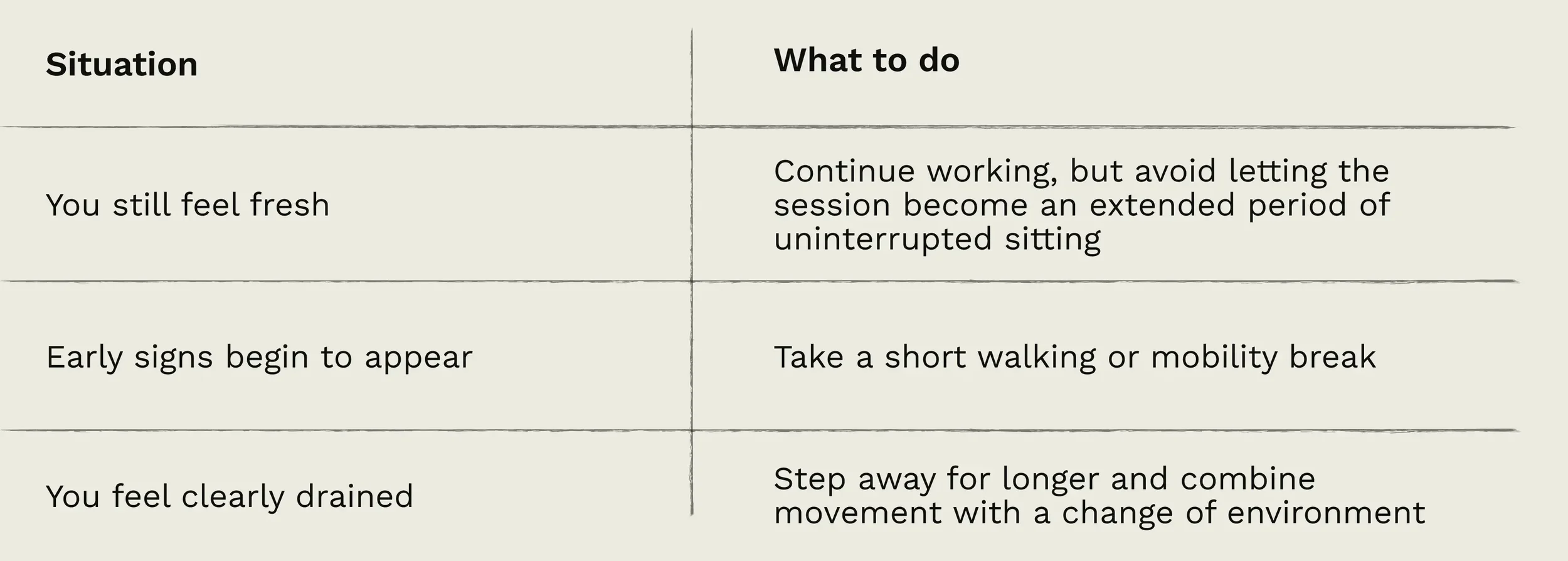
The exact timing will depend on what you are doing. Routine work may only require a brief interruption. After demanding writing, analysis, or decision-making, you may need a more complete break before returning.
The main rule is simple:
Do not wait for complete exhaustion. Break the pattern while recovery is still easy.
Read also: “Range of motion exercises for sitting all day: a 1-minute desk routine”.
Best movement breaks for mental fatigue
The most useful movement break is usually simple, light, and easy to repeat. You do not need a full workout. The aim is to interrupt sitting and concentrated work without creating additional fatigue.
Short walks
Walking is often the best place to start because it combines movement, a change of posture, and time away from the desk.
Even a few minutes may help you feel more alert and less drained than remaining seated. Walking outdoors may add another benefit by changing the visual environment and creating a clearer separation from work.
Simple options include:
walking through the office;
taking a short corridor or stairwell walk;
walking outside for several minutes;
or turning a phone call into a walking call.
Mobility and stretching
Mobility can be especially useful when mental fatigue is accompanied by stiffness or discomfort. A few slow movements for the hips, shoulders, upper back, or ankles can relieve the physical effects of prolonged sitting and make returning to the desk more comfortable.
However, stretching should not be treated as automatically better than walking for alertness or cognitive performance. Choose it when your body feels restricted, not because every break needs to become a mobility routine.
Read also: “Hip Flexor stretches for sitting all day: 5 simple moves for desk workers”.
Light bodyweight exercises
When you feel sleepy or under-stimulated, slightly more active movement may help. A short sequence can raise your heart rate and alertness without becoming a training session.
Examples:
5–10 chair squats;
wall push-ups;
calf raises;
slow marching;
alternating step-backs;
gentle stair climbing.
Keep the effort controlled. You should return to work feeling more awake, not sweaty or exhausted.
Looking for more structure? See the “MicroDosing Training 30-day plan.”
Match the break to what you need
Different states call for different types of movement.
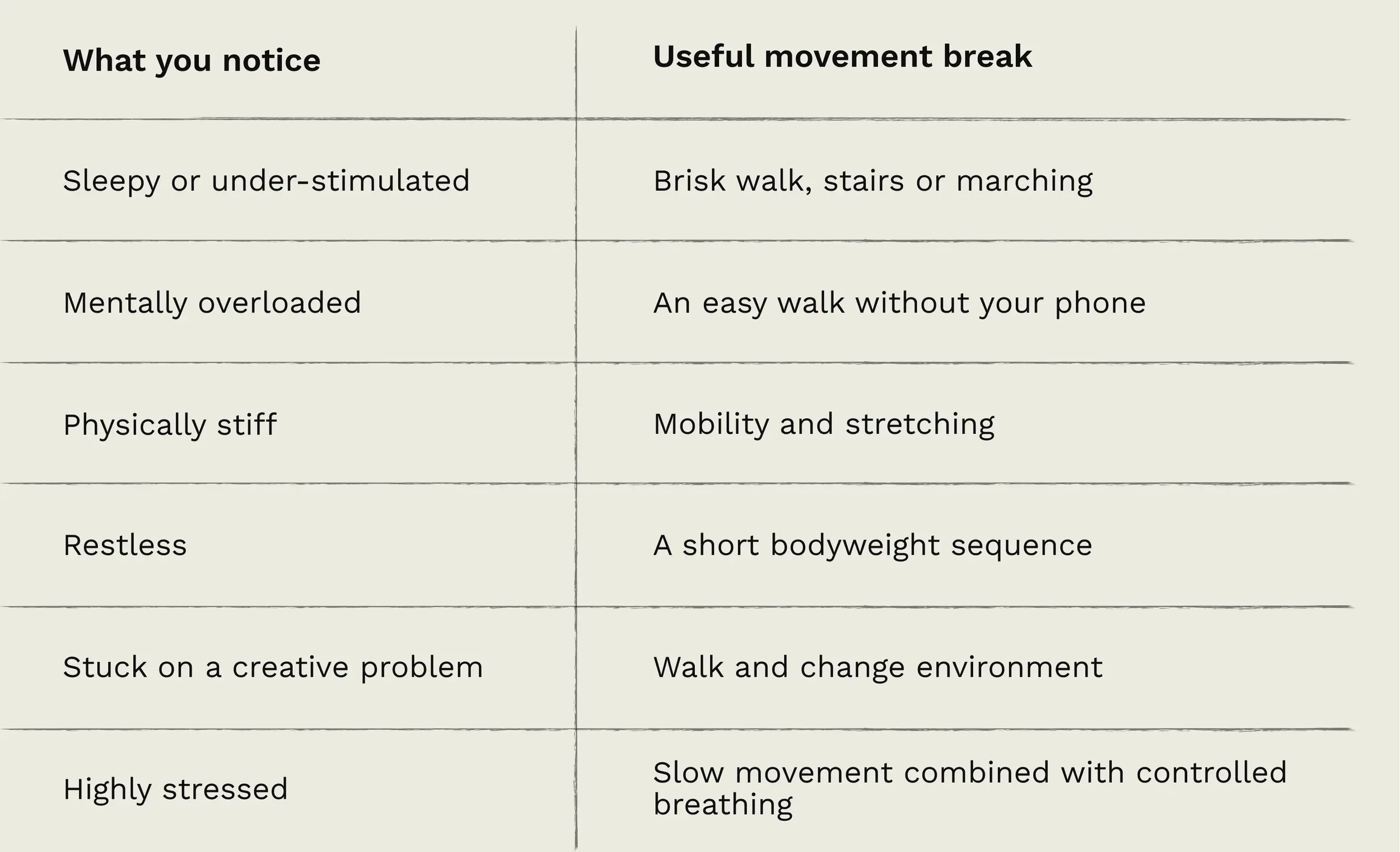
Walking is the most widely studied option, but it is not the only useful one. The best choice is the one that suits the moment, feels manageable, and is easy to repeat throughout the day.
The break does not need to be impressive. It only needs to interrupt the pattern.
Common mistakes
Waiting until you are completely drained
The longer you continue, the less likely a very short break is to be enough. If you are already making repeated mistakes, struggling to absorb information, or forcing yourself through every sentence, two minutes of movement may provide only limited relief.
Take the break before the decline becomes severe.
Replacing work with another screen
Standing up and immediately checking social media changes the task, but it may not give your attention much rest. Notifications, short videos, and rapid visual input keep the brain engaged with new information. Your posture may change, but the mental stimulation continues.
When possible, leave your phone behind.
Making every break too intense
A movement break should not leave you breathless, sweaty, or physically tired. Hard exercise has its place, but the purpose of a workday break is usually to increase alertness without creating another demand on recovery.
Keep most breaks light and controlled.
Treating the timer as a strict rule
A timer can be a useful reminder, but it should not control the entire process. You do not need to interrupt a productive train of thought the moment it rings. You also should not ignore clear signs of fatigue simply because the next scheduled break is still 20 minutes away.
Use the timer as a prompt, not a command.
Expecting one break to compensate for poor recovery
Movement can help you reset, but it cannot fully compensate for poor sleep, excessive workload, dehydration, skipped meals, or several hours without meaningful rest. If every task feels unusually difficult, the problem may require more than a short walk.
Turning the break into another task
A complicated routine creates friction. If the break requires equipment, planning, or a change of clothes, you are less likely to use it consistently. Keep it simple enough to begin immediately.
The best movement break is not the most advanced one. It is the one you will actually take before you need it.
FAQ
-
Not always. A short break may improve alertness, energy, and readiness to continue, but it cannot fully correct poor sleep, excessive workload, stress, or several hours of demanding work without proper recovery.
Movement is one part of managing mental fatigue, not a complete solution.
-
Standing changes your posture, but movement usually creates a stronger interruption. Walking, mobility exercises, or a few light bodyweight movements create a stronger break from prolonged sitting than simply standing at a desk.
Standing is still better than remaining in the same seated position for hours, but it should not replace regular movement.
-
A short break may take a few minutes away from the task, but continuing to work while mentally drained can also waste time. Errors, rereading, indecision, and slower thinking may reduce the value of staying at the desk.
The goal is not to take as many breaks as possible. It is to use brief interruptions when they help you maintain the quality of your work.
-
Usually not. Most workday movement breaks should feel light or moderate. You should be able to return to the desk without needing to cool down, change clothes, or recover from the exercise itself.
Harder training can still support health and well-being, but it serves a different purpose.
-
It may help temporarily. Changing posture, location, and activity can make you feel more awake and interrupt the monotony of repetitive work. However, movement cannot make an uninteresting task permanently engaging.
-
Not necessarily, but it may offer additional benefits. Going outside changes both your environment and visual surroundings, while also providing natural light and fresh air. A quiet outdoor walk may also make it easier to detach from work.
When going outside is not practical, a short indoor walk or mobility break is still worthwhile.
-
You can still move. Try ankle pumps, seated marching, shoulder circles, gentle trunk rotations, calf raises, or standing up and sitting down several times. Even a small amount of movement is better than remaining still.
-
The cause may be deeper than prolonged sitting or temporary mental overload. Poor sleep, illness, high stress, inadequate food or fluids, and an unrealistic workload can all contribute to persistent tiredness.
When fatigue is severe, continues despite rest, or regularly interferes with daily life, it may be worth discussing it with a qualified healthcare professional.
Regular movement is easier to maintain when it is built into your day. The Exercise Snacks plan gives you a simple structure for adding short, practical movement sessions without turning every break into a workout.
References:
Proost, M.,(2022): How to Tackle Mental Fatigue: A Systematic Review of Potential Countermeasures and Their Underlying Mechanisms.
Tran, Y.,(2020): The influence of mental fatigue on brain activity: Evidence from a systematic review with meta-analyses.
Li et al. (2020): The impact of mental fatigue on brain activity: a comparative study both in resting state and task state using EEG.
Albulescu, P., (2022): “Give me a break!” A systematic review and meta-analysis on the efficacy of micro-breaks for increasing well-being and performance.
Read more posts: