Improve circulation while working from home: a 3-part movement break system

“The practical question is this: how can you improve circulation in your legs while working long hours at a desk?”
Sedentary behaviour is not “the new smoking.” I strongly disagree with that statement.
People have been sitting for thousands of years. The real difference is not sitting itself, but how we sit today and how long we stay in the same position without moving.

Comfort is everywhere: in food, transportation and, of course, sitting. Just look at how chairs have changed over time. We moved from simple wooden seats to ergonomically designed chairs with soft materials, adjustable support and even built-in massage.
Modern chairs are made to keep us comfortable. But that comfort also makes it easier to stay almost completely still for hours.
And time matters. Sitting for a short period is one thing. Sitting at a desk for several hours with very little movement is something completely different. So the practical question is this: how can you improve circulation in your legs while working long hours at a desk?
Read the practical guide: “Movement breaks at work: a 1-minute system for desk workers”.
Why working from home can reduce daily movement
Logic tells us that working from home (WFH) should make life easier. You can handle personal tasks during the day, help with the kids, pay bills, order food, do the laundry, and manage more without leaving the house.
But the statistics tell a different story.
WFH can reduce daily movement because it removes many of the small walking moments that usually come with office life.
There is no commute, fewer stairs, no walk to a meeting room, no trip across the office to speak with a colleague, and often no lunch break outside. The whole workday can easily shrink into one chair, one desk, and one screen.
This matters because every step activates the muscles in your calves, thighs, and glutes. These muscles help move blood back up through your legs. When they stay inactive for long periods, your legs can feel heavy, stiffness can build, and your whole body may start to feel slower.
A large review of 38 studies, including 282,264 people from 15 countries, found that compared with office-based work, working from home was linked with:
around 31 extra minutes of sitting during working hours;
a higher chance of sitting for more than eight hours a day;
and about 2,564 fewer steps per day.
That is a big difference.
Those missing steps matter. Research suggests that adding just 1,000 steps to your day is linked with a lower risk of death from all causes. Even 500 extra steps may support better heart health.
The message is simple: working from home is not automatically unhealthy, but it can quietly remove a large amount of movement from your day. That is why short, regular movement breaks are so important.
You can also adjust your setup: “Home office ergonomics: how your setup affects your body”.
Why long sitting blocks matter for circulation
Normally, walking, standing, taking a few steps, and even changing your posture make the muscles contract.
These contractions create a muscle-pump effect. In simple terms, your muscles help push blood from your legs back toward your heart.
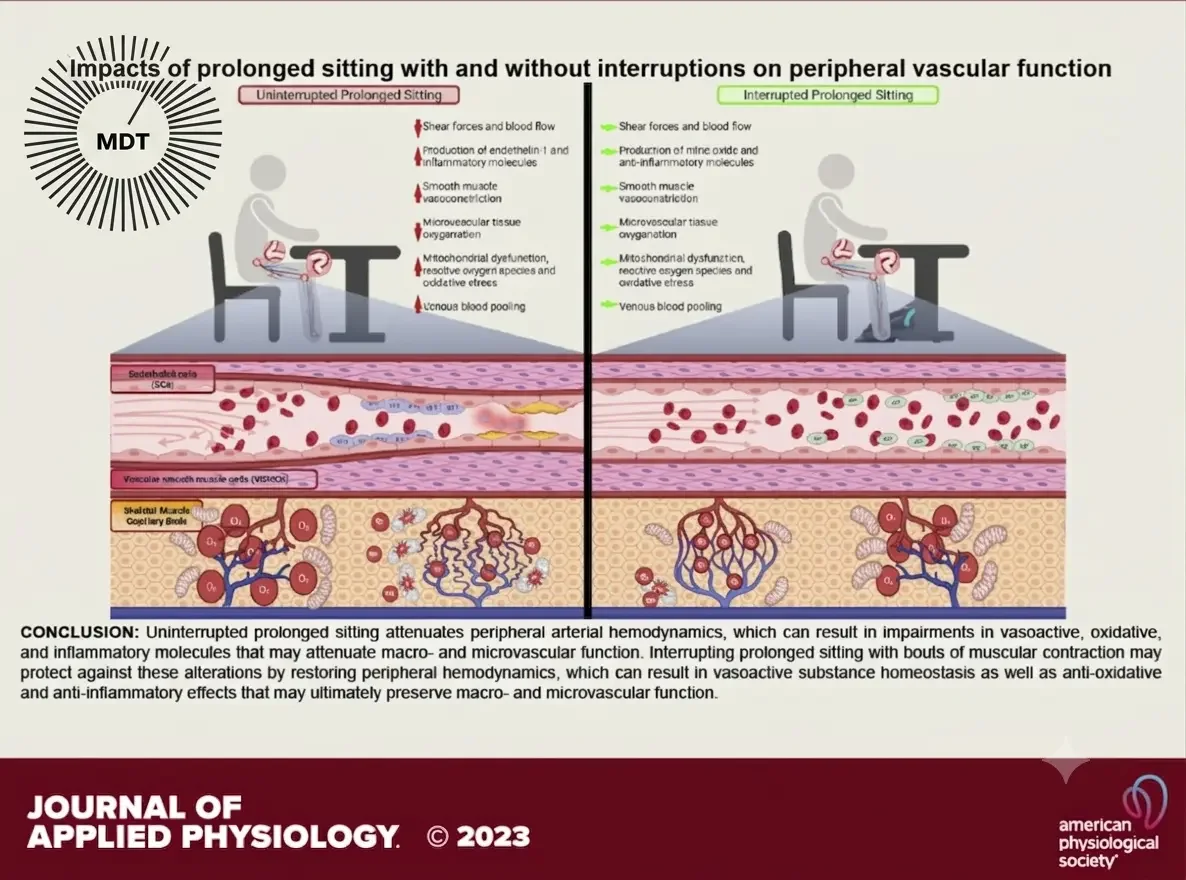
When you sit for a long time without moving, this pump becomes much less active. Blood flow through the legs can slow down, and fluid may collect more easily in the lower body.
This is one reason your legs may feel heavy, stiff, swollen, or restless after several hours at a desk.
Your blood vessels are also affected.
As blood moves through an artery, it creates a gentle force against the vessel wall. This is called shear stress. It may sound technical, but the idea is simple: regular blood flow helps your blood vessels stay responsive and work normally.
During long periods of uninterrupted sitting, blood flow and shear stress in the legs can decrease. Studies have also found temporary changes in how well the blood vessels in the legs respond after several hours of sitting.
The good news is that breaking up sitting with light movement can help reduce some of these changes.
Let’s look at a few numbers from the research:
Adults commonly spend around 6 to 8 hours per day sitting, while many young people accumulate close to 7 hours per day.
Many sitting studies define a prolonged, uninterrupted sitting block as 60 minutes or more.
Changes in lower-limb blood flow and shear stress have been observed after only 30 to 60 minutes of continuous sitting.
When you sit, the arteries around the hips and knees remain bent at approximately 90 degrees. This bent position may contribute to lower blood flow, together with reduced muscle activity and the effect of gravity.
In one study, 3 hours of uninterrupted sitting increased stiffness in the main arteries by around 0.3 to 0.4 metres per second.
Looking for a deeper explanation? Read: “Physiology of sedentary behavior: sit less, move more, AND exercise.”
There may also be another hidden factor in your home office: the air itself. In small or poorly ventilated rooms, carbon dioxide levels can rise to around 1,500 parts per million within 1 to 2 hours. That is around four to five times higher than normal outdoor levels.
Higher CO₂ levels do not affect circulation in the same way as sitting, but they may add to tiredness, poor concentration, and the general feeling of being sluggish.
So, the problem is not only the chair. It can be the combination of long sitting blocks, very little muscle activity, and a closed room with limited fresh air.
The important point is not that sitting is immediately dangerous. The problem is repeating long, uninterrupted blocks of sitting day after day.
How movement breaks may help improve circulation
Movement breaks are short periods of light activity that interrupt long blocks of sitting. They can be very simple: stand up, walk around the room, do a few calf raises, or march in place.
When these breaks are more structured, repeated throughout the day, and include a specific exercise, they are often called exercise snacks. The name fits well: they are small portions of movement spread across the day rather than one long workout.
Research published in 2026 looked at several types of movement that may help reduce some of the effects of prolonged sitting, including:
stair climbing;
walking;
bodyweight exercises such as squats and calf raises;
standing;
under-desk pedaling;
and stepping in place.
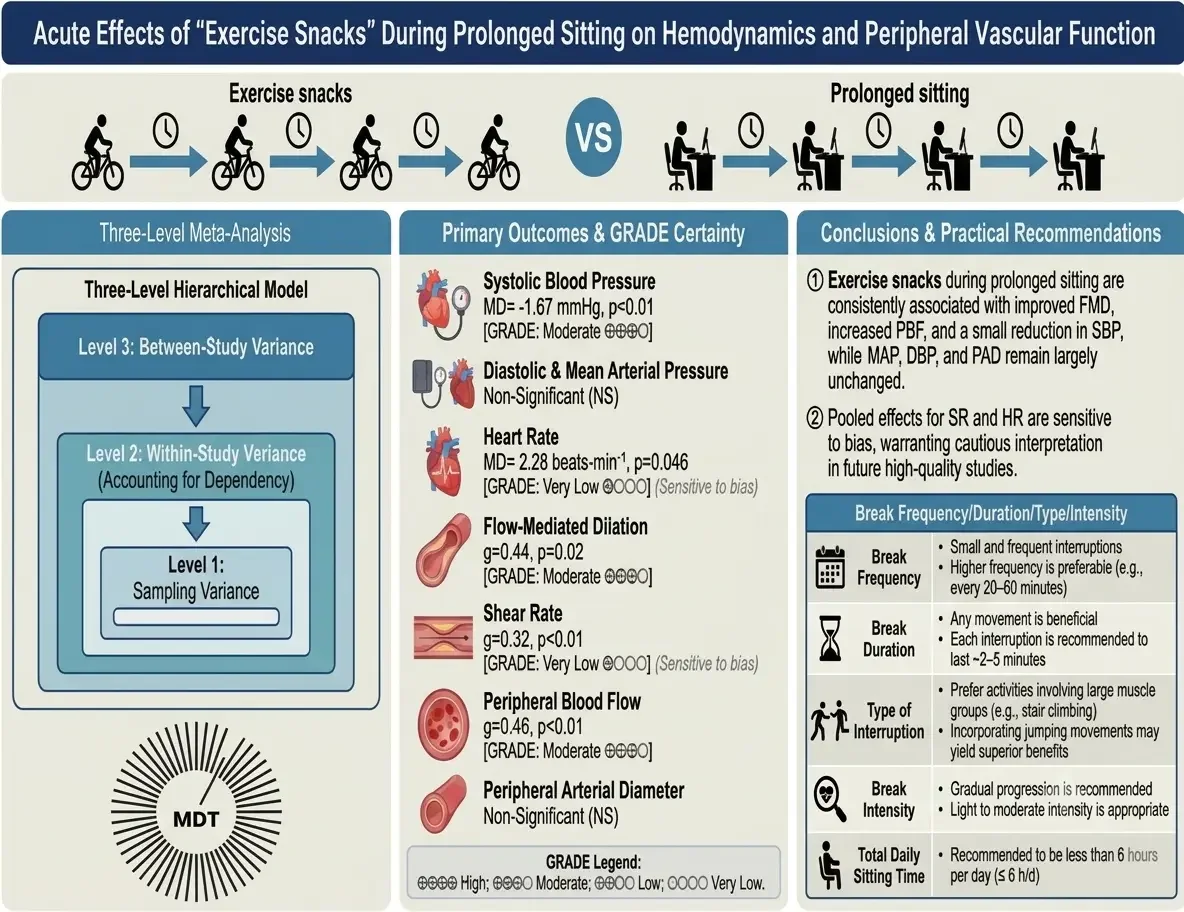
Even short activity breaks may make a measurable difference. The research found that they reduced systolic blood pressure the top number in a blood-pressure reading by around 1.67 to 2.09 mm Hg.
That may sound like a small change, but when repeated regularly, small changes can matter. Movement breaks may also help your blood vessels continue working as they should. Blood vessels need to widen and relax in response to changing blood flow. Research has linked a 1% reduction in this ability with a 13% higher risk of future cardiovascular events.
The purpose of movement breaks is not to create a dramatic response every time you stand up. Their value comes from repeatedly restoring muscle activity and blood flow before your body spends too long in one inactive position.
Not every type of movement appears to produce the same effect. Among the activities studied, stair climbing was one of the most effective for supporting blood flow and blood-vessel function.
Why?
Climbing stairs activates large muscles in the lower body, especially the quadriceps and glutes. It also makes your body work against gravity. This requires more effort than standing or walking slowly on a flat surface.
The researchers described stair climbing as a form of Vigorous Intermittent Lifestyle Physical Activity, or VILPA.
The term sounds complicated, but the idea is simple: VILPA means short bursts of harder movement that happen during normal daily life. Running up a flight of stairs, walking quickly uphill, or carrying something heavy may all fit this idea.
Because the intensity is higher, stair climbing may create a stronger response in your circulation than lower-intensity movement such as standing or slow walking. For the best results, the research suggests moving for around 2 to 5 minutes every 30 to 60 minutes.
Where possible, it may also help to keep your total sitting time below approximately 6 hours per day. Once daily sitting rises above 10 hours, each additional hour has been associated with an 8% increase in cardiovascular risk.
This does not mean you need to panic when you have a long working day. It means that both the total amount of sitting and the length of each uninterrupted sitting block may matter.
Think of movement breaks as small resets for your circulation. They reactivate your muscles, increase blood flow, and may help limit the temporary changes caused by sitting still for too long.
For a deeper explanation of movement frequency, read: “How often should you take movement breaks at work”?
3 Science-based movement breaks to keep your legs moving
If you prefer a structured plan, research gives us a useful place to start. One study tested a short routine called the Resistance Exercise Break, or REB protocol. It was designed for desk workers and takes only 3 minutes. You do not need equipment, a gym, or special clothes.
The routine includes three movements:
Bodyweight squats: 20 sec,
High knees with strong glute contractions: 20 sec,
Calf raises: 20 sec.
These three exercises are repeated for three rounds (3*20 sec each). The movements are performed at a steady pace of around one repetition every 2 seconds.
The researchers also tested how often office workers were willing to complete the routine.
4 breaks per day: every 2 hours. This was the most practical option. Around 88% of participants found this schedule acceptable. On average, they completed 3.2 of the 4 planned breaks.
8 breaks per day: every hour. This was harder to maintain. Only 40% of participants found it acceptable, although they still completed an average of 6.2 breaks per day.
16 breaks per day: every 30 minutes. This schedule was the least popular. Only 9% of participants found it acceptable. On average, they completed 9.2 of the 16 planned breaks.
These numbers show something important: a movement plan only works when people can realistically follow it.
Common challenges in the office
The biggest barrier was embarrassment. More than 55% of participants reported feeling self-conscious about exercising in front of their coworkers, especially when they first started.
Time was another concern. When participants were asked to complete only four breaks per day, 20.7% worried that the routine might affect their productivity. When the number increased to 16 breaks, this concern rose to 62.1%.
A practical recommendation
The study suggests that a 3-min resistance break every 2 hours around four times during the working day may be the best balance.
It is short, easy to remember, and more likely to become part of your routine. It may also support focus and physical comfort without taking too much time away from work.
And because you are working from home, you have one advantage: you do not need to worry about exercising in front of your coworkers.
Self-myofascial release: an optional circulation-support technique
Self-myofascial release, or SMR, uses a foam roller or massage ball to apply gentle pressure to the muscles.
Foam rolling may temporarily increase blood flow in the area and reduce the feeling of stiffness, especially in the calves, thighs, and glutes. However, SMR does not activate the muscle pump as strongly as walking, steps or squat.
For a circulation-focused movement break, use foam rolling as a short warm-up or recovery technique, then follow it with active leg movement. In simple terms, rolling may help your muscles feel looser, but movement is still the more effective way to get your legs working again after long periods of sitting.
You can try the following:
Place a massage ball under one foot and apply light pressure while standing with support.
Place the ball between your calf and a wall, then lean into it gently.
Place the ball between your thigh and a wall to work on the quadriceps or the outside of the thigh.
Use enough body weight to create moderate but comfortable pressure. It should feel similar to a deep massage, around 5 to 7 out of 10 on a discomfort scale.
The pressure should not feel sharp, painful, or make you tense your whole body. If you find yourself holding your breath or tightening up, reduce the pressure.
Move slowly across the muscle, pausing briefly on areas that feel tight. There is no need to rush or push aggressively.
For each muscle area, roll for around 45 to 60 seconds. You can repeat this up to three times, resting for 15 to 30 seconds between rounds or simply switching sides.
After rolling, finish with an active movement such as calf raises, marching in place, or a short walk around the room.
The main idea is simple: use rolling to reduce stiffness, then use movement to support circulation.
3 + 3 + 3 structural movement breaks to keep your legs moving
Now you can use the Exercise Snacks approach to create a more complete movement routine for your legs. The idea is simple: complete three short sessions during the day, with three exercises in each session.
Each break combines light self-myofascial release with active movement. The release work may help reduce stiffness, while the active exercises help switch the leg muscles back on and support blood flow.
Midday session
Foot self-myofascial release: Stand with support and gently roll the bottom of one foot over a massage ball for 20 seconds. Repeat on the other side.
Calf raises: Perform for 20 seconds.
Bodyweight squats: Perform for 20 seconds.
Afternoon session
Calf self-myofascial release: Use a massage ball against a wall for 20 seconds on each side.
High knees with strong glute contractions: Perform for 20 seconds on each side.
Alternating calf raises with a calf stretch: Perform for 20 seconds on each side.
Evening session
Quadriceps and outer-thigh self-myofascial release: Use a massage ball against a wall for 40 seconds on each side.
Bodyweight squats: Perform for 20 seconds.
Jump variations: Perform for up to 30 seconds.
For the jump variations, choose an option that matches your current fitness level. You can use small jumps, side-to-side hops, or a low-impact version without leaving the floor.
This 3 + 3 + 3 structure gives you nine short movement opportunities across the day without turning them into a full workout.
Follow the video below to see each exercise and learn how to build this structured approach into your working day.
Common mistakes
Sitting for hours and trying to make up for it later
A 60-minute workout after work is excellent for your health, but it may not fully cancel out a full day of uninterrupted sitting. Research suggests that how often you break up sitting matters, not only how much exercise you complete later.
Add short movement breaks throughout the workday, even if you already exercise regularly.
Read a deep science: “The "Sedentary Exerciser" paradox”.
Waiting until your legs feel stiff or heavy
Many people only move once they notice discomfort. By that point, the muscles in the legs may have been inactive for a long time.
Move before stiffness develops. Use a reminder every 30 to 60 minutes, or complete a more structured routine every couple of hours.
Stretching only your upper body
Neck and shoulder stretches can feel good, especially after working at a screen. But they do little to activate the calf muscles and larger leg muscles that help support circulation.
Include at least one lower-body movement, such as walking, calf pumps, sit-to-stands, squats, or marching in place.
Read: “Neck stretches for desk workers: 4 evidence-based exercises”.
Thinking the break has to be a workout
Keep it simple. A movement break can last only 1 to 3 minutes. The goal is to interrupt sitting, not complete a full training session.
Skipping movement because you work from home
Working from home removes many of the natural movement opportunities that come with office life, such as commuting, walking to meetings, taking the stairs, or visiting a colleague.
Create your own movement triggers. Walk while making coffee, stand during phone calls, or move for a minute after every meeting.
Using self-myofascial release instead of moving
Foam rolling and massage balls may help reduce the feeling of stiffness, but they do not replace the muscle contractions created by walking or leg exercises.
Trying to be perfect
Many people begin with an ambitious plan, such as moving every 30 minutes throughout the entire day. After a few days, the routine starts to feel unrealistic and is quickly abandoned.
Build a routine you can maintain. A simple movement habit completed most days is more useful than a perfect plan you rarely follow.
When to get medical advice
Movement breaks can help reduce stiffness and support circulation, but they are not a substitute for medical care.
See a healthcare professional if you experience:
swelling that does not go away.
sudden pain, warmth, or redness in one leg.
numbness or weakness that keeps returning.
or discomfort that continues even when you move regularly.
Mild stiffness after a long sitting period is common. Sudden, severe, or one-sided symptoms should be checked.
FAQ
-
A useful goal is to move every 30 to 60 minutes for 1 to 3 minutes.
When that feels unrealistic, try a structured 3-minute break every 2 hours. A routine you can follow consistently is better than a perfect schedule you quickly abandon.
-
Walking and stair climbing are strong options because they activate the calves, thighs, and glutes together. Calf raises, sit-to-stands, squats, and marching in place are also practical choices.
-
Both may reduce stiffness and help you feel more comfortable. However, they work best as additions to active movement, not as replacements for it.
-
Standing is better than remaining seated, but adding movement is even better. Walking, marching, or performing calf pumps activates the leg muscles more effectively than simply standing still.
-
Regular exercise is excellent for overall health, but it does not fully replace the benefits of breaking up prolonged sitting during the workday at home. Both structured exercise and frequent movement breaks are important.
-
Link them to habits you already have, such as finishing a meeting, refilling your water bottle, or making coffee. Calendar reminders, smartwatch alerts, or your MicroDosing Training routine can also help make movement a consistent habit.
If you want a simple system to follow, try the Exercise Snacks approach. It combines short movement breaks and targeted exercises into a routine that fits naturally into a busy workday.
References:
Schöne, C.,(2025): The impact of working from home on sedentary behaviour and physical activity compared to onsite work in the working population: A systematic review and meta-analysis.
Pekas, E. J.,(2023): Prolonged sitting and peripheral vascular function: Potential mechanisms and methodological considerations.
Wang, H., (2026): Acute effects of “exercise snacks” during prolonged sitting on hemodynamics and peripheral vascular function: A three-level meta-analysis.
Rogers, E. M.,(2024): Acceptability of performing resistance exercise breaks in the workplace to break up prolonged sedentary time: A randomized control trial in US office workers. Workplace Health & Safety.
Read more posts: