Neck stretches for desk workers: 4 evidence-based exercises

“During desk work, the muscles around your neck and shoulders remain lightly active for hours.”
The neck is often one of the first places where long hours at a desk begin to show.
You finish work, stand up, and your shoulders feel heavy. You turn your head and notice it doesn’t move as freely as it did in the morning. Sometimes the feeling follows you into the evening, and even lying on your back doesn’t completely remove the stiffness.
Over the years, I have heard this complaint from countless office workers. Rarely was it caused by one dramatic event. More often, it was the result of spending hours in the same position while looking at a screen, typing, and concentrating.
Imagine you spend just 6 hours a day at your desk. Over a typical 10-year career, that’s roughly 15,000 hours, equivalent to about 89 continuous weeks, or more than 1 year and 8 months with your neck and shoulders in a very similar position. It’s no surprise that your body eventually starts asking for more movement.
The human neck wasn’t designed to stay almost motionless for half the day.
During desk work, the muscles around your neck and shoulders remain lightly active for hours, supporting the weight of your head while your eyes stay fixed on the monitor. Add stress, deadlines, and very little movement, and it’s easy to understand why this area often becomes the first to complain.
In this article, we’ll look at why desk work commonly leads to neck tension, what research says about the underlying mechanisms, and fore neck stretches that can help restore movement and reduce the feeling of stiffness.
Looking for a complete desk routine? Read our guide: “Exercises for sitting all day: the complete guide for desk workers.”
Why desk workers often feel tension in the neck muscles
Neck and shoulder pain are among the most common musculoskeletal complaints in people who work from home or spend long hours using computers, laptops, and mobile devices. Some studies report that more than 70% experience work-related discomfort at some point.
The main mechanism is prolonged low-level muscle activity, often called static muscle loading. Instead of moving through different positions, the neck and shoulder muscles remain lightly active for hours. Over time, this can contribute to fatigue, stiffness, tenderness, and the familiar feeling of tightness around the upper neck and shoulders.
Unhealthy home office setups
Unhealthy "Home Office" spots are characterized by non-traditional setups where people work without proper desks or chairs, leading to static and awkward postures.
The sofa or mattress. This was the most frequently reported posture for mobile phone users, with 34.6% of people reclining on a sofa or mattress for 1 to 3 hours.
Sitting on the floor is another common "office" spot. Research shows that sitting on the floor while using a laptop (with or without a table) is significantly linked to musculoskeletal pain.
Working while lying on your stomach places particularly high demands on the neck because the screen is usually below eye level, requiring prolonged neck extension or rotation. This specific "prone" position is a major contributor to discomfort.
Many people work in chairs that do not have a corresponding desk, which often results in hunched shoulders and a bowed neck.
Research also suggests that using a computer for more than three hours a day, or approximately 42 hours per week, is associated with a higher likelihood of neck and shoulder discomfort.
Working from home? Read our post: “Home office ergonomics: how your setup affects your body”.
Forward head posture increases the load on the neck
A neutral adult head (when you look straight ahead) weighs roughly 10–12 lb (4.5–5.5 kg). When the head moves forward or tilts down toward a screen, the neck muscles must work harder to control that position.
A commonly cited biomechanical model by Hansraj estimated that the forces acting on the cervical spine increase as the head flexes forward: approximately 27 lb at 15°, 40 lb at 30°, 49 lb at 45°, and 60 lb at 60° of neck flexion.
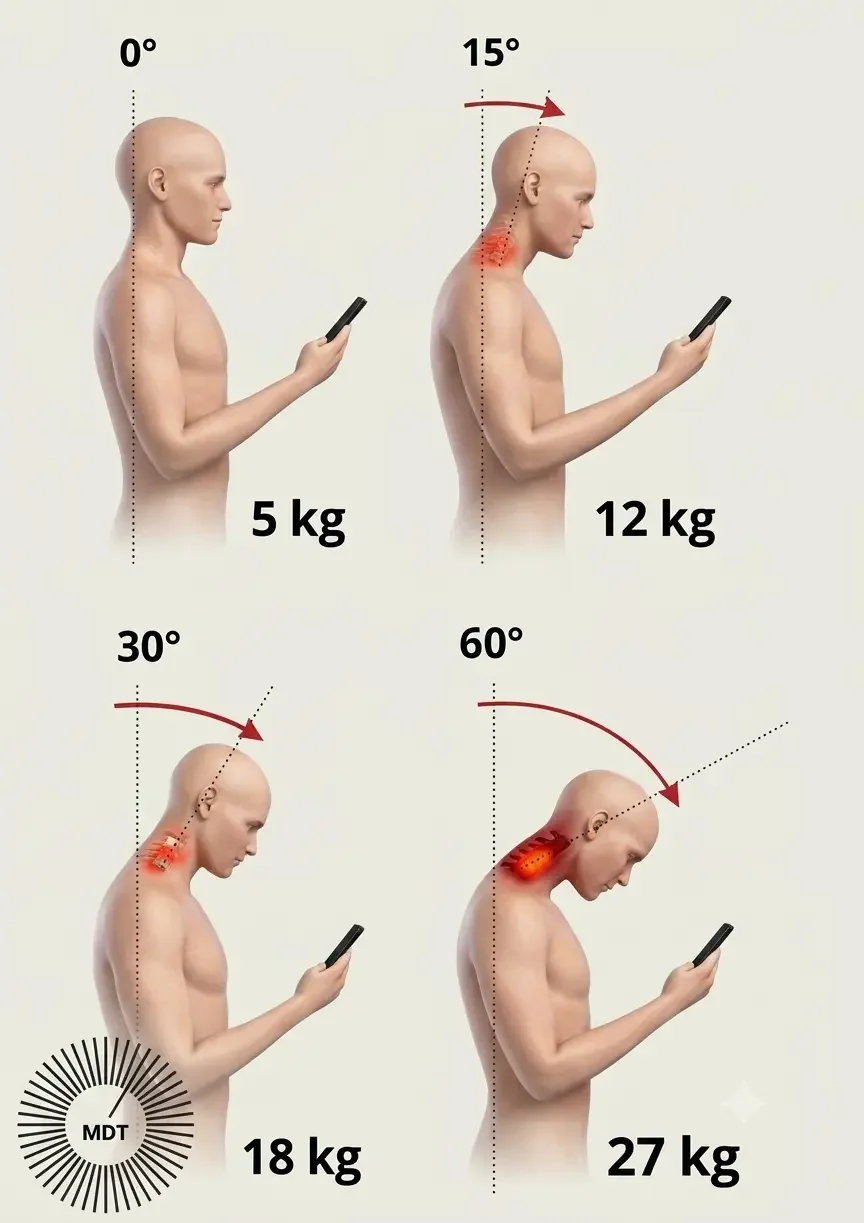
This does not mean your neck is literally “carrying 60 pounds” all day, but it illustrates why a small forward-head position can feel tiring over time.
Forward head posture is when your head sits in front of your shoulders instead of stacked over your spine. When you work on a laptop, phone, or low screen, your eyes move toward the screen and your head often follows. Instead of staying stacked over your shoulders, the head drifts forward.
The farther the head moves forward, the harder the neck and upper-back muscles have to work to support it.
Rounded shoulders change the position of the neck and shoulder muscles
Rounded shoulders can make the neck feel tense because the neck and shoulder blades are mechanically connected. When the shoulders drift forward during desk work, the chest muscles often become less active through their full range of motion and may feel tighter, while the muscles around the shoulder blades work harder to stabilise the upper body.
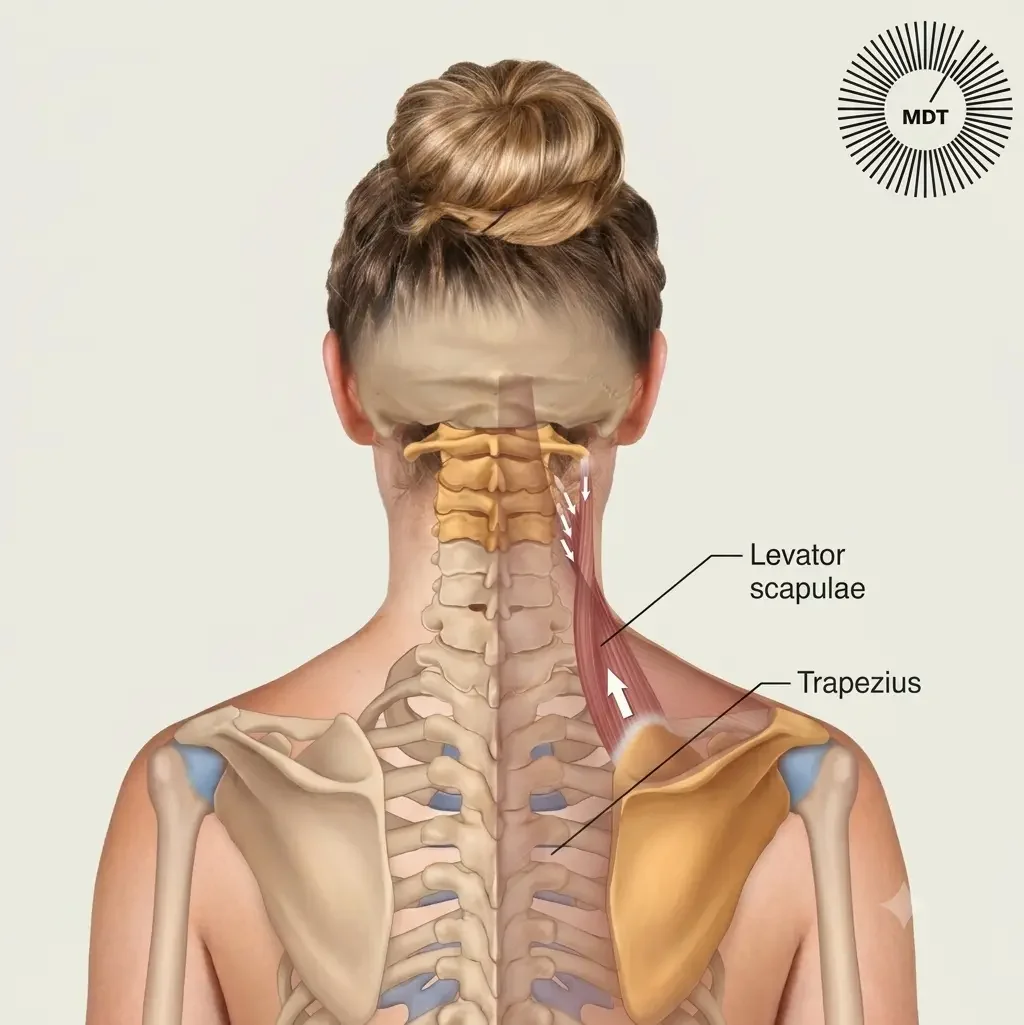
This can increase demand on the upper trapezius and levator scapulae, two muscles commonly involved in neck and shoulder tension. Over time, this posture can make the neck feel stiff, heavy, or tired, especially after long screen sessions.
The upper trapezius can become overactive during computer work
The upper trapezius is one of the muscles most commonly associated with desk-related neck tension. It runs from the neck and upper spine toward the shoulder. During computer work, it may stay lightly active to help support the arms, shoulder position, and head posture.
Stress and work demands can increase this effect. A systematic review and meta-analysis by Eijckelhof et al. found that workplace stressors such as cognitive demand, emotional stress, work pace, and precision can increase muscle activity in the neck-shoulder and forearm muscles during computer work. This helps explain why your shoulders may creep up toward your ears when you are focused, rushed, or under pressure.
Levator scapulae tension can contribute to neck stiffness
The levator scapulae connects the upper neck to the top of the shoulder blade. When you sit for long periods with the shoulders slightly raised, the head forward, or the neck rotated toward one screen, this muscle can feel stiff or tender.
This is one reason desk workers often feel discomfort near the upper inside corner of the shoulder blade or along the side/back of the neck. This muscle is commonly involved when the neck feels stiff or uncomfortable while turning to one side.
How to use these neck stretches safely
Before jumping into the exercises, remember that the goal isn’t to stretch as far as possible. The goal is to restore comfortable movement after spending hours in the same position.
A gentle, consistent approach usually works better than forcing your neck into a stretch.
Start from a comfortable position
Before each stretch:
Sit or stand upright with your spine supported.
Let your shoulders relax away from your ears.
Keep your head in a comfortable, neutral position before beginning the movement.
Move slowly and gently
Use your hands only to guide the movement, never to force it.
Stretch until you feel a gentle pull, not pain.
Hold each stretch for 20–30 seconds while breathing normally.
Return slowly to the starting position before moving to the next stretch.
Don’t wait until your neck feels terrible
One of the biggest mistakes desk workers make is waiting until the end of the day before moving.
Research on sedentary behaviour consistently suggests that frequent movement breaks are more effective than remaining in one position for several hours.
Try one or two neck stretches every 20–30 minutes, and stand up or walk for a minute at least once every hour.
Listening to your body
Some mild stretching or muscular effort is normal.
Stop the exercise if you experience:
Sharp or increasing pain.
Tingling or numbness.
Dizziness.
Pain spreading into the arm.
If symptoms continue despite changing your posture and activity, consider seeking advice from a healthcare professional.
Remember: Neck stretches work best as part of a broader strategy that includes regular movement breaks, good workstation habits, and general physical activity not as a one-time fix at the end of a long workday.
Myofascial release before neck stretching
Before stretching, some people find it helpful to begin with a few minutes of gentle self-myofascial release (SMR) using a massage ball, tennis ball, or even their fingers. This technique applies light pressure to areas that commonly feel tense, such as the upper trapezius, levator scapulae, or the muscles at the base of the skull.
Research on self-myofascial release and trigger-point techniques suggests they may temporarily reduce pain sensitivity and improve short-term range of motion. However, the evidence remains mixed, and the effects are generally modest.
For desk workers, the practical approach is simple: apply gentle pressure first, then follow with a slow stretch. Think of it as helping the muscle “downshift” before asking it to move more freely.
Pressure should feel like mild-to-moderate relief, not sharp pain. Avoid pressing directly on the front of the neck, throat, spine, or any numb/tingling area. Stop if symptoms travel down the arm, cause dizziness, headache worsening, or nerve-like pain.
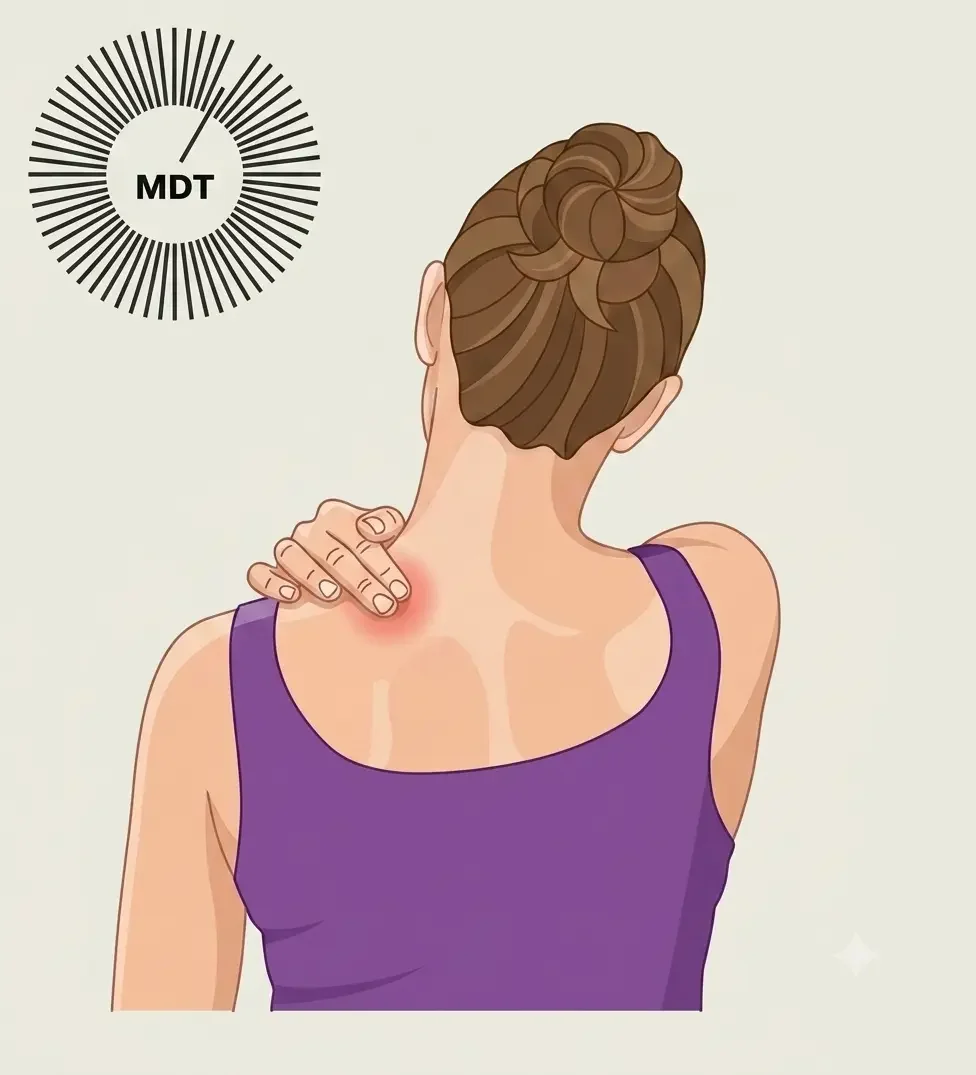
Upper trapezius and Levator scapulae myofascial release
Using your index and middle fingers, apply gentle pressure to the upper trapezius muscle near the top of the shoulder. Hold each tender spot for 30–60 seconds, then move slightly to explore four or five nearby areas. The pressure should feel relieving rather than painful.
4 Targeted neck stretch exercises
If you’ve chosen to perform self-myofascial release first, continue with the stretches below. If not, you can begin directly with the exercises. These movements target muscles that commonly become tense during prolonged desk work, including the upper trapezius, levator scapulae, suboccipital muscles, and scalenes.
Forward neck stretch
How to do it: Sit upright, tilt the head forward, place fingers on the back of the head, and gently pull forward. Then let the head tilt slightly forward. Keep the pressure light. Your hands should guide the movement, not force it.
Duration: 15–30 seconds, 1–2 rounds.
Upper back stretch
How to do it: Round the upper back, tuck the chin, reach forward up with straight arms and laced fingers, and hold for at least 20 seconds.
Duration: 15–30 seconds, 1–2 rounds.
Diagonal (levator scapulae) stretch
How to do it: Sit tall. Turn your head about 45 degrees to one side, then gently look down toward your armpit or front pocket. Use your hand only for light guidance, not force.
Duration: 20–30 seconds per side.
Scalene stretch (from neck)
How to do it: Sit tall. Keep one shoulder relaxed by placing that arm behind your back. Gently tilt your head away from that side, then slightly rotate your chin upward. The stretch should feel mild along the front-side of the neck. Do not press on the front of the neck.
When to use these stretches during the workday
Neck stretches and self-myofascial release (SMR) work best when they become part of your daily routine rather than something you remember only after your neck is already stiff.
You don’t need to perform the full sequence every time. Often, 30-60 seconds of gentle SMR followed by one or two stretches is enough to help your neck and shoulders feel more comfortable.
Good times to perform them include:
Before starting a long period of focused work.
After 60–90 minutes of continuous computer use.
Immediately after a long meeting or video call.
Whenever you notice your shoulders creeping toward your ears.
When you catch yourself pushing your head closer to the screen.
At the end of the workday to help your neck transition out of a prolonged sitting position.
Often, one or two stretches combined with standing up, walking for a minute, or simply changing your posture are enough to interrupt the static muscle loading that builds during desk work.
Remember: The best neck stretch is often the one you actually perform. A 30-second stretch or brief self-myofascial release repeated several times throughout the day is usually more valuable than one long session after eight hours of sitting.
Looking for more than just neck stretches? Try our: “Range of motion exercises for sitting all day: a 1-minute desk routine”
When to get professional help
Most cases of neck stiffness related to desk work improve with regular movement, posture changes, and time away from prolonged sitting.
However, neck pain isn’t always caused by muscle tension alone. Consider speaking with a healthcare professional, such as a physiotherapist or your primary care physician, if you notice any of the following:
Neck pain that is severe or continues to worsen despite changing your activity.
Symptoms that persist for several weeks without improvement.
Pain that radiates into the shoulder, arm, or hand.
Numbness, tingling, or weakness in the arm or fingers.
Pain following a fall, accident, or other injury.
Neck pain accompanied by dizziness, problems with balance, fever, or unexplained weight loss.
Pain that regularly wakes you at night or is present even when you are resting.
The exercises in this guide are intended for common desk-related muscle tension and stiffness. They are not a substitute for a medical assessment when symptoms are severe, persistent, or accompanied by neurological signs.
Common mistakes
Only stretching when your neck already hurts
Many people wait until the end of the workday before doing anything for their neck. By then, the muscles may have been under low-level tension for hours.
Instead, use short stretches and movement breaks throughout the day to interrupt prolonged static loading before discomfort builds.
Learn how to build movement into your workday: “Movement breaks at work: a 1-minute system for desk workers.”
Pulling too hard
A neck stretch should feel gentle, not painful.
Using excessive force or aggressively pulling your head with your hands is unlikely to provide extra benefit and may leave the muscles feeling more irritated afterward.
Only stretching the neck
Neck tension is rarely just a neck problem.
The upper back, shoulders, chest, and shoulder blades all influence how the neck moves and feels. Combining neck stretches with upper-body mobility exercises and regular movement breaks usually works better than focusing on the neck alone.
Neck tension often involves more than just the neck. Explore our full-body routine: “Muscle tension from sitting at a desk? 7 gentle exercises to try.”
Trying to find the “perfect” posture
There is no single sitting posture that completely prevents neck tension.
Even a well-adjusted workstation cannot replace regular movement. The best posture is still your next posture.
Ignoring stress
Deadlines, concentration, and mental workload can all increase muscle activity around the neck and shoulders.
If you notice yourself raising your shoulders or clenching your jaw while working, take a short break, breathe, relax your shoulders, and move before returning to your task.
Thinking stretching replaces exercise
Neck stretches can improve comfort and restore movement, but they don’t replace regular physical activity or strength training.
A healthy neck benefits from a combination of mobility, strength, movement breaks, and an ergonomic workstation.
Expecting immediate results
One stretching session won’t undo months or years of prolonged desk work.
Small amounts of movement performed consistently throughout the day are usually more effective than one long stretching session after work.
FAQ
-
Both can be useful. Stretching before work may prepare your neck for several hours at the computer, while stretching after work can help restore movement following a long day of sitting. Many desk workers benefit most from doing short sessions throughout the day rather than one longer session.
-
They can complement each other. Gentle self-myofascial release (SMR) may help reduce tenderness before stretching, while stretching encourages the neck to move through a comfortable range of motion. You don’t necessarily need to choose one over the other.
-
For most gentle neck stretches, holding the position for 20–30 seconds is a practical starting point. The stretch should feel comfortable, never painful.
-
Yes. For most healthy adults, gentle neck stretches and mobility exercises are safe to perform daily. The key is to move slowly and avoid forcing the movement.
-
Many people naturally spend more time looking toward one monitor, using one hand for the mouse, or carrying a bag on the same shoulder. Small differences in daily habits can lead to one side feeling tighter than the other.
-
Occasional painless clicking is common and is often related to normal joint movement. However, if clicking is accompanied by pain, locking, dizziness, or other symptoms, it’s worth discussing with a healthcare professional.
-
A standing desk can reduce sitting time, but it isn’t a complete solution. Standing in one position for long periods can also lead to discomfort. Regular movement and changing position throughout the day remain the most important strategies.
-
Both have their place, but if you had to choose one, moving more frequently throughout the day is likely to have the greater impact. Short movement breaks combined with occasional neck stretches are generally more effective than relying on stretching alone after eight hours of sitting.
These neck stretches can help you add movement when your upper body feels stiff, but the bigger win is consistency. Exercise Snacks give you a structured system of 1-minute exercises snacks, weekly PDFs, and calendar prompts to help you move more often during the workday.
References:
Hansraj, K. K. (2014): Assessment of stresses in the cervical spine caused by posture and position of the head.
Indri Hapsari Susilowati., (2022): The prevalence of bad posture and musculoskeletal symptoms originating from the use of gadgets as an impact of the work from home program of the university community.
Russin, N. H., (2026): Upper Crossed Syndrome in the Workplace: A Narrative Review with Clinical Recommendations for Non-Pharmacologic Management.
Toh, S. H., (2017): The associations of mobile touch screen device use with musculoskeletal symptoms and exposures: A systematic review.
Read more posts: