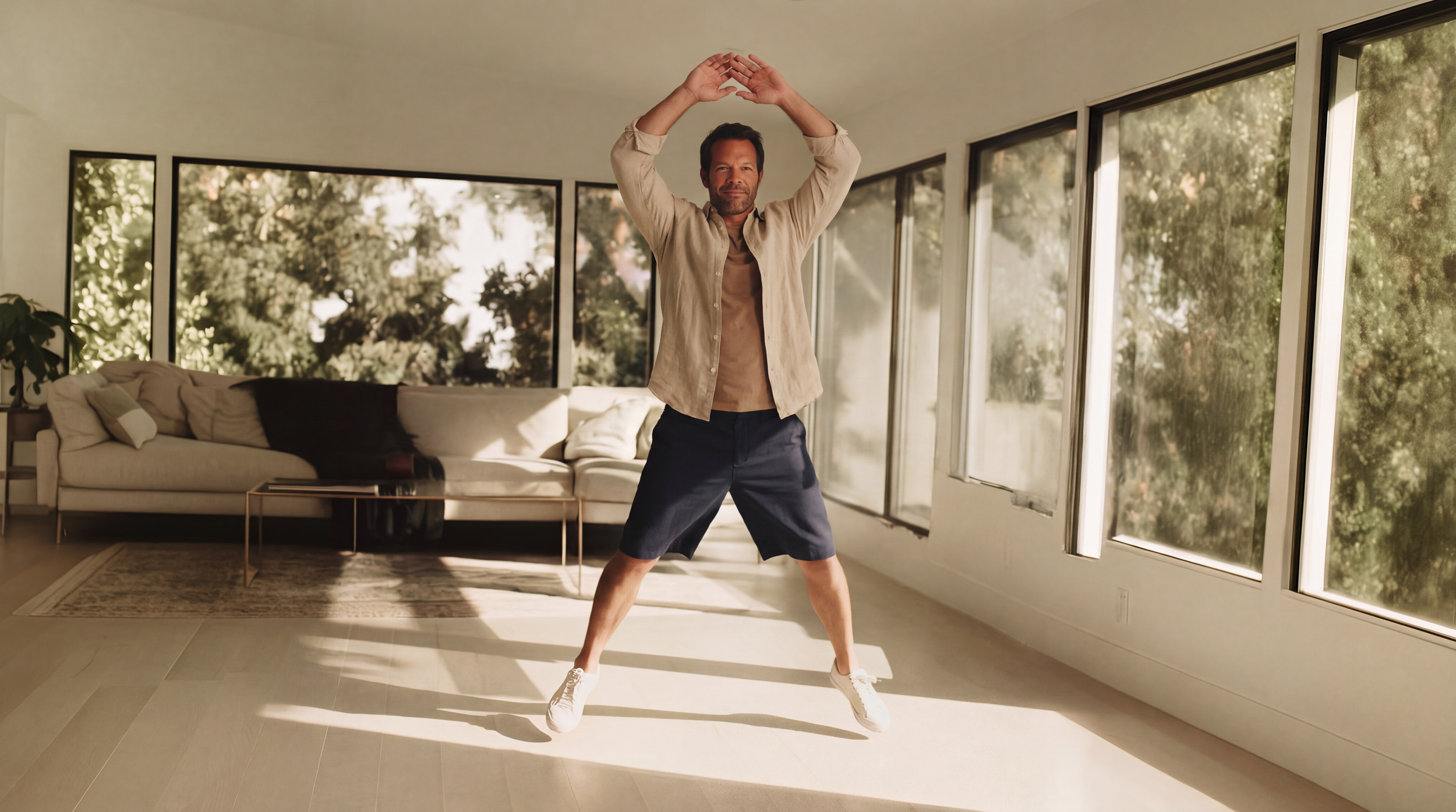
Jumping Jacks
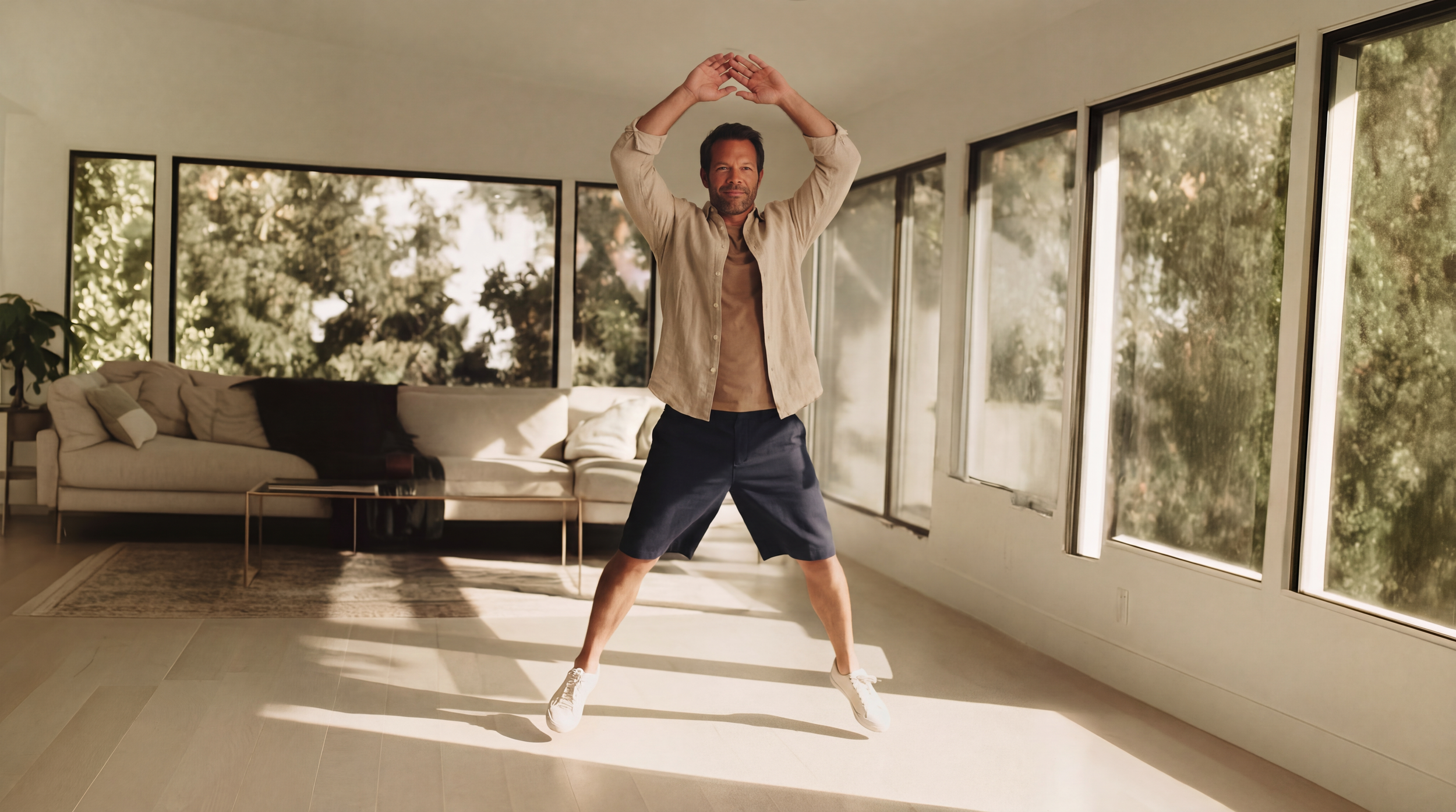
“A one-minute routine that can fit into a busy workday.”
I began using the MicroDosing Training approach with both my clients and in my own training because I was looking for ways to make movement more practical, varied, and easier to repeat.
Because if you are going to do something, it makes sense to do it intelligently, right? That brings us to jumping jacks.
They are simple, familiar, and easy to overlook. Yet they involve the upper and lower body at the same time, require no equipment, and can raise your heart rate within a short period.
This raises a practical question:
Could jumping jacks be one of the most efficient full-body movements for a one-minute Exercise Snack for desk workers?
In this post, we will look at their benefits and limitations, several lower- and higher-impact variations, and a one-minute routine that can fit into a busy workday.
What are jumping jacks?
Jumping jacks have been used in physical education, military training, and sports conditioning for generations. They are one of the best-known calisthenics exercises — a form of bodyweight training that uses simple, repeated movements to improve fitness.
Their popularity comes from their simplicity. Within seconds, jumping jacks combine rhythmic upper- and lower-body movement, making them an efficient way to increase activity and raise your heart rate without equipment.
An interesting historical detail is that General John J. “Black Jack” Pershing is often credited with developing or popularizing an early version of the exercise at West Point in the late nineteenth century. However, the exact origin is uncertain. The name “jumping jack” is more likely connected to an older jointed toy whose arms and legs moved outward when a string was pulled.
Unlike many bodyweight exercises that mainly emphasize one area, jumping jacks involve several joints and muscle groups at the same time.
During each repetition, you use:
the calves, quadriceps, and glutes to jump and land;
the muscles around the hips to move the legs outward and inward;
the shoulders and upper back to raise and lower the arms;
the core muscles to stabilize the trunk.
Jumping jacks are not primarily a strength exercise in the same way as squats or push-ups. Instead, they combine coordination, muscular endurance, and cardiovascular effort.
Proper jumping jack technique
Good technique makes the movement more efficient and helps reduce unnecessary impact. There are also several lower- and higher-impact variations, which we will cover later in the article and demonstrate in the video.
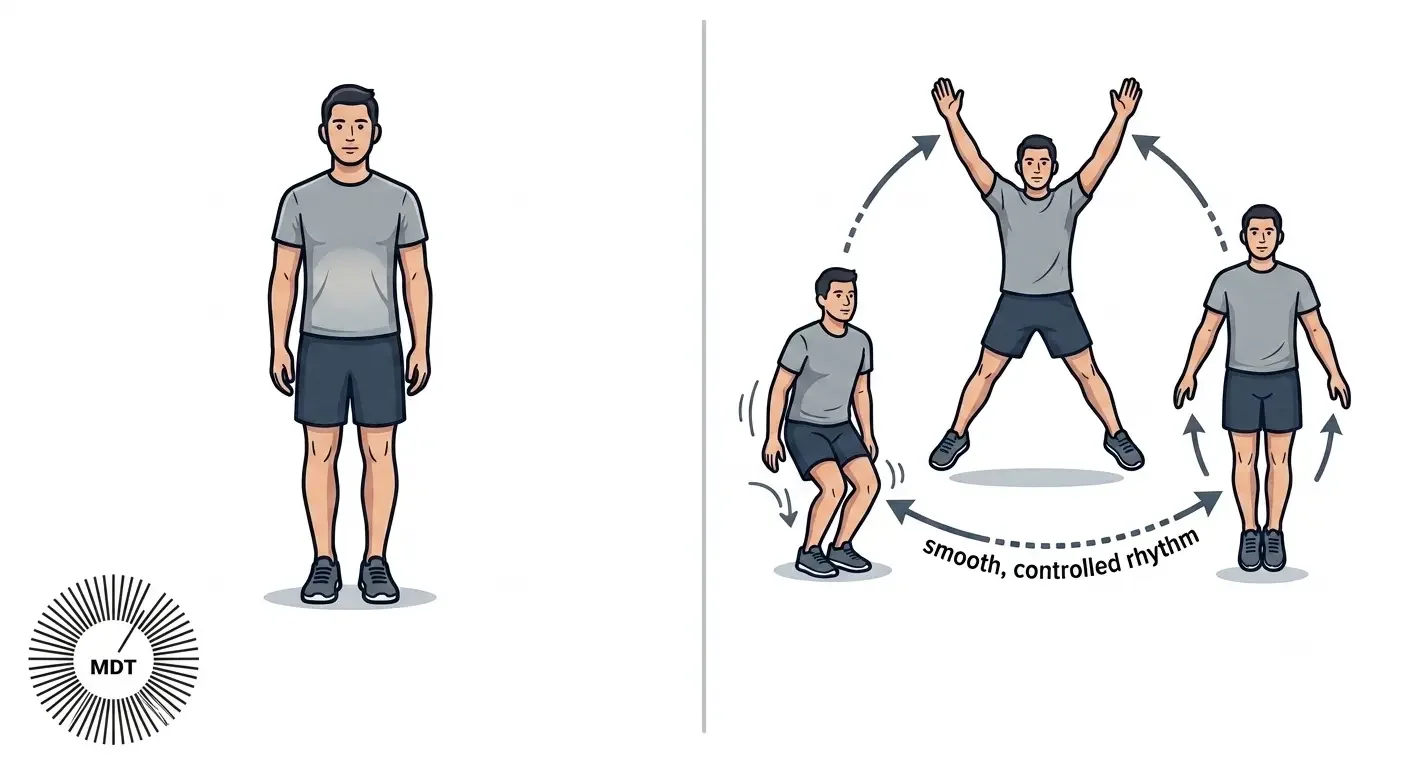
Starting position
Stand tall with your feet together.
Keep your arms by your sides.
Brace your core lightly and look straight ahead.
Movement
Jump your feet wider than shoulder width.
Raise your arms overhead at the same time.
Land softly with slightly bent knees.
Jump back to the starting position.
Maintain a smooth, controlled rhythm.
At first glance, jumping jacks may seem like little more than a warm-up exercise. However, their ability to engage large muscle groups and raise your heart rate quickly makes them well suited to the Exercise Snack concept: a brief bout of movement designed to interrupt prolonged sitting and increase activity during the day.
Why jumping jacks work well as an exercise snack
Exercise snacks are brief, planned bouts of movement performed periodically throughout the day. Unlike incidental activity, such as walking to another room, they are intentional and usually repeated according to a simple structure.
Depending on the goal, an exercise snack may involve vigorous activity, light movement, or a specific exercise targeting a particular area of the body. In this context, the main purpose is to interrupt prolonged sitting and add short periods of purposeful movement to the day.
Physiological benefits
Research on exercise snacks has mainly examined activities such as stair climbing, cycling, and brief bodyweight exercise. Proof-of-concept studies suggest that repeated, vigorous stair-climbing snacks can produce modest improvements in cardiorespiratory fitness in previously inactive adults.
Brief activity breaks may also help counter some of the immediate effects of prolonged sitting. Studies included in the reference section have reported benefits for post-meal insulin responses, peripheral blood flow, and vascular function, although results vary according to the activity, intensity, frequency, and population studied.
There are other possible benefits, but we do not need to examine every physiological mechanism here.
Read also: “Physiology of sedentary behavior”.
Jumping jacks fit the exercise snack format for several practical reasons:
They require no equipment. You only need enough space to move safely.
They involve the whole body. The legs, hips, shoulders, arms, and trunk work together.
They raise the heart rate quickly. This makes them useful when the goal is to add a short burst of more vigorous movement.
They are time-efficient. A brief set can fit between meetings or during a natural pause in the workday.
They are easy to modify. Step jacks and other low-impact variations make the movement more accessible for different fitness levels.
This does not mean jumping jacks are the best choice for everyone. They create more impact than walking or gentle mobility exercises and may not suit people with certain joint problems, balance limitations, or unsuitable footwear.
An interesting finding from research
Jumping jacks have even been used as the basis of a field fitness assessment known as the Jumping Jacks Test (JJT).
In one study, participants performed jumping jacks at a standardized cadence before continuing at maximum effort until exhaustion. The test showed excellent repeatability for estimating maximal oxygen uptake (VO₂max), suggesting that jumping jacks are a consistent whole-body movement capable of producing a meaningful cardiovascular challenge.
While the JJT was designed as a fitness assessment, it highlights how physiologically demanding this simple bodyweight exercise can be. Together with their practical advantages: no equipment, minimal space, and the ability to involve large muscle groups quickly, this helps explain why jumping jacks can be a useful exercise snack for many generally healthy adults.
Impact and safety
Jumping jacks are considered a high-impact movement because both feet briefly leave the floor before returning to the ground. Each time you land, the floor exerts force back through the body. This is known as ground-reaction force.
The amount of force involved depends on several factors, including:
how high you jump;
how quickly you land;
your body mass;
the surface and footwear;
how effectively your ankles, knees, and hips absorb the landing;
whether fatigue has started to affect your technique.
Impact is not automatically harmful. Bones, muscles, tendons, and joints are capable of tolerating and adapting to appropriate levels of loading. Problems are more likely to occur when the amount of impact exceeds what the body is currently prepared to handle - for example, when someone does too much too soon, lands with poor control, or does not allow enough recovery.
A softer landing spreads the force over a slightly longer period. Rather than landing with stiff legs, allow the ankles, knees, and hips to bend naturally and work together to absorb the load.
Land quietly. Keep the knees soft. Let the ankles, knees, and hips share the load.
People who are new to impact exercise, carrying more body mass, returning after an injury, or experiencing discomfort may benefit from beginning with a lower-impact variation such as the step jack, which we will cover in the next section.
A step jack keeps one foot in contact with the floor and removes the simultaneous takeoff and landing while still providing rhythmic, full-body movement.
The goal is not to eliminate all force. It is to choose a level of impact that you can tolerate comfortably and control with good technique.
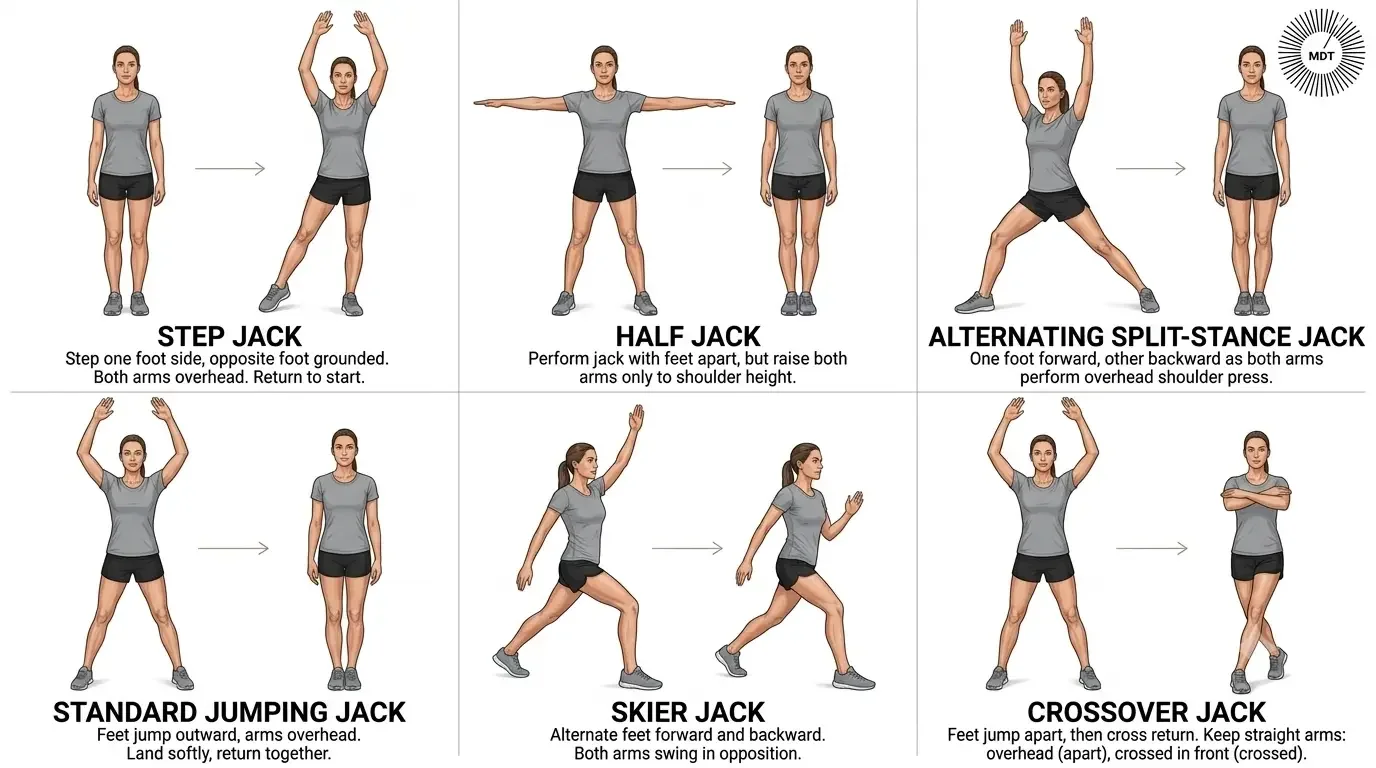
1. Step Jack
Instead of jumping both feet apart at the same time, step one foot out to the side while raising the arms, then return to the starting position and repeat on the other side.
This variation reduces impact, noise, and coordination demands while preserving the rhythm of the movement.
Best for:
beginners;
people returning to exercise;
office environments;
anyone who prefers a no-jump option.
2. Half Jack
Perform either a regular jumping jack or a step jack, but raise the arms only to shoulder height instead of taking them fully overhead.
Best for:
people with limited shoulder mobility;
rooms with low ceilings;
anyone who feels discomfort during overhead movement.
3. Alternating Split-Stance Jack
Move one foot forward and the other backward while the arms move through the shoulders press pattern, then switch sides on the next repetition.
This variation can be performed as a step or with a light jump, depending on your comfort level.
Why use it:
adds a coordination challenge;
introduces forward-and-back movement;
may feel more dynamic than a standard step jack;
can be adjusted to a lower- or higher-impact version.
4. Standard Jumping Jack
Jump both feet outward while raising the arms overhead. Land softly, then jump the feet back together as the arms return to your sides.
Best for:
people who are comfortable with impact;
creating a moderate-to-vigorous cardiovascular effort;
anyone who already tolerates jumping with good control.
5. Skier Jack
Instead of moving the feet from side to side, alternate one foot forward and the other backward. The arms move in opposition, similar to the rhythm used in cross-country skiing.
Why use it:
challenges coordination;
emphasizes forward-and-back movement;
adds variety;
may require less space from side to side.
6. Crossover Jack
Jump the feet apart, then cross one foot in front of the other as you return toward the center. Alternate which foot crosses in front. The arms may also cross in front of the chest.
Why use it:
creates a greater coordination challenge;
adds lateral control;
introduces faster changes in foot position;
increases complexity without requiring a higher jump.
Choose the variation that allows you to move with control. A more complex or higher-impact version is not automatically better.
A 1-Minute Jumping Jack Routine
Choose the level that best matches your fitness, confidence, and comfort with impact. Focus on controlled movement rather than speed.
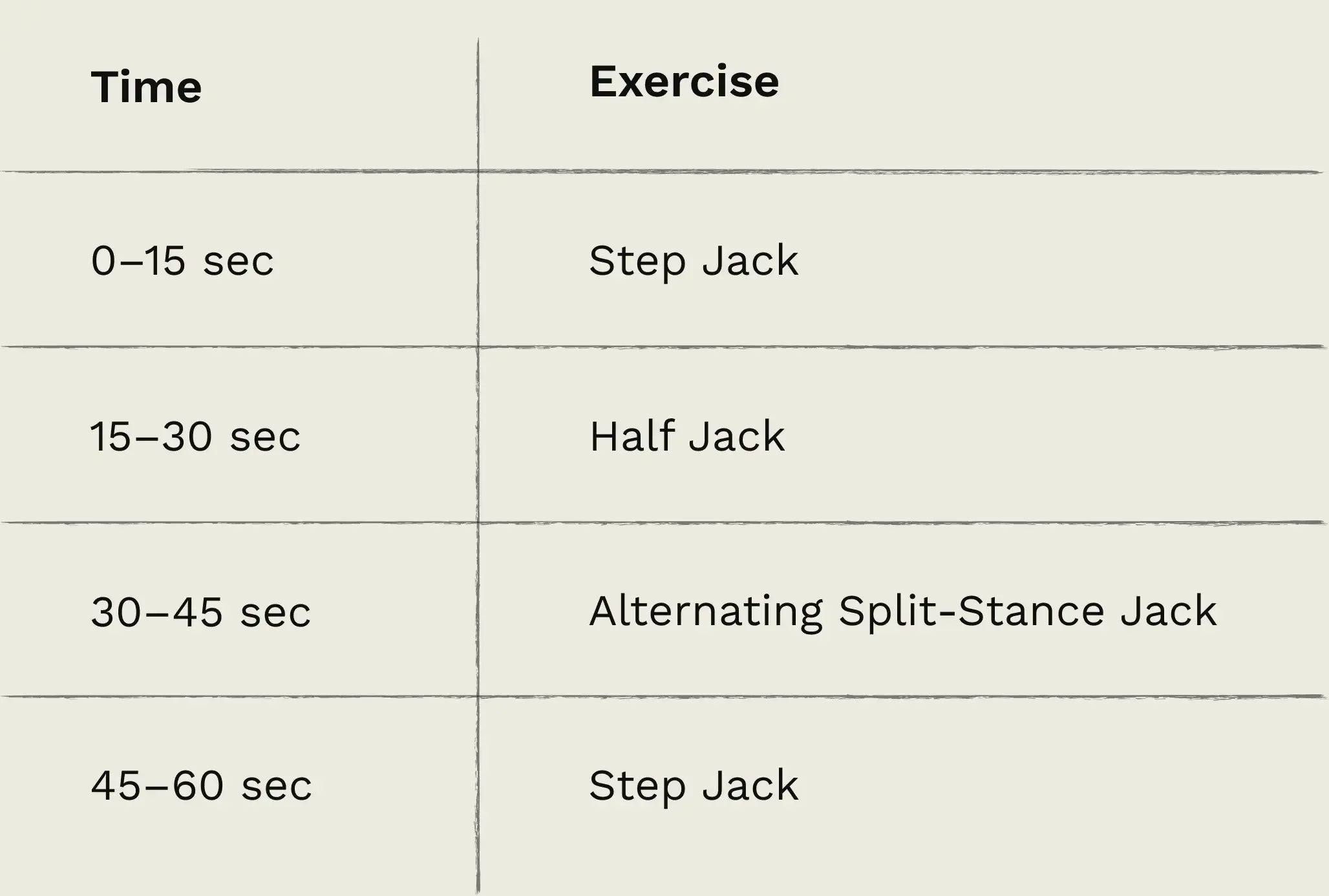
Level 1 – Easy (Low impact)
Designed for beginners or anyone who prefers to avoid jumping.
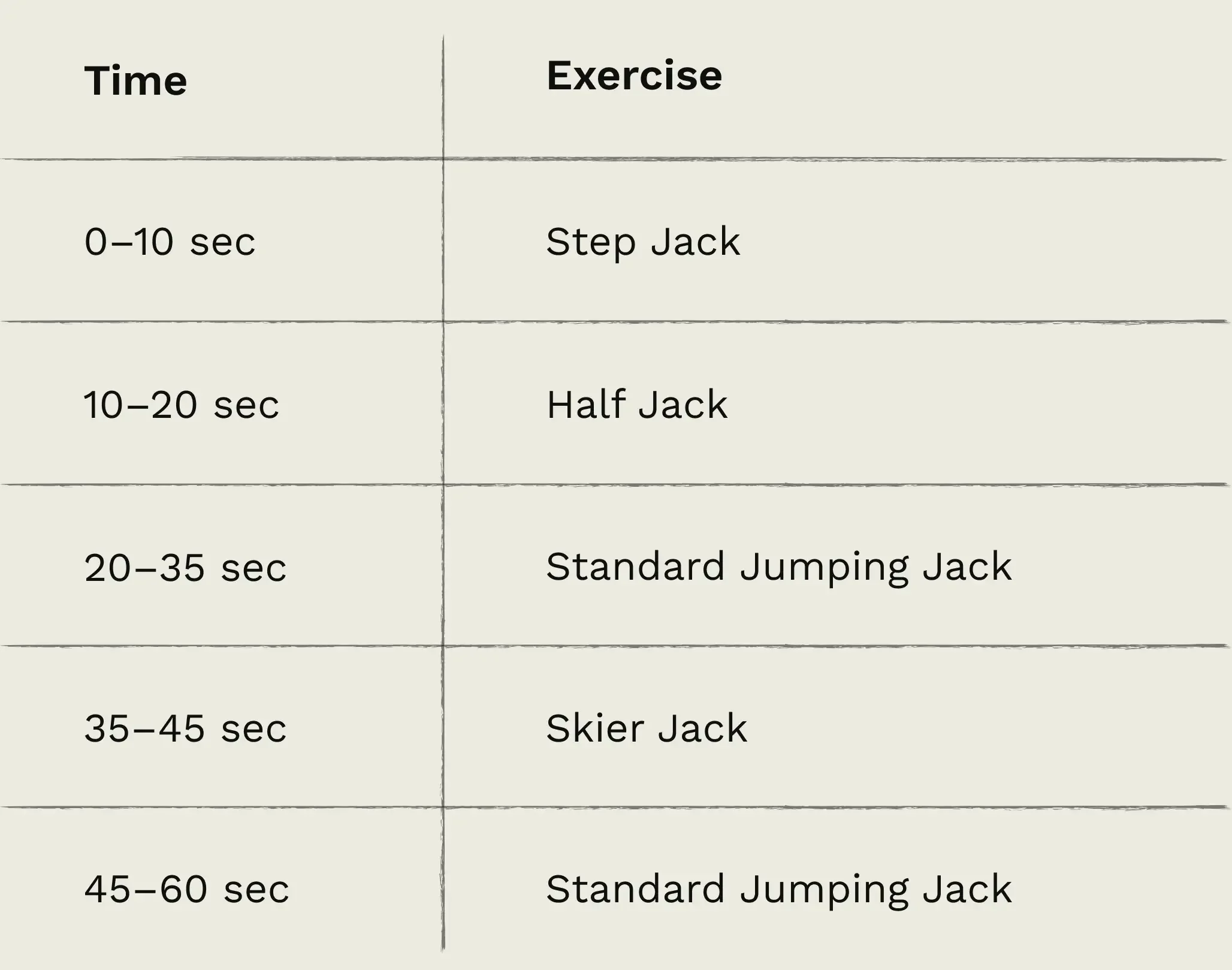
Level 2 – Intermediate (Mixed impact)
A combinationt of low- and moderate-impact variations that gradually increases cardiovascular demand.
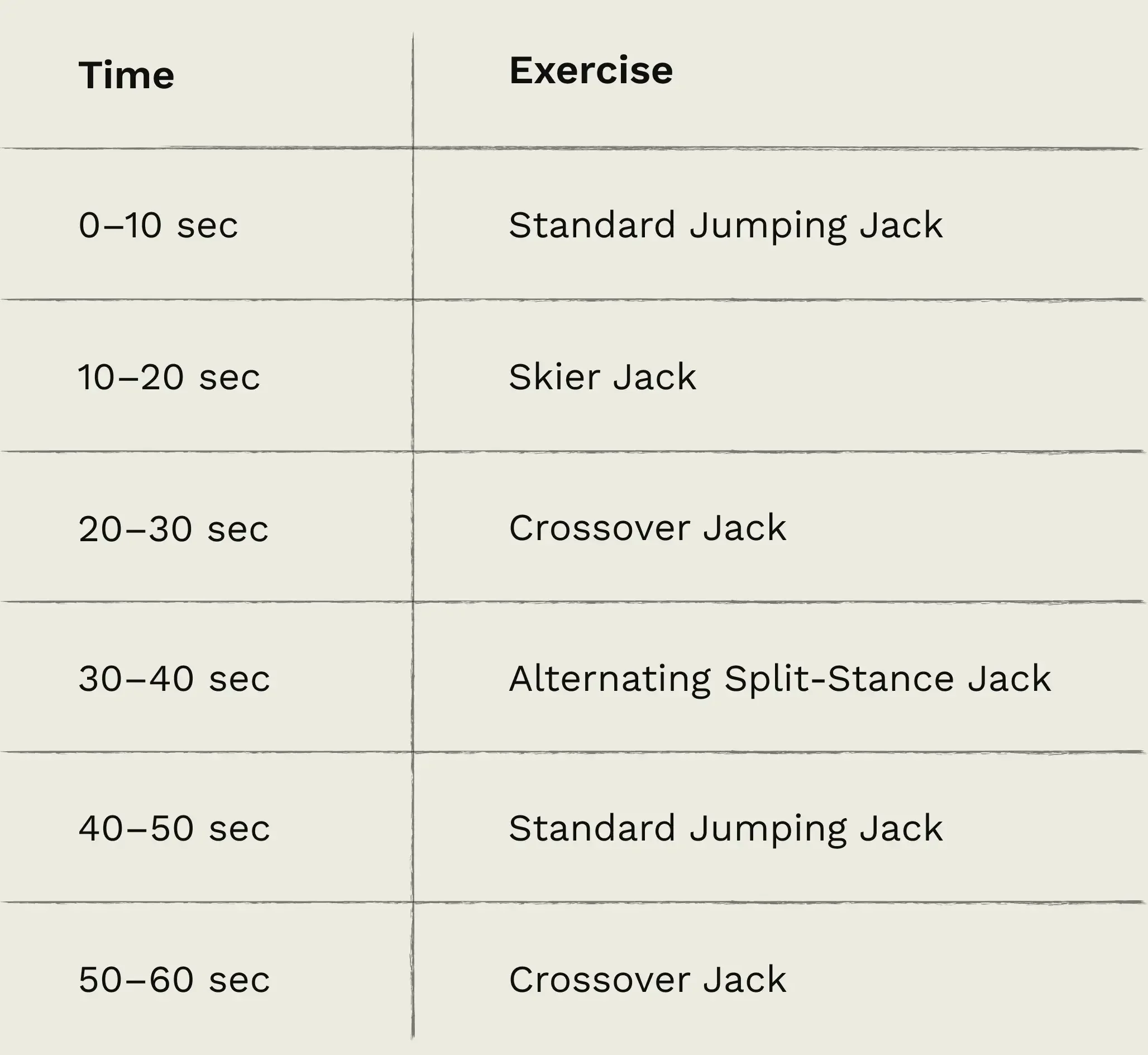
Level 3 – Advanced (Higher intensity)
For people who are comfortable with jumping and want a more demanding one-minute Exercise Snack.
Move continuously but stay in control. Land softly, keep your knees slightly bent, and stop or switch to a lower-impact variation if you experience pain, dizziness, or loss of balance.
Read also: “Muscle tension from sitting at a desk? 7 exercises to try”.
When to use jumping jacks
Jumping jacks work best as a short movement break rather than a workout. Their purpose is to interrupt prolonged sitting, increase whole-body movement, and briefly raise your heart rate before returning to work.
As discussed in our guide onhow often you should take movement breaks, most research suggests that breaking up sitting every 30–60 minutes is a practical target for desk workers. The exact timing matters less than building a routine you can repeat consistently.
Good times to use them include:
Between meetings. A one-minute set provides a quick physical reset before starting the next task.
Before a deep work session. A brief burst of movement can help you transition into a period of focused work.
After 60–90 minutes of sitting. Use jumping jacks to break up prolonged sitting and restore movement.
During the afternoon slump. Instead of remaining seated, a short set of jumping jacks can add variety and increase activity when energy starts to dip.
When working from home. They require no equipment and only a small amount of space, making them easy to perform between emails, phone calls, or while waiting for the kettle to boil.
Jumping jacks are only one option within the exercise snack approach. On some days, a short walk, mobility routine, or stretching session may be a better choice. The goal is not to perform the same exercise every time, but to interrupt prolonged sitting with purposeful movement.
If jumping jacks feel too demanding, begin with step jacks or another low-impact variation. As your confidence and tolerance improve, you can gradually progress to the standard version.
Read also: “Range of motion exercises for sitting all day”.
Common mistakes
Landing too heavily
A noisy landing usually means the joints are absorbing more force than necessary. Land softly with slightly bent knees, allowing the ankles, knees, and hips to absorb the impact together.
Choosing a variation that is too difficult
Many people immediately perform standard jumping jacks, even if they are new to exercise or have not jumped for a long time. Start with step jacks or another lower-impact variation. Progress only when you can move comfortably with good control.
Moving too fast
Speed is often mistaken for intensity. As fatigue develops, technique usually becomes less controlled. Maintain a steady rhythm and focus on quality of movement rather than completing as many repetitions as possible.
Forgetting about arm movement
Some people focus only on the legs and barely move the arms. Use the full movement pattern. Raising the arms helps engage more muscle groups and contributes to the whole-body nature of the exercise.
Using jumping jacks for every movement break
Jumping jacks are a useful exercise snack, but they are only one option. Rotate them with walking, mobility exercises, stretching, resistance exercises, or other depending on your goals, available space, and energy levels.
Ignoring pain
Feeling your heart rate increase or your breathing become faster is normal. Joint pain is not. If you experience pain during jumping jacks, stop and switch to a lower-impact variation or another exercise. Persistent pain should be assessed by a qualified healthcare professional.
Remember, the goal of an exercise snack is not to perform the hardest exercise possible. It is to introduce brief, purposeful movement that you can repeat consistently throughout the day.
FAQ
-
Yes. Jumping jacks are a practical exercise snack because they involve the whole body, require no equipment, and can be completed in less than a minute. They are particularly useful for breaking up prolonged sitting during the workday.
-
There is no ideal number. For an exercise snack, focus on time rather than repetitions. Performing jumping jacks continuously for 30–60 seconds is usually enough to interrupt sitting and briefly increase your heart rate.
-
Yes. If standard jumping jacks feel too demanding, start with step jacks or another low-impact variation. As your coordination and confidence improve, you can gradually progress to the standard movement.
-
Not necessarily. For most healthy people, jumping jacks are well tolerated when performed with good technique and an appropriate level of impact. If you have knee pain, are returning from injury, or are new to jumping exercises, choose a lower-impact variation and consult a healthcare professional if symptoms persist.
-
Yes, but the goal is not to maximize calorie expenditure. Instead, jumping jacks are used to add brief periods of movement throughout the day, helping to interrupt prolonged sitting and increase overall physical activity.
-
They can be included whenever you take a movement break. Many experts recommend interrupting prolonged sitting every 30–60 minutes, although the exact timing is less important than creating a routine you can maintain consistently.
-
No. Jumping jacks are a useful way to increase daily movement, but they should complement, not replace regular aerobic exercise, resistance training, and mobility work.
-
There is no single best variation. The best choice depends on your fitness level, available space, and comfort with impact. Step jacks are often ideal for beginners, while standard, skier, and crossover jacks provide a greater cardiovascular and coordination challenge.
One exercise is a great start. A routine is even better.
Jumping jacks are just one example of an exercise snack. The real benefits come from making short movement breaks part of your daily routine.
References:
Khamjing, C., (2024): Validity and Reliability of a Novel Jumping Jacks Test for Estimating Maximal Oxygen Consumption in Healthy Young Adults. Natural and Life Sciences.
Islam, H.,(2022): Exercise snacks: A novel strategy to improve cardiometabolic health. Exercise and Sport Sciences Reviews.
Read more posts: