Muscle tension from sitting at a desk? 7 exercises to try

“In modern ergonomics the best posture is your next posture.”
As the years passed and I gained more experience as a gym founder and personal coach, I started paying closer attention to why people came to train in the first place.
Most weren’t powerlifters or professional athletes. They were ordinary office workers spending most of their day behind a desk.
The most common reason wasn’t weight loss or building muscle. It was discomfort. Neck tension. Tight shoulders. A stiff back. Achy hips after sitting all day.
After a few weeks or months of consistent training, something interesting usually happened. People complained less about stiffness and moved with much more confidence. Their bodies became stronger, but perhaps more importantly, they simply moved more.
If sitting at a desk leaves your neck, shoulders, back, or hips feeling tense, you are not alone. Long workdays often mean long periods in the same position, and your body may start asking for movement before the day is over.
This guide introduces seven gentle exercises that can help add movement variety, reduce the feeling of stiffness, and interrupt long periods of sitting throughout your workday.
For the full routine, see our “complete guide to exercises for sitting all day”.
Why sitting can make your muscles feel tense
Let’s start with a common question: is there really such a thing as good and bad posture?
The answer is yes… and no.
In biomechanics, we often talk about a neutral posture or neutral alignment. This is a position where the body’s joints are aligned so muscles, ligaments, and other tissues experience relatively low mechanical stress.
Rather than “bad” posture, it’s often more accurate to think about positions that place greater mechanical demands on certain tissues, especially when they’re maintained for long periods.
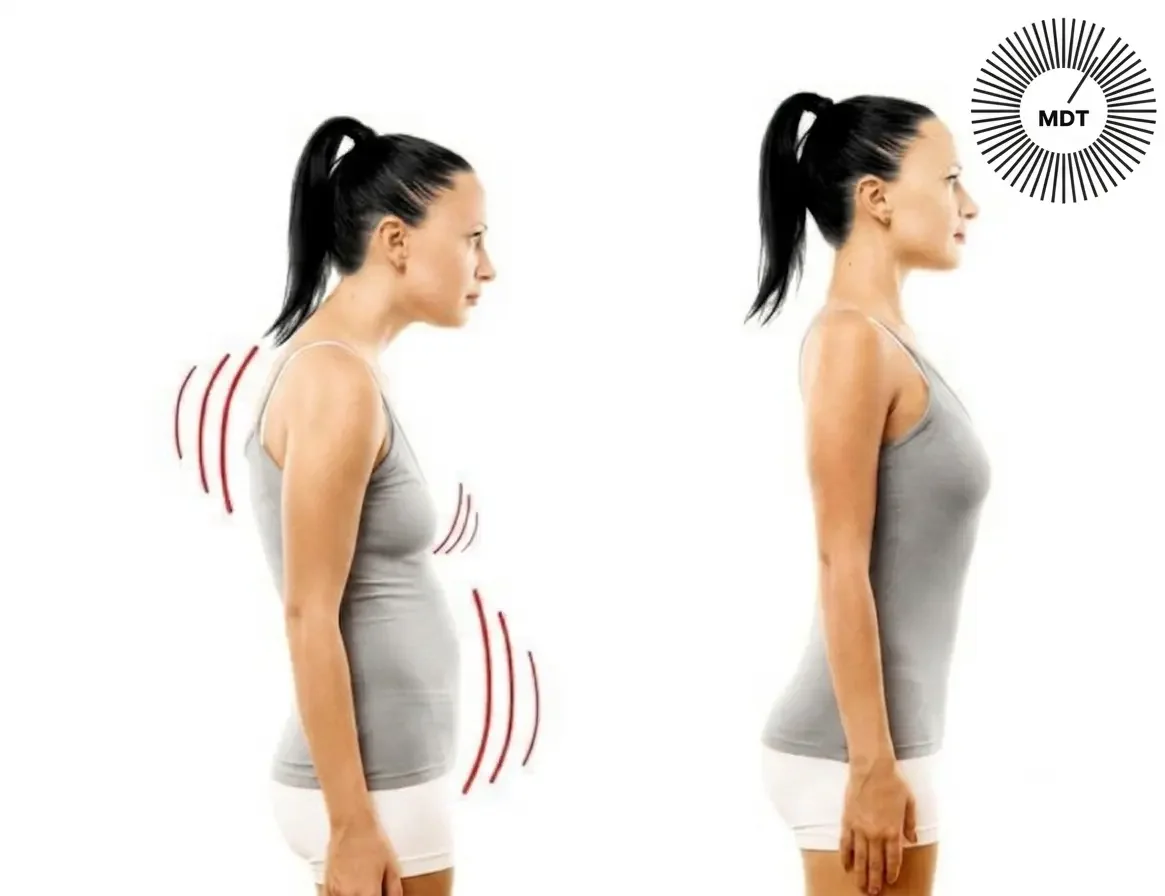
In modern ergonomics the best posture is your next posture.
If you’re interested in optimising your workstation, read our guide: “Home office ergonomics: how your setup affects your body.”
Sitting at a desk can make your muscles feel tense because the body is held in a low-movement, low-variation position for too long. Even if you are sitting with “good posture,” your neck, shoulders, back, hips, and forearms still have to hold steady positions while you look at a screen, type, and use a mouse.
The main mechanism is static muscle loading. Instead of contracting and relaxing through a full range of motion, many of the muscles used during desk work stay lightly active for long periods. This is common in the neck, upper shoulders, lower back, hip flexors, and forearms. Over time, that low-level holding pattern can contribute to fatigue, reduced comfort, and a feeling of tightness or tension.
Research on computer and office work links prolonged sitting with several tension-related factors: static postures, low-level muscle activity, fewer rest breaks, reduced movement variation, and increased neck, shoulder, and low-back discomfort. Stress can also amplify this.
These factors rarely occur in isolation. During a typical workday, several of them often happen at the same time, which is why muscle tension can gradually build even when the workload feels relatively light.
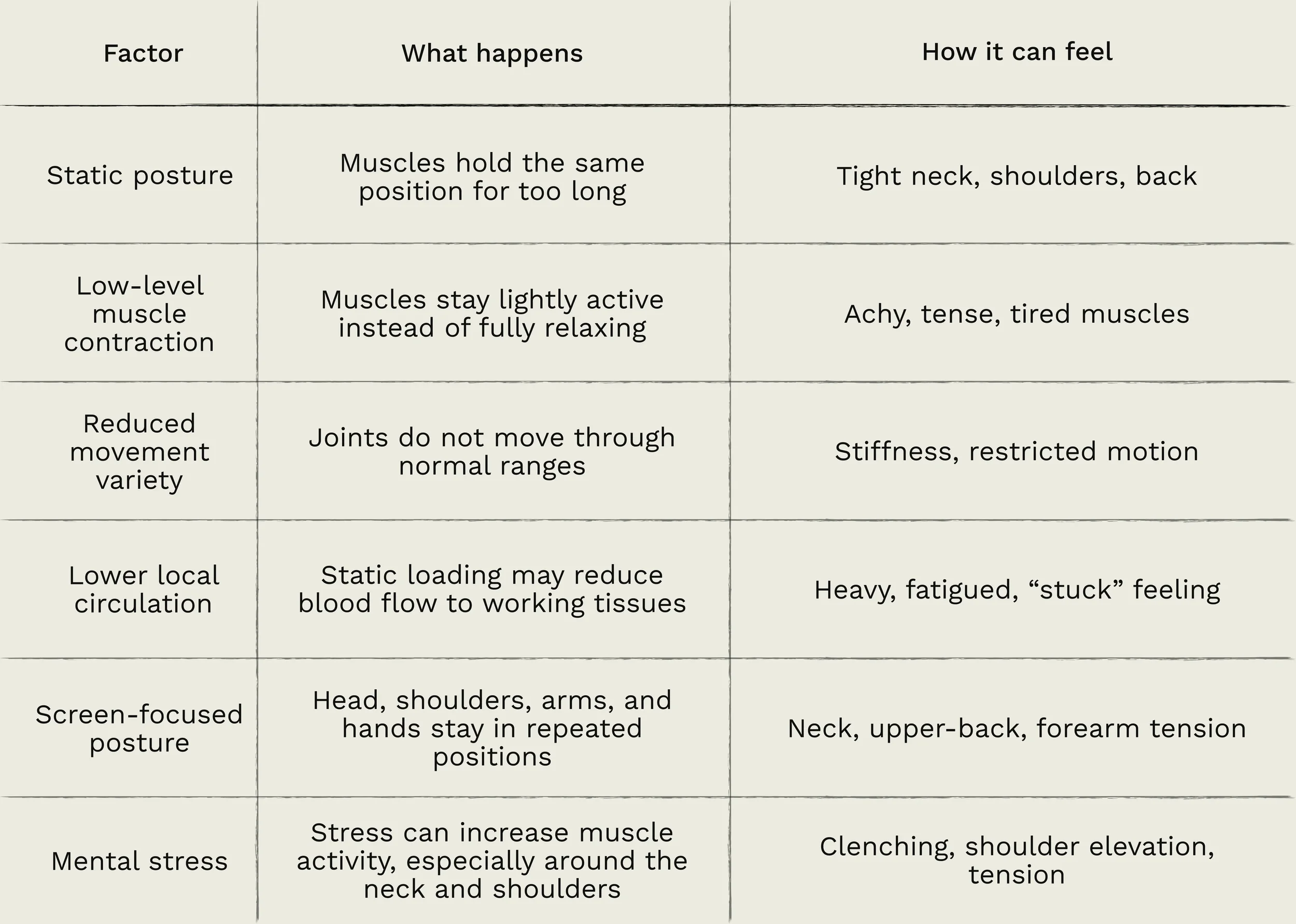
Where desk-related muscle tension often shows up
Low back and spine
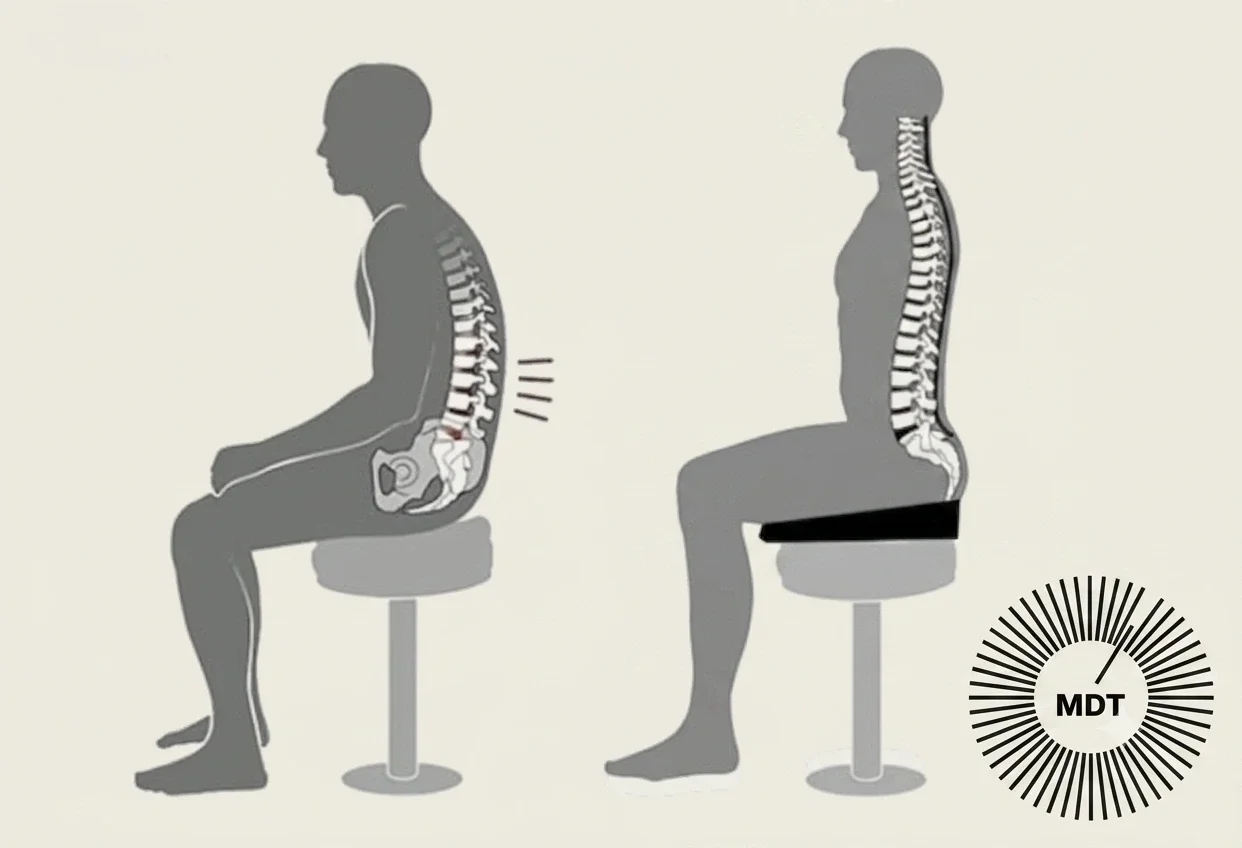
The lower back is one of the most common areas of discomfort among desk workers. During prolonged sitting, the natural inward curve of the lumbar spine (lumbar lordosis) often becomes flatter as the pelvis gradually tilts backward (posterior pelvic tilt), changing how forces are distributed across the spine and surrounding muscles.
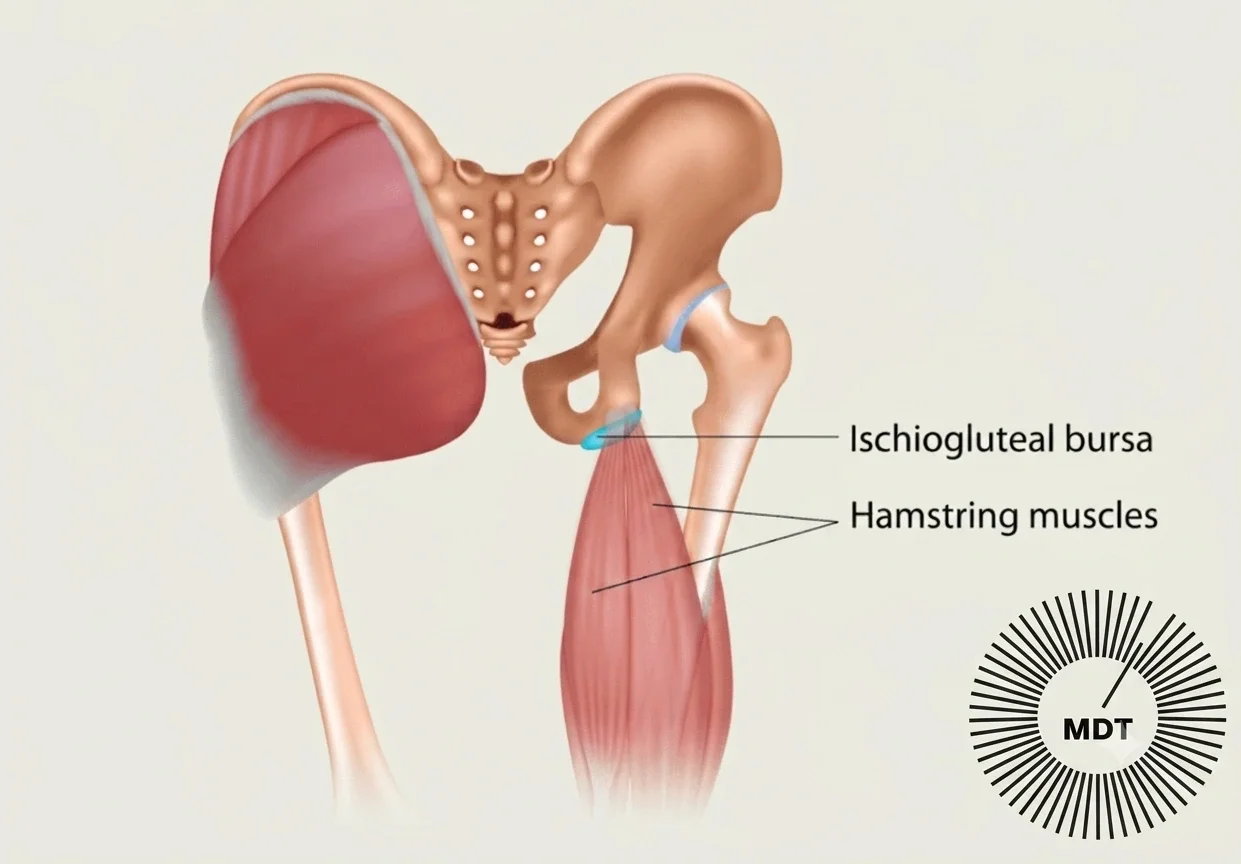
Hips, thighs, and buttocks
This area often experiences the earliest and most significant increases in discomfort, sometimes as early as 90 minutes into a sitting session. This is largely due to increased pressure around the sitting bones (ischial tuberosities), where the body’s weight is concentrated during prolonged sitting. Additionally, minimal muscle activity in the legs during sitting can reduce circulation in the legs, potentially leading to swelling or a feeling of heavy legs.
Neck and upper limbs
Discomfort also increases in the neck and shoulders, which is frequently associated with neck flexion and the strain of holding the arms unsupported for long periods. Repetitive movements from using a mouse and keyboard further contribute to this upper body tension.
Looking down at a laptop or monitor for prolonged periods can further increase the demands placed on the neck muscles.
How stress can increase muscle tension
One of the more surprising findings from ergonomics research is that muscle tension isn’t caused only by posture.
Mental workload also plays a surprisingly important role.
Studies show that cognitive demands, time pressure, and emotional stress can increase muscle activity, particularly in the neck, shoulders, and forearms, even when your body position doesn’t change.
Cognitive load
Tasks involving sustained concentration, memory, mental arithmetic, or rapid decision-making increase overall nervous-system arousal.
You can even experience this yourself by trying a simple STROOP test, a classic psychology experiment that measures selective attention and cognitive control.
Even though the task is purely mental, many people unconsciously tighten the muscles around the neck and shoulders while performing it.
Want to understand why this happens? Read our guide: “Physiology of sedentary behavior”.
Work pace and precision
The way you work also matters. Typing as quickly as possible, making rapid mouse movements, or repeatedly clicking small on-screen targets increases muscle activity in the forearms and hands. Research suggests that these physical demands often combine with mental stress, making posture-controlling muscles such as the upper trapezius even more active throughout the workday.
The upper trapezius is highly sensitive to both cognitive stress and work pace. Even when a stressor doesn’t directly interfere with the task, increased mental arousal can still lead to greater muscle activity.
Forearm muscles are primarily affected by task-related demands such as speed and precision, but they also become more active during purely mental tasks. Researchers believe this occurs because people subconsciously tighten their arm muscles to maintain precision under mental pressure.
Practical takeaway
Muscle tension isn’t always a sign that something is mechanically wrong.
Sometimes your muscles are responding not only to prolonged sitting, but also to deadlines, concentration, and mental workload. Both the body and the brain contribute to how “tense” your muscles feel by the end of the day.
Looking for a practical system? Learn how to interrupt prolonged sitting with our guide: “Movement breaks at work: a 1-minute system for desk workers”.
Tension vs. flexibility vs. strength
Muscle tension refers to the force produced within a muscle. It can occur during active contraction, such as lifting a weight, or passively when a muscle is stretched beyond it’s resting length, where connective tissues such as collagen and elastin begin to resist the movement.
Muscle tension is not always the same as poor flexibility (limited range of motion). For example, your shoulders may feel stiff after two hours at a laptop because the muscles of your neck and upper back have been working continuously at a low level for a prolonged period. In that case, gentle movement and position changes may help more than aggressive stretching.
Flexibility is the ability of a joint and its surrounding tissues to move comfortably through an available range of motion comfortably without unnecessary restriction. If your hips, shoulders, or upper back cannot move comfortably through normal ranges, stretching and mobility work may be useful. This is why desk workers often benefit from exercises that move the hips, spine, neck, and shoulders rather than only “fixing posture.”
Strength is your ability to produce force and tolerate repeated work. If your back, shoulders, or hips fatigue quickly during the day, stretching alone may not solve the problem. You may also need strengthening exercises that build endurance and support better posture over time.
Strength also improves a muscle’s capacity to tolerate repeated low-level work, such as maintaining posture during a long workday.
Want to improve your mobility? Read: “Range of motion exercises for sitting all day: a 1-minute desk routine”.
The key point is simple: muscle tension may respond best to movement, limited flexibility may benefit from stretching or mobility work, and muscle weakness often requires strengthening.
Gentle desk exercises are useful because they combine several of these approaches. They introduce movement variety, reduce prolonged static loading, and help you identify whether an area feels better after moving, stretching, or becoming stronger over time.
In reality, these problems often overlap. A desk worker may have tight-feeling neck muscles, limited shoulder mobility, and weak upper-back muscles at the same time. That’s why a balanced routine usually works better than relying on stretching alone.
Muscle tension relief protocol
Before we get into the exercises, there’s one more important point.
These exercises are not meant to become another 30-minute workout. Their purpose is to interrupt prolonged sitting, introduce movement variety, and give commonly used muscles and joints a chance to move again.
Perform the routine once or twice a day, depending on how much time you spend sitting.
Move slowly and gently. You should feel comfortable movement or a gentle stretch, never sharp pain.
Spend 30-60 seconds on each exercise, or repeat it for several controlled repetitions where appropriate.
Try the routine in the morning to prepare your body for a day at the desk, or after work to relieve the tension that has built up throughout the day.
If one area feels particularly stiff, it is perfectly fine to repeat that movement more than once.
And one more thing: these exercises are not a replacement for regular physical activity or strength training. Think of them as movement “snacks” that help your body cope with long periods of sitting between your regular workouts.
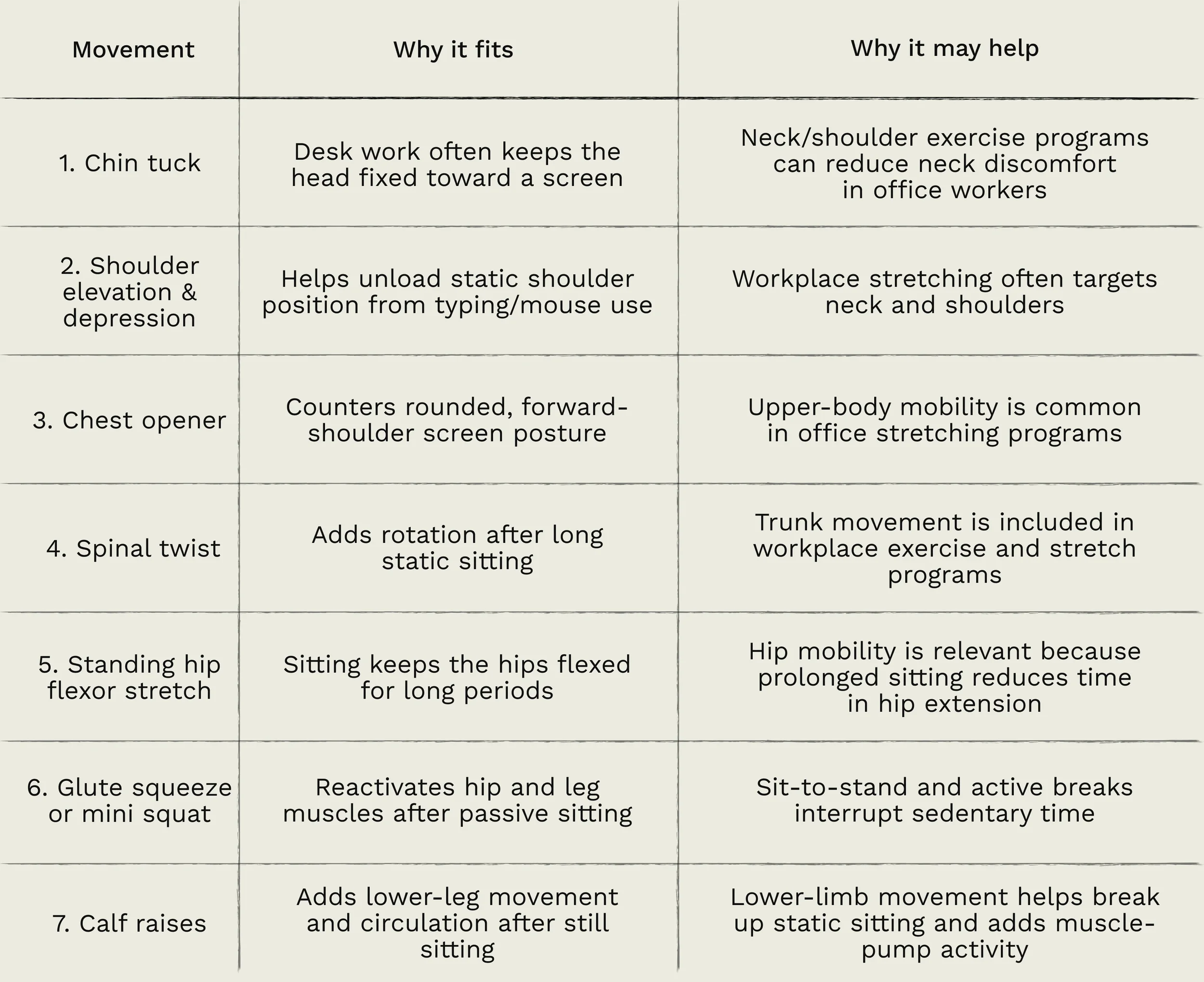
7 exercises to try when sitting makes you feel tense
Research suggests that workplace exercise, stretching, and active movement breaks can reduce musculoskeletal discomfort, particularly around the neck, shoulders, and lower back. The seven exercises below are simple movements I regularly recommend because they are easy to perform almost anywhere.
1. Chin tuck
How to do it: Stand tall. Gently draw your chin straight back, as if making a “double chin.” Keep your eyes level and avoid looking down. Hold briefly, then relax.
Muscles: Helps reduce tension around the upper neck and suboccipital area while activating the deep neck flexors.
Duration: 5–8 slow reps, holding each for 2–3 seconds.
2. Alternating shoulder elevation and depression
How to do it: Slowly lift your shoulders toward your ears, then gently press them down away from your ears. Move with control, not force.
Muscles: Upper trapezius, levator scapulae, lower trapezius, and shoulder-girdle muscles.
Duration: 8–10 slow reps.
3. Active chest opener
How to do it: Bring your arms slightly behind your body, open your chest, and gently squeeze your shoulder blades together. Relax, then repeat.
Muscles: Front of the chest, shoulders, and upper back.
Duration: Hold for 15–30 seconds.
4. Split-step spinal twist
How to do it: Stand with one foot slightly forward and one foot slightly back. Keep your hips mostly facing forward. Gently rotate your upper body toward the front leg, then return to center. Repeat on the other side.
Muscles: Thoracic spine muscles, obliques, spinal rotators, lower-back muscles, and muscles around the rib cage.
Duration: 5 slow rotations per side.
5. Standing active hip flexor stretch
How to do it: Stand in a split stance with one foot behind you. Gently bend the back knee, squeeze the glute on that side, and shift your hips slightly forward. Keep your torso tall. You should feel the stretch in the front of the hip or thigh, not the lower back.
Muscles: Hip flexors, especially the iliopsoas and rectus femoris, plus the front of the hip and upper thigh.
Duration: Hold 20–30 seconds per side.
6. Split-stance mini squat
How to do it: Stand with one foot slightly forward and one foot slightly back. Bend both knees slightly and lower a few inches, then stand back up. Keep the movement small, controlled, and pain-free.
Muscles: This is more of an activation movement. It activates the glutes, hamstrings, quadriceps, and hip stabilizers.
Duration: 5 mini squats per side.
7. Alternating calf raises
How to do it: Stand tall and lift one heel, then lower it and lift the other heel. You can also do both heels together or hold onto a desk for balance.
Muscles: Calves, especially the gastrocnemius and soleus, foot muscles.
Duration: 10 calf raises.
You don’t have to perform all seven exercises every time. Even choosing two or three movements that target the areas feeling most tense is often enough to interrupt prolonged sitting and introduce some movement variety.
Micro-Dosing Training Combo: advanced desk reset
This short sequence combines all seven movements into a single 2 minute desk reset. Use it when you feel tense after a long sitting block, before a deep-work session, or after a meeting.
These movements are not meant to be a workout or a replacement for medical care. Think of them as micro-dosed sessions: small, repeatable bouts of movement that help your body escape the static positions created by desk work.
See also “Hip Flexor stretches for sitting all day”.
When to get professional help
Consider speaking with a healthcare professional, such as a physiotherapist or your primary care physician, if you notice any of the following:
Pain that is severe or continues to worsen despite changing your activity.
Symptoms that persist for several weeks without improvement.
Numbness, tingling, burning sensations, or weakness in an arm or leg.
Pain that wakes you at night or is present even when you are resting.
A significant loss of movement that does not improve with gentle exercise.
Symptoms following a fall, accident, or other injury.
Most importantly, remember that muscle tension and pain are not always the same thing.
It is completely normal to feel stiff after several hours at a desk, and for many people that feeling improves after standing up, walking, or performing a few gentle mobility exercises.
Persistent pain, however, deserves a proper assessment. Pain is influenced by many factors, including previous injuries, overall health, stress, sleep, and workload and it cannot always be explained by posture or muscle tightness alone.
Gentle movement is an excellent place to start, but it should never replace professional assessment when symptoms are persistent, severe, or accompanied by neurological signs such as numbness or weakness.
Common mistakes
Only focusing on the area that feels tense
The area that feels the most tense is not always the source of the problem. For example, tight shoulders may also be related to limited upper-back movement, prolonged static loading, or weak postural muscles. A routine that combines mobility, activation, and light strengthening often works better than repeatedly working on a single area.
Only exercising when discomfort appears
Don’t wait until your neck or back feels stiff before moving. These exercises work best when they become a regular part of your workday rather than a last-minute fix.
Moving too aggressively
Gentle, controlled movement is usually enough. Forcing a stretch, pushing into pain, or performing fast, uncontrolled exercises rarely provides additional benefit and may leave your muscles feeling more irritated afterward.
Ignoring strength and endurance
Mobility exercises can improve movement variety and reduce the feeling of stiffness, but they don’t replace strength training. If your muscles fatigue quickly during the day, improving strength and muscular endurance may be just as important as improving mobility.
Thinking posture is the only problem
There is no single “perfect” sitting posture. Muscle tension is influenced by many factors, including prolonged static loading, limited movement variety, workstation setup, mental workload, and stress. Changing position regularly is usually more helpful than trying to sit perfectly all day.
Expecting immediate results
One Exercise Snacks session won’t undo months or years of prolonged sitting. Like most healthy habits, the benefits come from repeating small amounts of movement consistently over time.
FAQ
-
Yes. Prolonged sitting places many muscles under low-level, continuous load while limiting movement variety. Research links long periods of desk work with increased discomfort, particularly in the neck, shoulders, lower back, and hips.
-
A feeling of tightness does not always mean a muscle has physically shortened. After sitting for a long time, muscles may simply become fatigued from maintaining the same position. Gentle movement, mobility exercises, and changing posture often help more than aggressive stretching alone.
-
For most desk workers, performing this routine once or twice a day is a practical starting point. You can also choose one or two exercises whenever you notice stiffness building during the workday.
Read our guide: “How often should you take movement breaks at work?”.
-
No. The full routine takes only a few minutes, but you don’t have to complete every exercise each time. If your neck feels tense, focus on the upper-body movements. If your hips and lower back feel stiff, spend more time on those areas.
-
No. These movements are designed to reduce the effects of prolonged sitting, not improve cardiovascular fitness or build significant strength. They work best alongside regular physical activity and strength training.
-
Stop the movement if you experience sharp or increasing pain. A mild stretching sensation or light muscular effort is normal, but pain is not. If symptoms persist or worsen, consider seeking advice from a healthcare professional.
-
For most healthy adults, yes. The movements are gentle and designed for regular use. The goal is simply to introduce more movement into your day rather than perform an intense workout.
-
There isn’t a single “best” exercise. Different parts of the body respond to different types of movement. A combination of neck, shoulder, spine, hip, and leg exercises usually provides more benefit than repeating the same movement over and over again.
-
In most cases, yes. Gentle movement often helps reduce the feeling of stiffness caused by prolonged sitting. However, if movement causes sharp pain, your symptoms are getting worse, or you’ve recently had an injury, stop the exercise and seek appropriate medical advice.
These 7 movements help release tension. But lasting relief comes from consistent movement throughout your day.
That's why we built the Exercise Snacks plan: structured movement breaks + targeted exercises + your personal routine.
References:
Baker, R., (2018): The short term musculoskeletal and cognitive effects of prolonged sitting during office computer work.
Eijckelhof, B. H. W., (2013): The effects of workplace stressors on muscle activity in the neck-shoulder and forearm muscles during computer work: A systematic review and meta-analysis.
Read more posts: