1 Minute | 2 Exercises | 5 Times a Day: The Exercise Snacks methodology

“People who stay physically active throughout the day are generally healthier than those who spend most of their waking hours sitting.”
I’ve been active my entire life, although I didn’t fully realize it until later. As a child, my mom always told me, “Don’t jump around after a meal. Sit for 30 minutes.” And guess what I did?Personally, I’ve never been able to sit still long periods of time. Some internal drive gets me moving almost immediately. Maybe it’s just genetics, or maybe I simply enjoy movement more than most people.
Looking back, I realize that staying active throughout the day has always been part of my life. Today, we’re going to talk about micro-movements.
This post explains the methodology behind MicroDosing Training in detail.
I hope it resonates with both your logic and your experience and inspires you to move more often.
People who move throughout the day tend to be healthier
The entire Exercise Snacks concept is built around one simple idea. Do you think it’s true?
The scientific evidence largely supports it. People who stay physically active throughout the day are generally healthier than those who spend most of their waking hours sitting, even when both groups perform some structured exercise.
The key message is not simply “exercise more.” It is to reduce prolonged, uninterrupted sitting and regularly break it up with brief periods of physical activity.
What is uninterrupted sitting?
Uninterrupted sitting refers to remaining in a seated, reclined, or otherwise low-movement posture for an extended period without standing, walking, or performing enough activity to interrupt the sedentary period.
Scientifically, it is a type of sedentary behavior, usually defined as waking behavior that uses very little energy, typically ≤1.5 metabolic equivalents (METs), while sitting, reclining, or lying down.
For more details on sedentary behavior and metabolic equivalents, see my post: “MDT Foundation”.
Examples:
Sitting at a desk for 2 hours without getting up
Watching TV for 90 minutes without standing or walking
Driving for a long period without breaks
Sitting through a meeting or lecture without movement breaks
What is frequent low-level movement?
Frequent low-level movement refers to repeated light-intensity physical activity performed throughout the day. In exercise science, this is often called light-intensity physical activity (LIPA). It requires more energy than sitting but does not qualify as structured exercise. In energy terms, LIPA is typically classified as activities between 1.6 and 2.9 METs.
Examples:
Standing up and walking around the room
Slow walking
Light housework
Washing dishes
Folding laundry
Walking while talking on the phone
Taking stairs slowly
Stretching or gentle mobility work
Getting up every 30–60 minutes for a short movement break
Why movement is good for health?
Human bodies are built for regular muscle activity. When you sit for long periods, the large muscles in your legs and hips become almost inactive. That matters because those muscles help regulate blood sugar, blood fats, blood flow, blood pressure, inflammation, and energy use.
When you move during the day, even lightly, you repeatedly “switch on” these systems. Walking, standing, climbing stairs, doing chores, stretching, or taking short movement breaks can improve how the body handles glucose and fats after meals, support vascular function, and reduce the total time spent in a metabolically inactive state. Physiology of sedentary behavior.
A large meta-analysis (*1) examined the relationship between physical activity, sedentary time, and all-cause mortality. The study included 36,383 participants with an average age of 62.6 years. Participants were followed for an average of 5.8 years, during which 2,149 deaths were recorded.
The researchers found that:
Any physical activity, regardless of intensity, was associated with a significantly lower risk of death.
Higher levels of light intensity activity (such as slow walking) were associated with substantially reduced risks of death. The greatest risk reduction was observed at approximately 375 minutes per day.
For Moderate-to-Vigorous Physical Activity (MVPA), the greatest reduction in mortality risk was observed at approximately 24 minutes per day.
Mortality risk increased gradually among people who were sedentary for 7.5–9 hours per day, becoming significantly higher at 9.5 hours or more.
A simple way to summarize the evidence is:
Regular exercise + frequent movement + less prolonged sitting = better health.
Exercise Snacks formula definition: 1 | 2 | 5 |
1 minute = low-friction, realistic, and easy to repeat.
2 exercises = one preparation + one main movement.
5 times per day = physical activity breaks distributed across sedentary time.
Is 1 minute is really enough?
The three foundational variables of any exercise program are frequency, intensity, and volume.
Together, they form the basis of exercise prescription:
Frequency determines how often movement is performed.
Intensity determines how hard the movement is.
Volume represents the total amount of work completed.
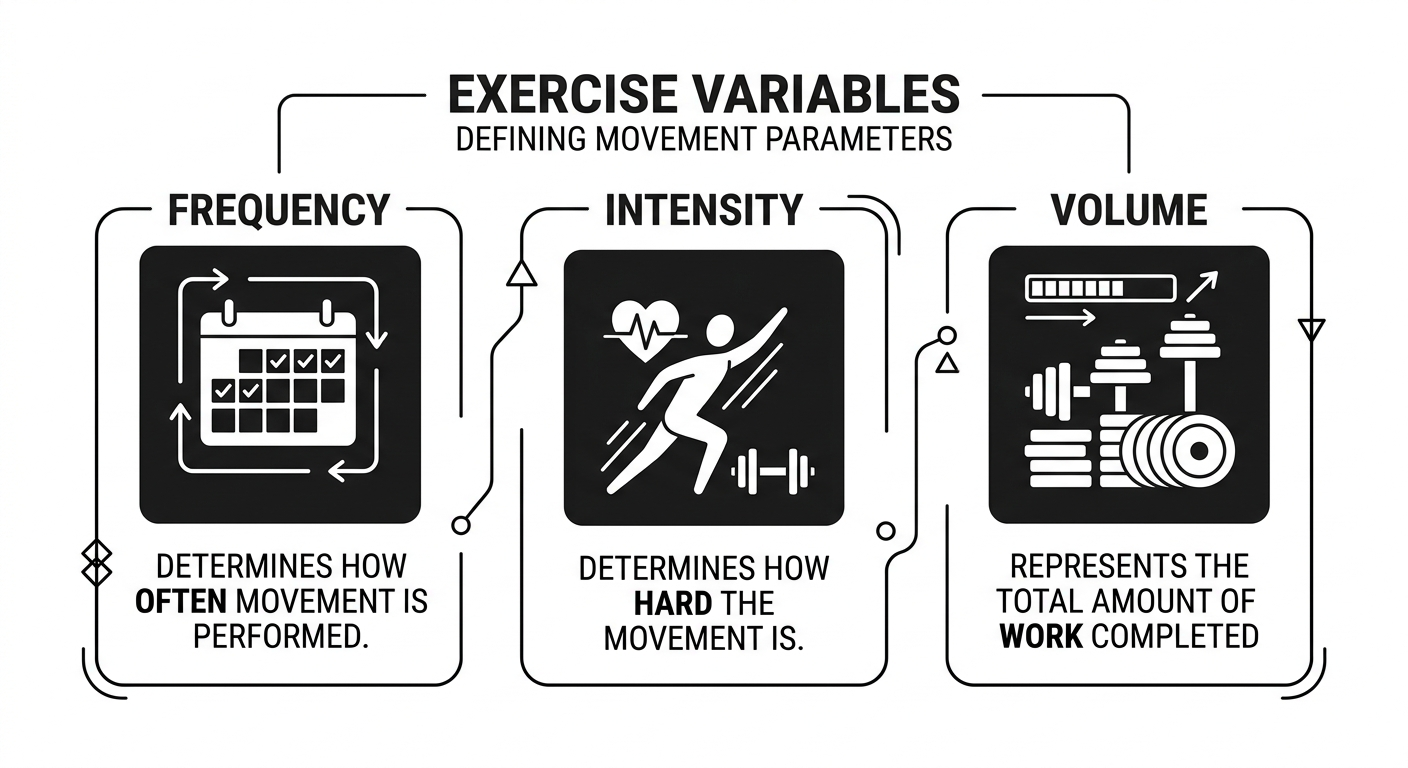
We applie these principles in a flexible way.
An Exercise Snack Session provides structure through frequency and volume, while intensity remains user-selected.
This allows the same sequence to be performed gently, moderately, or vigorously depending on the user’s physical readiness and environment.
A 1-minute MDT session can fall within the range of Moderate-to-Vigorous Physical Activity (MVPA). Even such a short bout is long enough to acutely activate cardiovascular, metabolic, muscular, and neuroendocrine systems.
It can increase:
heart rate
oxygen demand
skeletal muscle glucose uptake
blood flow
catecholamine signaling
post-exercise energy expenditure
Repeated throughout the day, these short activity bouts may accumulate into meaningful health benefits. Research supports this possibility.
A systematic review (*2) examined whether physical activity bouts shorter than 10 minutes provide measurable health benefits, or whether benefits occur only when activity is accumulated in bouts of 10 minutes or longer.
The findings were encouraging:
One prospective study found similar mortality risk reductions for total moderate-to-vigorous physical activity (MVPA), MVPA in bouts of ≥5 minutes, and MVPA in bouts of ≥10 minutes.
Bouts of physical activity lasting less than 10 minutes were associated with lower resting blood pressure and a lower incidence of hypertension.
Shorter bouts of activity (<10 minutes) were found to predict lower fasting glucose, fasting insulin, and HbA1c levels.
For adults aged 50 and older, meeting MVPA guidelines was associated with reduced frailty and lower multi-morbidity regardless of whether the activity was performed in bouts of ≥10 minutes or shorter.
To summarize: One minute is enough to create an acute physiological response.
By itself, it is not enough to guarantee long-term health improvements.
What matters is repetition.
One minute becomes meaningful when it is repeated several times throughout the day, performed at sufficient intensity, and used to interrupt prolonged sitting.
The value of one minute is not that it is magical, but that it helps remove one of the most common barriers to movement: “I don’t have time.”
A one-minute session is short enough to fit almost anywhere and simple enough to repeat consistently.
Based on the available evidence, I believe it is reasonable to suggest that 1 minute × 5 times per day can meaningfully improve daily movement exposure and reduce sedentary behavior.
Why 2 exercises in one session?
Exercise 1: Preparation / activation (30 sec)
The first movement prepares the body for the second movement.
After prolonged sitting, joints may become stiff, circulation may be reduced, posture may become compressed, and muscles may be underactive. A short activation movement helps transition the body from a sedentary state into a movement-ready state.
Its purpose is to increase:
joint range of motion
local circulation
neuromuscular coordination
postural awareness
movement readiness
tissue temperature and comfort
Exercise 2: Main movement (30 sec)
The second movement creates the main adaptive signal.
This is the movement that creates the stronger physiological effect through repeated muscle contractions, postural resetting, metabolic activation, mobility work, or strength development.
Its purpose is to create:
meaningful skeletal muscle contraction
increased heart rate and circulation
glucose uptake by active muscle
postural reset after sitting
strength or mobility stimulus
neuromuscular coordination
a clear interruption of sedentary physiology
Environmental adjustment
The 30-second preparation phase is a minimum guide, not a fixed rule.
In colder outdoor environments, Exercise 1 may be extended to allow the joints, muscles, circulation, and nervous system to become movement-ready before the main exercise.
This preserves the logic of the two-exercise MDT slot: first prepare the body, then apply the stimulus.
Intensity should be user-selected
Your should be able to choose the intensity of both exercises.
Light intensity - gentle mobility, slow marching, easy step-touch.
Moderate intensity - brisk marching, controlled squats, faster step-ups.
Vigorous intensity - fast rapid squats, high knees, powerful step-ups.
This flexibility matters because the same exercise can feel very different depending on:
temperature
clothing
terrain
footwear
fatigue
fitness level
speed of movement
range of motion
whether the person is indoors or outdoors
Why 5 times a day?
The number five represents a potentially practical balance between physiology and consistency.
Laboratory studies often use frequent sitting interruptions, such as short activity breaks every 30 minutes. These interruptions have been associated with improvements in glucose regulation, insulin response, triglycerides, vascular function, and other cardiometabolic markers.
However, asking people to move every 30 minutes may be unrealistic in everyday life.
Five sessions per day provide a feasible minimum structure: frequent enough to break up prolonged sitting, yet simple enough to sustain over time.
We use current MDT daily rhythm in our plans:
Morning → Energize
Midday → Maintain
Afternoon → Reset
Evening → Downshift
Optional 5th → use when needed
What Exercise Snack is - and what it is not?
It is not:
a replacement for all exercise
a maximal strength program
a fat-loss miracle
medical treatment
gym replacement
It is:
a daily movement supplementation system
a practical way to interrupt prolonged sitting
a structure for consistency
a bridge between sedentary life and traditional training
You can, of course, apply the principles presented in this post on your own.
But if you’re looking for a more structured and personalized approach, we’d be happy to help.
Take your first Exercise Snack today.
The goal of MicroDosing Training is not to replace exercise. The goal is to make movement a normal part of everyday life again.
For most of human history, people did not need reminders to move. Movement was built into work, transportation, and daily survival.
Modern life removed much of that natural activity. MDT is simply an attempt to put some of it back.
Since this post was published, we've refined the Exercise Snacks system based on user feedback. Recent updates focus on simplifying the structure and delivery to make it easier to use while maintaining the core principles outlined here.
References:
Ekelund, U., Tarp, J., Steene-Johannessen, J., et al. (2019). Dose-response associations between accelerometry measured physical activity and sedentary time and all cause mortality.
Jakicic J, et al. (2019). Association between bout duration of physical activity and health: systematic review.Medicine & Science in Sports & Exercise.
Read more posts: