MicroDosing Training foundation – Part 3

“The gym alone is no longer a complete solution.”
In my previous posts (Part 1 and Part 2), I aimed to establish a clear scientific foundation showing that modern life pushes us toward long periods of sedentary behavior.
The trend is hard to ignore: our lifestyle is becoming increasingly centered around sitting. From a biological perspective, this makes sense - our bodies are naturally wired to conserve energy and minimize unnecessary movement. But in today’s environment, this instinct is working against us.
The gym alone is no longer a complete solution. Not only because of low adherence and consistency, but also due to a growing phenomenon known as the “sedentary exerciser”.
This paradox shows that even when people meet the World Health Organization’s recommendation of 150/300 minutes of moderate-to-vigorous physical activity per week, they can still remain metabolically compromised. The reason lies in the “biological silence” that dominates the other 23 hours of the day. Reduced muscle activity, especially in the lower body has a direct impact on metabolic health.
In this third part of the Microdosing Training Foundation series, I explore the latest systematic review on physical activity patterns, focusing on how short, frequent bouts of movement throughout the day influence overall health.
Optimizing physical activity bouts to interrupt sedentary behaviour for cardiometabolic health
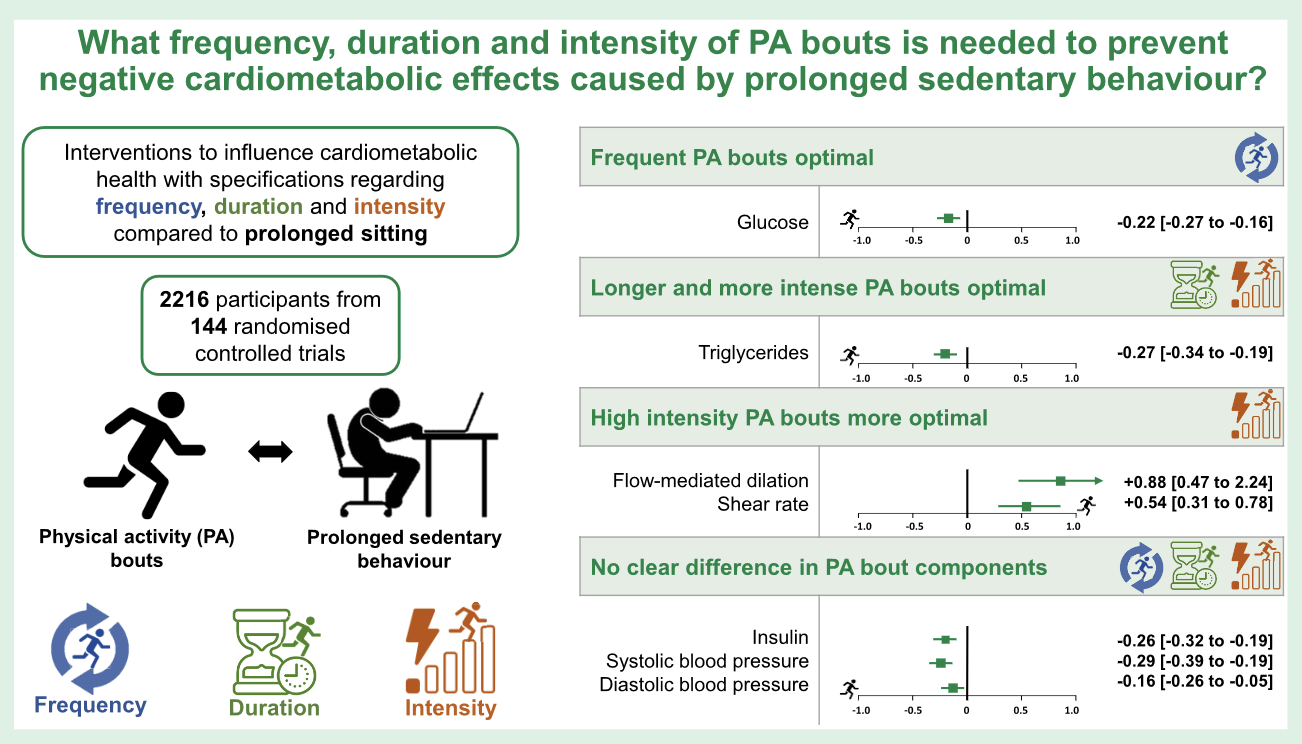
In a large study (1, Vanherle et al., 2026) analyzing more than 140 experiments, researchers examined how short bursts of activity can be used to break up periods of sitting. These “activity bouts” included simple movements like walking, cycling, and even stair climbing.
Some of these bouts were extremely brief, lasting as little as 30 seconds, while others were longer. On average, they were performed about every 25 minutes.
The goal was simple: to understand how these small “sparks” of movement influence the body’s internal chemistry compared to uninterrupted sitting.
The "sugar switch"
If your goal is stable energy and better blood sugar control, one simple rule stands out: move often.
Your muscles act like a sponge for sugar (glucose) in your bloodstream. When you sit for too long, that sponge stays inactive. But when you move, your muscles “switch on” and begin absorbing glucose.
The research (1) shows that frequent movement breaks are more effective at lowering blood sugar than a single, longer session of activity.
The key insight is what researchers call a “duration × frequency” interaction: shorter, more frequent bouts of movement work best. By “sparking” your muscles every 20 to 30 minutes, you activate glucose uptake through a natural, insulin-independent pathway, helping to keep your energy levels steady throughout the day.
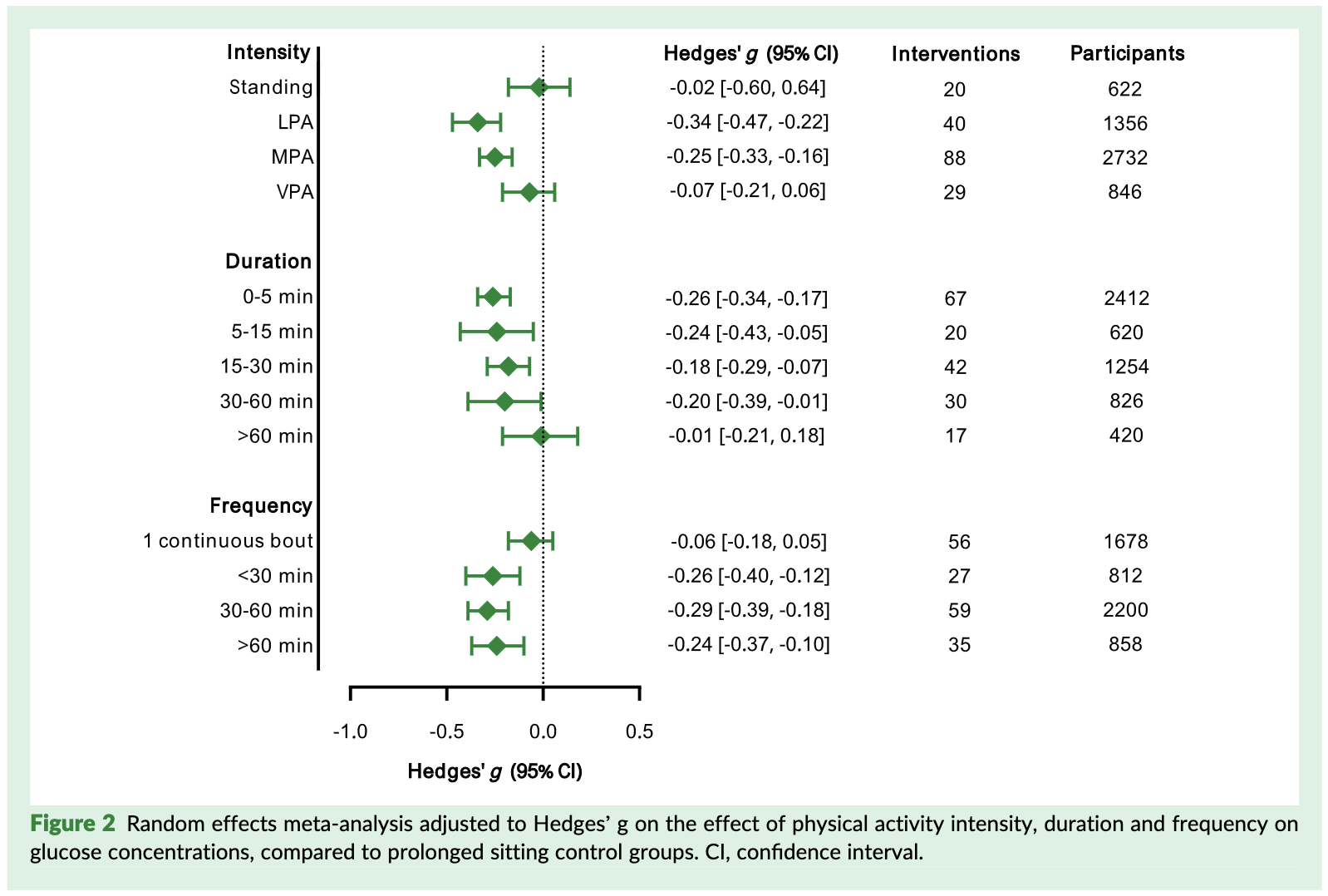
The figure 2 shows that both Light (LPA) and Moderate (MPA) activities significantly lower blood sugar compared to just sitting. This confirms that you don't need to be sprinting to get your glucose under control; a simple walk does the job.
Standing has no significant effect on glucose concentrations, simply getting up isn't enough, your muscles actually need to move to act as a "sugar sponge".
Movement bouts lasting up to 60 minutes are effective, but very long single sessions (over an hour) lose their specific advantage for glucose control.
Frequency + Duration. Blood sugar reductions are maximized when you use shorter bouts more frequently.
The "fat filter"
While your “sugar switch” can be activated with quick, frequent movement, clearing fats, specifically triglycerides, from your bloodstream requires a bit more effort.
The data shows that triglyceride levels improve most when movement bouts are either longer than 30 minutes or performed at a higher intensity. This is because longer or more intense activity increases the action of an enzyme called lipoprotein lipase (LPL).
Think of LPL as a filter for fat. When it’s activated, it helps clear triglycerides from your blood and directs them to where they can be used or stored properly.
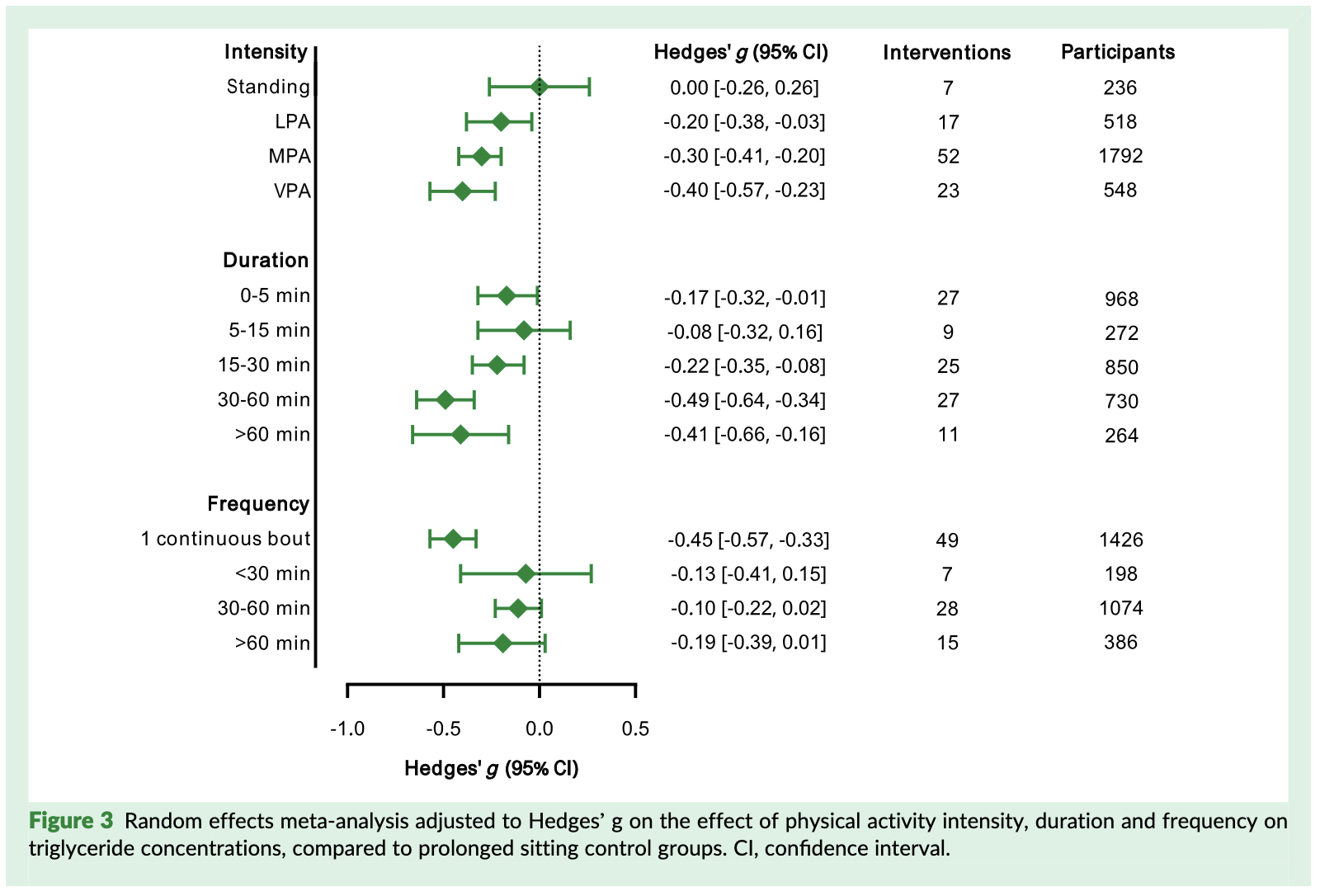
The figure 3 shows that standing bouts have no significant effect on triglyceride levels, whereas the largest benefits are seen following vigorous-intensity (VPA) activity.
Bouts lasting longer than 30 minutes produce significantly greater reductions in triglycerides compared to shorter bouts.
A single continuous daily bout of exercise was found to be more effective for lowering triglycerides than multiple frequent interruptions.
If a movement bout is short, it must be high-intensity to effectively reduce triglycerides.
Higher-intensity and longer-duration activities are better at stimulating lipoprotein lipase (LPL) activity and fat oxidation, which are the primary drivers for clearing triglycerides from the bloodstream.
The "heart pump"
While managing sugar and fat is about chemistry, this part is about your “plumbing.” Your blood vessels are living tissue and they need stimulation just like your muscles.
When you move at a brisk pace, blood flows faster through your arteries, creating a healthy friction known as shear stress. This friction sends a signal to the inner lining of your vessels to release nitric oxide, a natural compound that helps your arteries relax, stay flexible, and widen.
The research shows that light activity or simply standing isn’t enough to trigger this effect. To truly improve vascular health, measured by flow-mediated dilation (FMD), you need movement that reaches at least a moderate intensity.
And the impact is significant. Every 1% improvement in vessel flexibility is linked to a 13% reduction in cardiovascular risk.
In practical terms, a short burst of higher-intensity movement like a brisk walk or climbing a few flights of stairs isn’t just “exercise.” It’s a way to actively support your circulation, almost like giving your arteries a massage from the inside out.
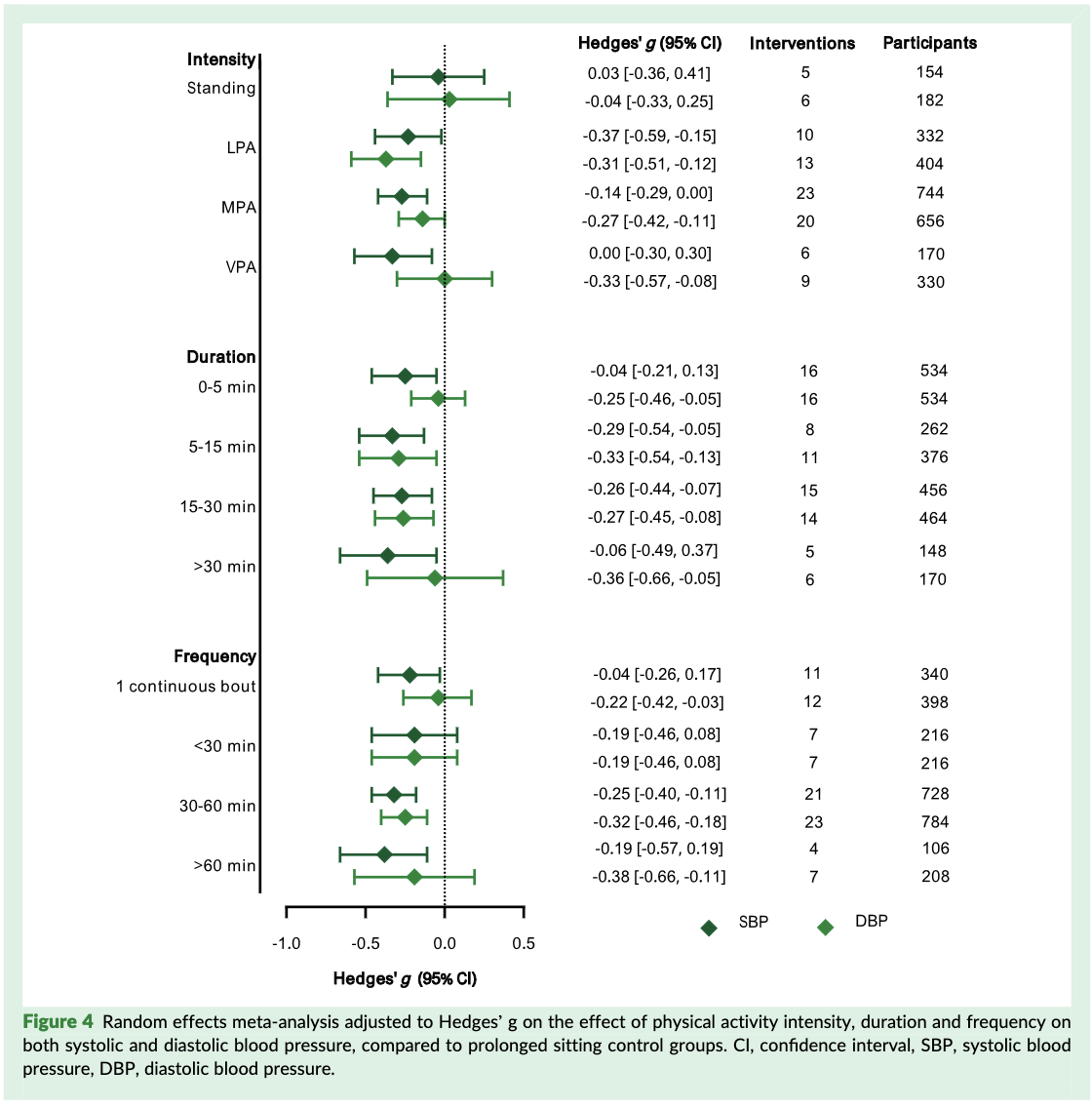
Whether you prefer frequent short walks or longer, more intense sessions, your blood pressure will likely improve.
All intensities: Light (LPA), Moderate (MPA), and Vigorous (VPA)—significantly reduced systolic pressure compared to just sitting.
Standing alone showed no significant effect on reducing blood pressure.
Every 10 mmHg reduction in systolic blood pressure is linked to a 20% lower risk of major cardiovascular events and a 13% reduction in the risk of death from any cause.
The standing myth
Many people believe that switching to a standing desk is the ultimate solution to long hours of sitting. While it’s a step in the right direction, this research offers a reality check: standing alone is not enough to truly activate your metabolism.
The reason is simple. Standing doesn’t significantly increase muscle activity or energy expenditure. Your internal “plumbing” the systems responsible for clearing sugar and fats only fully activates when your muscles are actively contracting.
Conclusion
The science of MicroDosing Training has officially moved beyond the vague advice of simply "moving more". We now know that our bodies require a specific "prescription" of movement to stay healthy in a world designed for sitting. By breaking the biological silence with intentionality, you can target exactly what your body needs at any given moment.
If your goal is stable energy and better blood sugar control, focus on frequency short bursts of movement every 20 to 30 minutes. If your goal is to clear blood fats or support heart health, increase the intensity or extend the duration of your activity. And remember: while a standing desk helps, it’s muscle contraction that truly flips the metabolic switch.
By layering these intentional "movement snacks" on top of your regular exercise, you ensure that the "silence" never lasts long enough to do damage.
References:
Read more posts: